Lifetime Citizen Portal Access — AI Briefings, Alerts & Unlimited Follows
Legislature lets Mayor’s Council carry over prior-year funds to FY26 amid mayors’ requests
Loading...
Summary
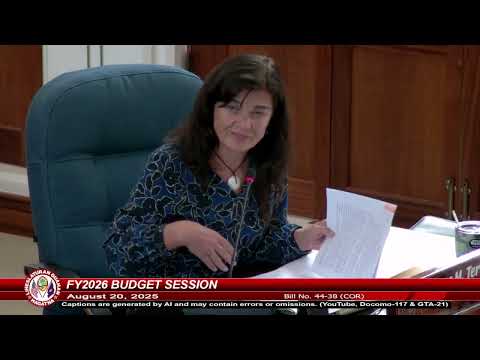
The Committee of the Whole approved an amendment to allow unexpended appropriated funds available to the Mayor’s Council of Guam in prior fiscal years to remain available in fiscal year 2026 instead of lapsing.
The Committee of the Whole approved an amendment to allow unexpended appropriated funds available to the Mayor’s Council of Guam in prior fiscal years to remain available in fiscal year 2026 instead of lapsing. Senator Tategui proffered the amendment, saying it was intended to let mayors finish pending procurements and hirings and to use balances for one-time purchases such as heavy equipment and new software.
The change will let the Mayor’s Council draw on unspent balances from earlier years to complete projects they already have underway. “They had asked us for 10 million more than what they had received in FY25,” Senator Tategui said, summarizing requests the mayors brought during budget hearings. He described uses the mayors had told lawmakers they needed: a single piece of heavy equipment, software to process residency requests, procurement support and personnel to avoid staffing reductions.
Supporters stressed the mayors’ role providing daily services at the village level. Senator Barnes told colleagues he “rises in support” of the amendment, saying the mayors are “24/7 facilitators for their villages” who run recycling, cleanups and other neighborhood services. Senator Tadigui and other members urged colleagues to approve continuing appropriations so the mayors would not be forced to halt projects before procurement and hiring finished.
Lawmakers also discussed a related provision moving $1.5 million from the Guam Environmental Protection Agency recycling-revolving fund into the Mayor’s Council budget so mayors can run an island-wide cleanup program. OFB staff explained the recycling funds are deposited under GEPA and move to the Mayor’s Council only with explicit authorization, so the bill’s language appropriates the 1.5 million to allow transfers.
Not all amendments before the panel succeeded. Senator Burnett proffered an amendment to appropriate $4,000,000 from the unobligated FY2026 general fund balance to the Mayor’s Council; the amendment failed on the floor. Other amendments changing wording and flexibility for how mayoral funds may be used were debated and several passed by voice vote without a roll-call tally recorded in the transcript.
Why it matters: The continuing-appropriation language preserves local control over money already allocated to village governments, enabling ongoing procurements and hires to finish without a new appropriation. The debate also highlighted tensions over shifting shortfalls in targeted special funds and whether the general fund should be used to maintain prior-year service levels.
Votes at a glance - Amendment (TMT P113) to make prior-year unexpended appropriations available in FY2026: approved (voice vote; no roll-call tally recorded). Senator Tategui proffered the motion. - Burnett amendment to appropriate $4,000,000 from FY2026 general-fund unobligated balance to Mayor’s Council: failed (recorded on floor as "Amendment fail"). - Snogstein amendment (JSSA L20P.II3) to strike Section 7 (clarifying earlier allocation language): recorded as passed on the floor.
Background and next steps: The Mayor’s Council asked lawmakers during budget hearings for additional recurring and one-time funds; the committee approved continuing-appropriation language so prior-year money can be spent in FY26. OFB staff and the Mayor’s Council will manage transfers from GEPA and other special funds as spelled out in the amendment text. The committee recorded the outcomes on the floor; several adjustments were decided by voice vote and without roll-call allocations.
Ending: The panel’s action preserves flexibility for mayors to complete purchases and hires they described during hearings. Lawmakers signaled they will continue to monitor special-fund balances (for example GEPA recycling funds) and may return to adjust allocations if collections or needs change.