Get Full Government Meeting Transcripts, Videos, & Alerts Forever!
Get email alerts on the Public Health Outreach topic
No spam. Unsubscribe anytime.
DPH highlights phase 2 of recovery awareness campaign, uptick in mpox and street‑team coordination
Summary
Department of Public Health Director Tsai told the Health Commission the department launched phase 2 of the 'Living Proof Recovery is Possible' campaign funded by CDC grants, reported a slight uptick in mpox cases, and described expanded, coordinated street‑team efforts across city agencies to connect people to treatment.
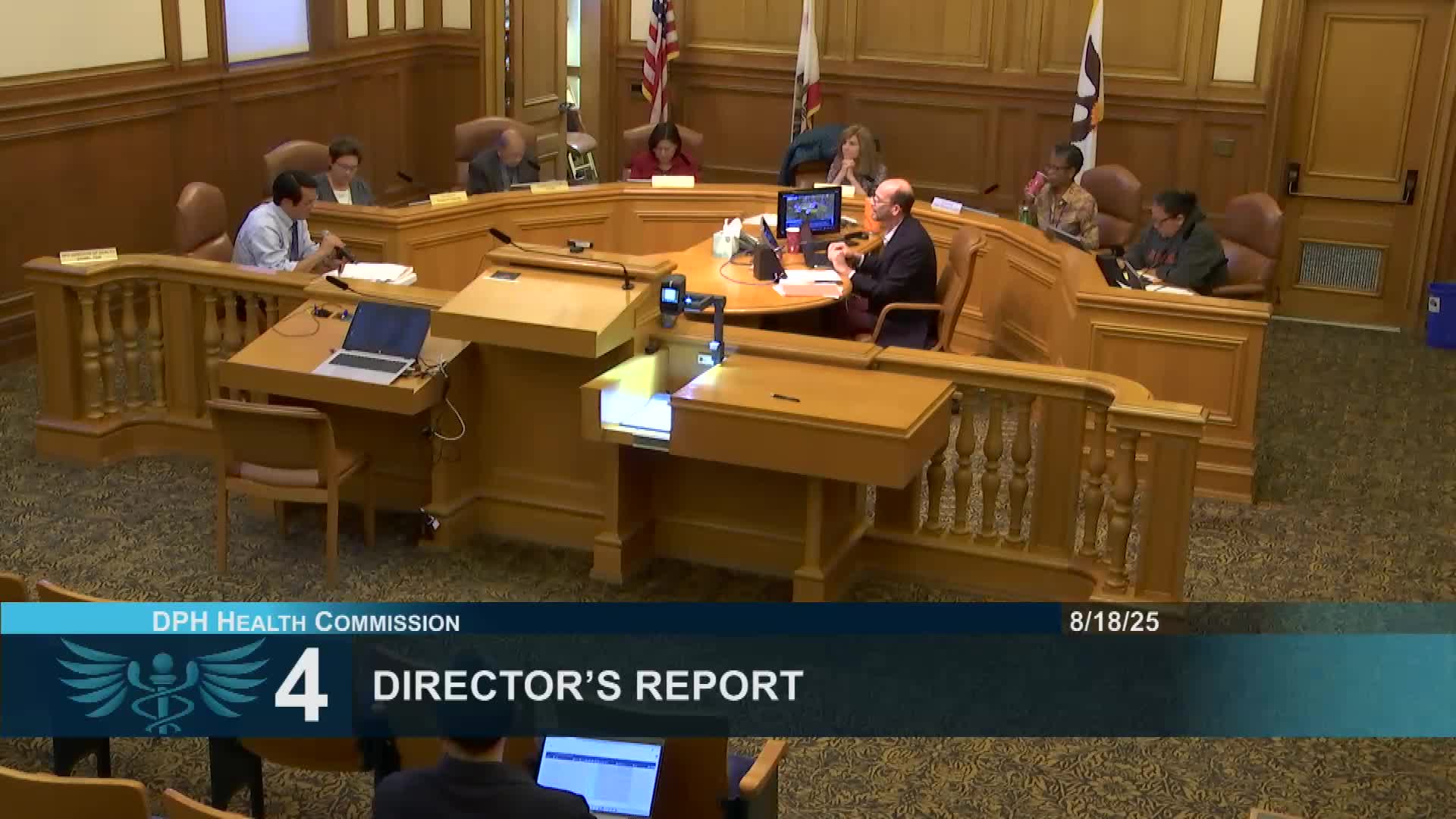
Director Tsai delivered the Department of Public Health director’s report and highlighted the launch of phase 2 of the department’s Living Proof Recovery is Possible campaign, which the director said is funded by CDC grants. “We are starting phase 2 of that campaign,” Tsai said, describing the campaign as an awareness effort featuring people with lived experience to connect residents to treatment and recovery services.
Tsai also told commissioners that DPH is monitoring “a slight uptick recently in mpox cases across the city” and that the department has sent clinician alerts and public information through City Clinic’s free services. The director framed these items as part of a broader, proactive emphasis on outreach and linkage to care.
Tsai reviewed the city’s reconfigured neighborhood street‑team model, which DPH participates in alongside other agencies. He described four missions for the network — services, enforcement, cleaning and holding space — and stressed that DPH’s role centers on services and treatment linkage. “Our street teams have 4 different missions that the teams, collective teams are expressing,” Tsai said, and he singled out Restore and night navigators as programs that helped engage people in treatment during off hours.
Commissioners asked whether the campaign’s phone‑line or email referrals could be quantified. Tsai said DPH did not yet have exact referral counts tied to the campaign but would explore whether intake lines or partner staff could provide estimates. Commissioners also raised sustainability questions, asking what would happen if CDC funding ended; Tsai acknowledged the need for backup funding information to support continued outreach.
Public comment on the director’s report included a single written and in‑person remark urging more information on plans to expand skilled nursing capacity; that comment anticipated the subsequent item on skilled nursing transfers.
Ending: The commission thanked DPH for the report and asked for follow‑up on campaign referral metrics and any available data on mpox case trends and street‑team outcomes.