Get Full Government Meeting Transcripts, Videos, & Alerts Forever!
Get email alerts on the Education Budget topic
No spam. Unsubscribe anytime.
Guam lawmakers, budget office spar over DOE funding; education officials warn of cuts if requests unmet
Summary
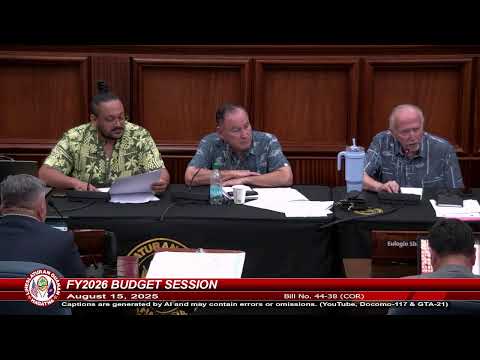
The Guam Legislature's Committee on General Government Operations and Appropriations spent a late session questioning the Guam Department of Education's budget request and the executive branch's treatment of education funding, with agency leaders warning that significant cuts or layoffs could follow if additional money is not provided.
The Guam Legislature's Committee on General Government Operations and Appropriations spent a late session questioning the Guam Department of Education's budget request and the executive branch's treatment of education funding, with agency leaders warning that significant cuts or layoffs could follow if additional money is not provided.
The dispute centered on how the executive branch presented DOE in the Executive Budget Request (EBR) and on how much of the department's previously appropriated funds remain unspent. BBMR and OFB fiscal staff said the EBR was submitted Jan. 31 and that DOE and several other agencies were grouped in a reserve category rather than shown as separate line items. DOE officials and several senators said that made it difficult to reconcile requests, appropriations and carryover funds.
Why it matters: DOE is Guam's largest agency by head count and budget. Lawmakers said uncertainty about whether DOE can absorb additional appropriations and whether lapses are available for carryforward affects decisions over whether the legislature should restore or add tens of millions of dollars to the department's proposed FY-26 appropriation.
BBMR official Steve Carlson told the committee, "BBMR prepares the governor's executive budget request for submission to the legislature. And we did so on January 31." Carlson said BBMR did not use reserve-agency submissions in preparing the EBR and that staff derived reserve allocations by applying historical percentages to the lump-sum reserve.
DOE Superintendent Dr. Swanson and senior staff defended their spending plans while acknowledging capacity and procurement constraints. Dr. Swanson told senators that if the funding bill is passed, DOE will submit a schedule F and "identify where we're gonna make these cuts to meet what the appropriation is." He added that DOE would first seek to maximize nonpersonnel reductions before pursuing layoffs.
Numbers and requests: BBMR and DOE gave differing figures for recent requests and appropriations. BBMR staff reported the department received these local-and-federal appropriations in recent years: about $219.9 million (FY2020), $207.0 million (FY2021), $205.0 million (FY2022), $231.1 million (FY2023), $246.9 million (FY2024) and $266.4 million (FY2025). DOE staff said its original FY-26 request submitted earlier in the year was roughly $306.3 million; BBMR's EBR number for DOE was presented to the committee as about $264 million, while a substitute bill circulating in the legislature puts DOE at about $266 million (roughly $1.9 million higher than the EBR figure).
Lapses and ARP reimbursements: DOE reported expected lapses and delays related to contracts and reimbursements, and staff said some American Rescue Plan (ARP) projects are being processed under a reimbursement model that requires DOE to pay vendors first and then seek federal reimbursement. DOE budget staff told the committee they currently estimate an available lapse balance of about $11 million going into FY-26, and cited audit and CER reports showing prior-year surpluses and estimated lapses (for example, a $7 million surplus reported for FY-22 and $1.1 million for FY-23 in audit documents and a $22 million total shown in a fiscal report for FY-24).
Austerity options listed: DOE budget staff provided a list of items that would be reduced or cut if appropriations are not increased. Examples named to the committee include: - $3.2 million for replacement network switches that DOE says are 12 '13 years old and were only rated for five years; staff said cutting that would risk network failures. - Reductions to grounds and custodial maintenance supplemental contracts and vehicle fleet maintenance. - Cuts to continuing-education and accreditation spending for elementary and middle schools (DOE said high-school accreditation would be prioritized). - Postponing or reducing planned purchases of case management (SPED) and student information systems (PowerSchool/TyNet) and interscholastic sports supplements. - Personnel actions: DOE listed a possible $21 million reduction tied to field positions (described as potential reductions in force, reduced hours or other changes) and other vacancy savings. Officials said they would try to maximize nonpersonnel reductions first.
Legislators pressed both sides. Some members, including Senator Barnett, framed the dispute over education funding against proposed tax rollbacks and argued the decision about whether to add $40 million to DOE rests with the legislature. Senator Parkinson and others argued Guam still underfunds public education compared with U.S. jurisdictions and urged greater investment.
Capacity questions: Several legislators and BBMR officials warned that simply increasing DOE's appropriation does not guarantee faster spending. BBMR staff said they used multi-year averages and the FY-25 appropriation to construct the EBR baseline and that historical lapses and spending patterns informed their ceiling. DOE officials acknowledged procurement protests and staffing shortages that complicate rapid execution of large projects.
Next steps: Committee members said they will continue budget work, including amendments scheduled for the next session day and follow-up with DOE and fiscal offices. The committee recessed after late-evening remarks and planned to reconvene the following morning.
The hearing record shows continued disagreement about the proper revenue baseline (members identified a roughly $47 million revenue gap tied to a proposed business tax rollback and other adjustments) and about whether DOE has sufficient capacity to spend significant additional funds in FY-26. Committee members signaled oversight follow-up and possible requests for additional documentation of lapses, carryforwards and procurement status.