Get Full Government Meeting Transcripts, Videos, & Alerts Forever!
Get email alerts on the Master Plan Implementation topic
No spam. Unsubscribe anytime.
City staff outline downtown master plan implementation matrix; officials point to housing momentum and outstanding connectivity projects
Summary
City planners presented an implementation matrix showing 85% of downtown master plan recommendations complete or ongoing, highlighted nearly 930 attainable housing units in the development pipeline, and identified Bayfront Park and Fruitville Road connections as outstanding items for further study.
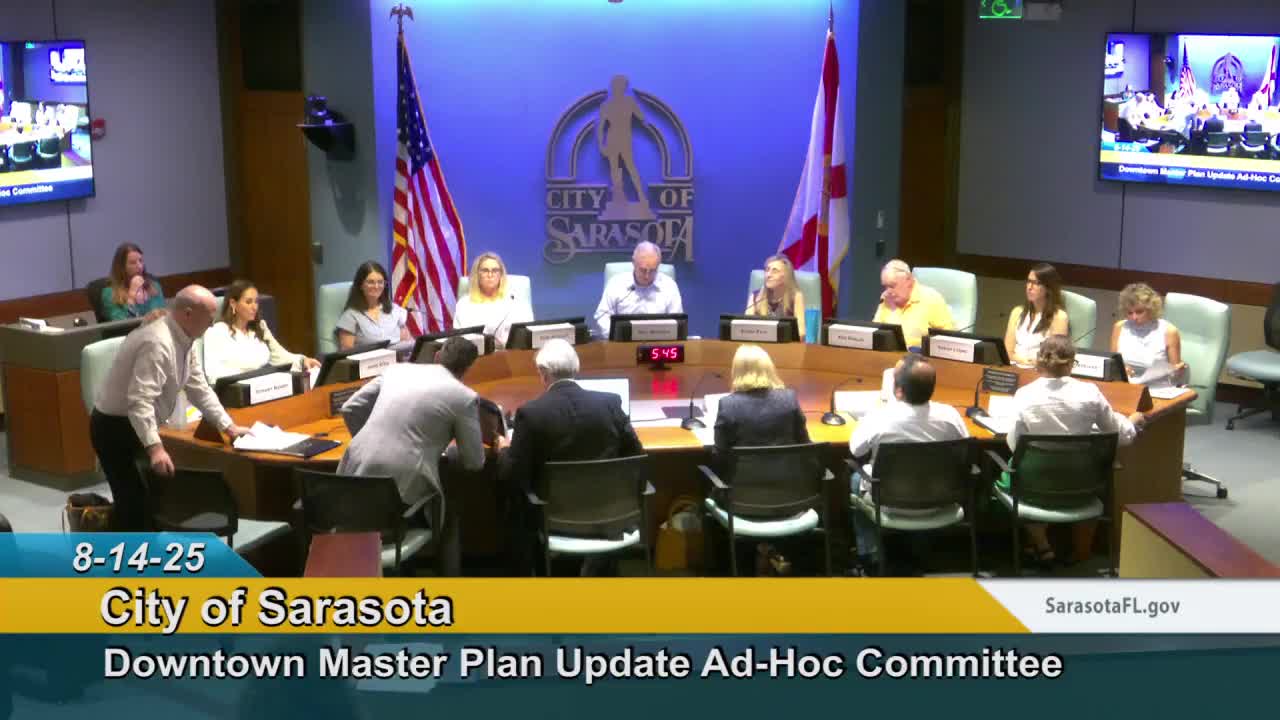
City planning staff reviewed a Downtown Master Plan implementation matrix that summarizes actions taken since the original plan and identifies outstanding projects and next steps. Staff said roughly 85% of plan recommendations have been completed or are ongoing.
David Smith, manager of long range planning, said the original master plan organized work around six themes — including connecting downtown to the bayfront, a system of walkable streets and a balanced transportation system — and that many recommendations have translated into implemented projects and code changes. Steve (planning director) and Ryan Chatley (general manager) described completed items such as roundabouts and the transformation of Lemon Avenue, the creation of parking garages and the success of the farmer’s market.
Staff reported a surge in housing activity driven by the city’s density bonus program: about 930 attainable housing units are currently in the pipeline across roughly 25 projects, including Sarasota Station (the former Stoudemire Shoemaker lumberyard) where staff said the planned development includes roughly 150 attainable units and 69 market-rate townhomes. Staff contrasted the city’s density-bonus approach with the state’s Live Local program: Live Local allows up to 120% of area median income (AMI) for all units to qualify for administrative review, while the city's density-bonus program requires at least one third of bonus units to be at 80% AMI and limits the share at higher AMI tiers.
Committee members singled out several outstanding items for additional study: the Bayfront Park area and its surface parking near Marina Jack’s, and Fruitville Road connections and “pedestrian sleeves” between Rosemary and downtown. Staff said Fruitville Road had been the subject of earlier design concepts and federal grant consideration but did not advance under a prior commission decision. Members also raised questions about pedestrian bridges, and staff counseled caution: a staff member noted cost, maintenance and limited use in other cities and said bridges can be expensive to maintain and may not be the best solution for pedestrian access.
The presentation emphasized that many downtown infrastructure projects were funded in part by tax-increment (TIF/CRA) dollars and that the city has updated zoning to create downtown form‑based districts that include transition zones to protect adjacent neighborhoods. Staff recommended the committee consider Bayfront Park and Fruitville Road connectivity among the priorities for the master plan update and consultant work.
Quotes in this article are taken from the meeting presentation. David Smith said the matrix shows the “effectiveness of the initial downtown master plan,” and staff noted the momentum in attainable housing projects currently in the pipeline.