Get Full Government Meeting Transcripts, Videos, & Alerts Forever!
Get email alerts on the Public Health topic
No spam. Unsubscribe anytime.
Cochise County health director: grants, modest organic growth account for recent budget increases; supervisors ask for deeper review
Summary
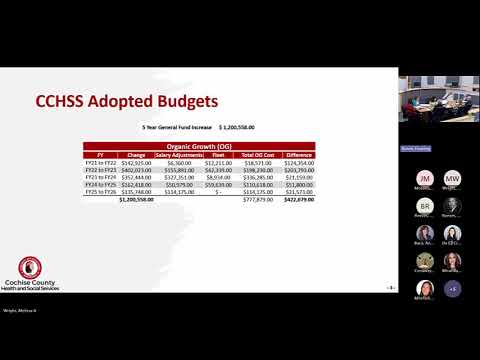
Cochise County Health Director Barb Lang told the Board of Supervisors during the Aug. 14 work session in Bisbee that the health departmentbudget has increased about $1.2 million since fiscal year 2021, and that nearly half of the departmentfunding comes from grants rather than county general funds.
Cochise County Health Director Barb Lang told the Board of Supervisors during the Aug. 14 work session in Bisbee that the health departmentbudget has increased about $1.2 million since fiscal year 2021, and that nearly half of the departmentfunding comes from grants rather than county general funds.
Lang said the five-year picture shows a mix of grant funding related to COVID and recurring "organic" cost drivers such as market salary adjustments and fleet costs. "There's a pretty equal split between grants and general funds. It's nearly 50%," Lang said. She asked the board to separate organic increases the department does not control from budget items the department can influence.
The discussion mattered to supervisors because members had previously asked how the health department's growth compared with inflation and what portion was driven by COVID-era grants. Chairman Antinori said the board requested more information at the July budget meeting; several supervisors expressed concern about keeping property taxes low and asked how department spending connects to county priorities such as economic development.
Lang broke down several specifics. She said the department's total increase since FY2021 is about $1,200,000 and that, after removing market and fleet-driven costs the county sets centrally, the department's organic growth over five years amounts to roughly a 9% increase. "When you look at 2021 to 2026, you do see slight increases over time that are really attributed to inflation," Lang said. She added the department currently has about 87 to 88 full-time equivalent positions and that two positions that had been funded through COVID grants are no longer on the payroll: "There were 2 positions that were paid for during COVID, and those 2 positions are gone. The money's gone. The positions are gone."
Lang described how grants and general-fund items are split in practice and noted the board will continue to distinguish statutorily required services paid from the general fund versus grant-funded programs. "Anything that we do that's statutorily required is paid out of the general fund. Those other things you refer to as more social are grants," Lang said.
Program-level updates
Lang also reviewed ongoing and planned public-health programs the board asked about, including partnerships aimed at keeping health care and related spending in the county and outreach to vulnerable populations:
- Local food and school snacks: Lang said the department is working with the University of Arizona and a McNeal-area agricultural cooperative to provide fresh carrot sticks, cucumbers and apples as school snacks under a Department of Education grant. Lang said almost every county school has signed on and the program could expand to salad bars and school lunches over time. "We're starting with snacks, then we're moving a salad bar, then we're moving to school lunches," she said.
- "Keeping care local" marketing and database: Lang said she contracted a marketing firm for a campaign to encourage residents to use county medical services; the campaign's tagline is "Health is here." She said she has applied for a follow-up grant to build a searchable database and geo-mapping site that would list county providers and visiting specialists; the grant decision was pending at the time of the meeting. "If I get the grant for that website, there'll be QR codes on every advertisement," Lang said.
- WIC outreach at Canyon Vista Medical Center: To increase enrollment among newborns and new mothers, Lang said county WIC staff will go to Canyon Vista two days a week to enroll qualifying mothers at the hospital rather than requiring them to travel to county clinics.
- Sharps disposal and needle collections: Lang explained the department's sharps-disposal policy and fee structure. The county charges $5 per sharps container, but provides disposal free of charge for people who cannot afford that amount; the fee covers contractor disposal through Stericycle, she said. "We rarely have people pay the $5. Most people do it free of charge," Lang said. She also said Cochise Harm Reduction recently delivered 2,400 needles to the county's collection program.
- Justice care collective for people experiencing homelessness: Lang described an Oct. 9 event in which a justice-court judge, a superior-court judge and the county attorney had agreed to convene services to waive noncriminal warrants (trespassing and public camping), provide medical exams, and offer peer supports and substance-use counseling with the goal of connecting people to treatment and employment.
- Vector surveillance and emergency preparedness: Lang said the county operates mosquito traps and conducts vector testing in coordination with state and federal partners; she reported that, as of two days before the meeting, there had been no infected insects detected in the county. She also described a daily reporting center in the Public Health Building for emergency communications and coordination with emergency management.
Supervisors' response and next steps
Supervisors said the presentation helped but asked for further detail separating general-fund statutory obligations from grant-funded programs and for a program-by-program review in the future. Several supervisors emphasized broader county priorities, including economic development and tax policy, and said a deeper budget review should wait until next year's budget cycle. "That would be a program-by-program review of all these different programs that the health department does and having a discussion on the budget related programs. That's probably a discussion that we probably aren't gonna do until next year," Antinori said.
At the end of the session the board and staff agreed to schedule regular updates. Lang and board members proposed a quarterly work session to continue education and monitoring of health-department activities and to provide additional detail on which costs are grant-funded and which are borne by the general fund.
Ending: The board did not take a formal vote on any ordinance, contract or budget action during the work session; the item concluded with a direction to continue quarterly briefings and to provide requested program-level budget detail in future sessions.