Get Full Government Meeting Transcripts, Videos, & Alerts Forever!
Get email alerts on the State Legislation Recap topic
No spam. Unsubscribe anytime.
Lobbyists recap turbulent Florida session and spotlight bills affecting Plantation
Summary
Plantation’s contracted lobbyists told the City Council at a legislative workshop on Aug. 13 that Florida’s 2025 session was unusually contentious and produced tax cuts, vetoed member projects and several bills that could affect local authority and funding.
Plantation’s contracted lobbyists told the City Council at a legislative workshop on Aug. 13 that Florida’s 2025 legislative session was unusually contentious and produced a mix of tax cuts, vetoes and policy changes that could affect the city.
Candice Eriks of Eriks Consultants and Lauren Jackson said a long session — roughly 100 days, they said, versus the typical 60 — produced a package of tax reductions, including repeal of the business rent tax and a roughly $1.3 billion overall tax cut that carried provisions affecting local transportation surtaxes and communication-services-tax (CST) revenue. They said Governor-issued line-item vetoes removed about $660 million in member projects, including a study tied to property-tax reform.
The lobbyists flagged several bills and topics with direct relevance to Plantation. They said SB 1080 included language aimed at limiting school-board impact fees for affordable-housing projects by shifting the burden of proof to the schools. They described a Live Local program expansion that passed in amended form. They also said a large post-storm recovery bill, SB 180, placed a 180-day moratorium on certain impact-fee increases and building-code changes after an emergency declaration, and that the breadth of emergency declarations covering all 67 counties could permit developers to seek relief in areas not damaged by storms.
On communication-services taxes and utility relocation, the lobbyists said the final compromise prevented local governments from being required to pay relocation costs for communications providers. Instead, $50 million in CST distributions was set aside as a one-time pot from which providers could apply for relocation grants. They said the bill also included auditing authority for a state office allowing audits of local governments, and they reported that Broward County is already undergoing one such audit.
The presenters said negotiations produced compromises on recovery-residence regulation that stopped short of full preemption of local ordinances but left a process for variances and reasonable accommodations in place; they said the issue will likely return in 2026. They also identified other measures that failed but are likely to return next year, including major changes to community redevelopment authorities (CRAs), higher sovereign-immunity caps, accessory-dwelling-unit mandates and E911 consolidation proposals that, as drafted earlier in the year, could have centralized county dispatching and affected Plantation’s volunteer fire dispatch.
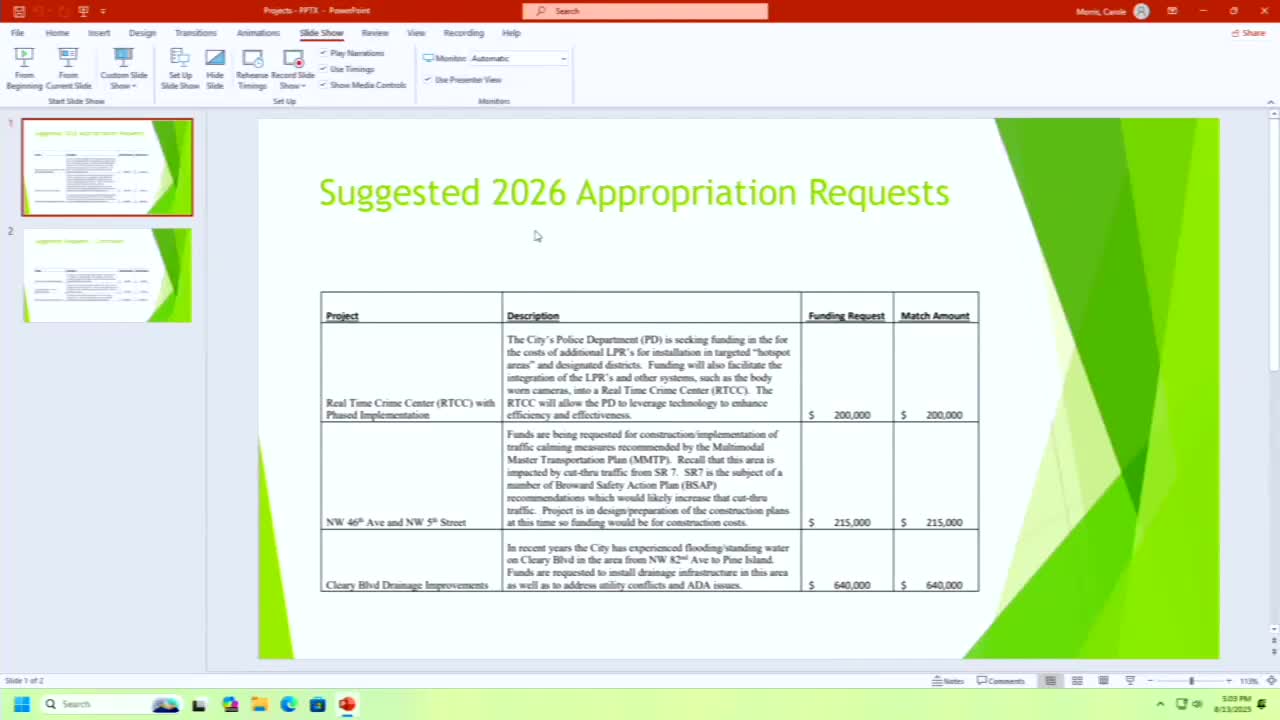
Why it matters: the lobbyists emphasized that many of the law changes and vetoes will affect local revenue, project planning and permitting. They told council members that some enacted language may be revisited or clarified in 2026 and that Plantation’s delegation helped secure two appropriation items this year — roughly $447,000 for Broward drainage improvements and $181,000 for a Lauderhill water-main interconnect — but that other proposals could constrain local authority or funding going forward.
The presentation was largely informational; the lobbyists advised that Plantation staff and representatives remain engaged with the Legislature and League of Cities as unfinished and returning issues are negotiated ahead of the 2026 session.