Get Full Government Meeting Transcripts, Videos, & Alerts Forever!
Get email alerts on the Budget And Finance topic
No spam. Unsubscribe anytime.
Legislators press budget officials on $138 million in uncollected business taxes, limits on using lapse funds and rainy-day cap
Summary
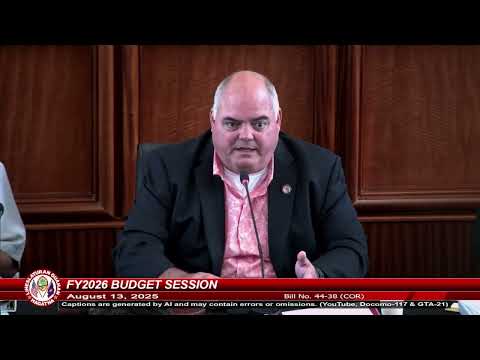
During a legislative budget hearing, senators questioned executive branch officials about roughly $138 million in uncollected Business Privilege Tax (BPT) liabilities, requests to use FY2025 lapse funds for agency continuity, procurement and recruitment bottlenecks, and whether the rainy-day fund has reached its statutory cap.
Lawmakers pressed executive budget and administrative officials at a legislative budget hearing about several fiscal risks and operational constraints, including approximately $138 million in uncollected business tax liabilities, agency requests to use FY2025 lapse funds for ongoing projects, persistent procurement and recruitment bottlenecks, and how close the government is to the rainy-day fund cap.
Senator Shelly Cabo opened a block of questioning on agency flexibility and lapse funds, saying agencies such as the Department of Community Affairs (DCA) and the Department of Youth Affairs (DYA) sought authority to use FY2025 lapse funds in FY2026 for capital maintenance and continuity of programs. A DOA official told senators that lapse funds are generally disfavored unless there is a clear, documented reason for the lapse and that encumbered projects do not need lapse authority because the funds are already committed. The official said exceptions could be considered on a case-by-case basis.
A revenue-collection official identified Business Privilege Tax (BPT) accounts receivable as a “constantly moving target” and said the latest figure the agency had for outstanding BPT was about $138,000,000 (2023 figure). The official cautioned that that number can include amounts that later become uncollectible because of statute-of-limitations issues, overpayments, or other adjustments. Senators asked whether a future tax-amnesty program could be used to recover a portion of those liabilities; staff recalled a prior amnesty that generated roughly $40,000,000 in collections but said an amnesty carries administrative challenges and would require further planning.
Procurement, recruitment and midyear budget adjustments were also a focal point. Officials said they have increased procurement staffing for FY2026 and are encouraging agencies to submit requisitions early so GSA (government services procurement) can encumber funds and avoid end-of-year bottlenecks. Committee members described persistent recruitment shortfalls in agencies such as police, corrections and emergency services; budget staff said the legislature’s prior appropriations for recruitment cycles and pay adjustments have helped some departments attract and retain staff but that police recruiting still shows higher dropout rates than for the fire department.
On reserves and bond ratings, budget staff reported the rainy-day fund balance and cap calculations. Using the most recent three fiscal years, one calculation of the cap came to about $90.4 million; officials said the balance is expected to end the year near $77 million, meaning the cap has not been reached. A budget official said the government’s general obligation bonds are currently rated at the low end of investment grade (noted as “BBB-” with a stable outlook) and that improving reserves and fiscal controls are part of efforts to raise the rating and lower future borrowing costs.
Committee members also reviewed several special and revolving funds. Officials told senators the Healthy Futures Fund and other special accounts show year-to-year variability; the consolidated report cited roughly $10.3 million in special-fund shortfalls as of June and noted that shortfalls have historically been covered by the general fund. The Tourist Attraction Fund (TAF) projection for the coming year was set near $33.6 million in the executive request, down roughly $2.3 million from FY2025, and staff said recent airline and marketing momentum gives some confidence in reaching that figure. Senators pressed for details about a $10 million incentive appropriation for GVB (Guam Visitors Bureau); staff said the funds would support marketing and airline incentives and that questions about that program would be addressed in a separate Committee of the Whole hearing with GVB.
Correctional facility and modernization funding drew questions. Senators asked which prior appropriations for the DOC modernization plan were actually loaded into the accounting system. Officials said an initial $5 million appropriation linked to an EITC (federal reimbursement) was not loaded because the reimbursement mechanism was not available; a later $5 million appropriation for the current fiscal year was loaded and the balance has been used for operations.
Several senators asked about policy tools to protect revenues, including a statutory or budgetary “sunset” or trigger tied to collections. Budget staff and OFB representatives noted the existing fiscal realignment mechanism that is triggered when revenues track 3% below adopted levels for a quarter and said that mechanism had functioned as intended in prior years. Officials said they were open to discussing other protections but cautioned that introducing many sunset clauses could complicate budget planning.
The hearing included repeated appeals from senators for more timely, finer-grained financial reporting (for example, July CER/raw fund reports) and for agencies to plan and encumber funds earlier in the fiscal year to reduce year-end congestion.
Ending: The committee did not take formal votes on the questions discussed during this session. Senators asked staff to follow up with more detailed, itemized spreadsheets on rainy-day calculations, the status of special-fund shortfalls, and a breakdown of recent rainy-day deposits and DOC appropriations, and scheduled additional hearings with GVB and other agencies to review incentive and special-fund proposals.