Get Full Government Meeting Transcripts, Videos, & Alerts Forever!
Get email alerts on the Transit Finance Ridership topic
No spam. Unsubscribe anytime.
CTA reports midyear budget gains, slower fare growth; rolls out bus-tracker transparency
Summary
At an Aug. 13 meeting the CTA finance committee heard that year‑to‑date public funding and system revenue were ahead of budget, while fare and pass revenue lagged projections. Staff described ridership patterns—rail gains, softening on some bus corridors—and new bus-tracker tools to flag cancelled trips and reroutes.
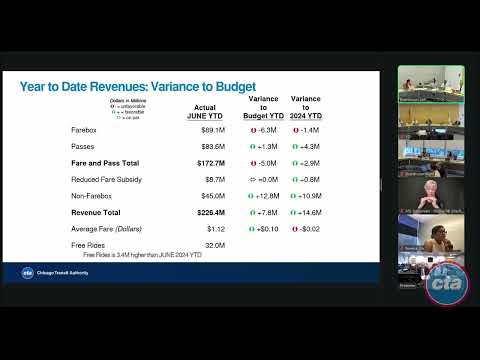
At an Aug. 13 meeting of the Chicago Transit Authority Committee on Finance, Audit and Budget, Chief Financial Officer Tom McComb reported year‑to‑date results through June showing the authority roughly $49.9 million favorable to budget on public funding and $7.8 million positive to budget on system‑generated revenue, while fare and pass revenue remained slightly below the budgeted growth rate.
Tom McComb said June is the fiscal halfway mark and that fare and pass revenue was “coming slightly under budget for the month” even as non‑fare‑box revenue and investment returns provided offsetting gains. He told the committee total operating expenses were favorable to budget and that the authority had seen a $39.4 million positive variance in operating expenses year to date.
The report matters because the CTA is moving through the year with a mix of stronger public funding collections—notably sales tax and real‑estate transfer tax receipts—and slower passenger revenue growth than forecast, a combination that shapes budget planning ahead of next year. “We’re comfortable with those results right now,” McComb said, while noting ridership growth was a few percentage points below initial projections.
Planning and service staff described where ridership is growing and where it is not. Molly Poppy, chief planning and innovation officer, said rail is showing a stronger rebound—“now it’s growing at a 6 to 7% rate”—while bus ridership is softer overall. She highlighted bright spots on the frequent bus network: the J14 route is growing at nearly 20% year over year and other frequent routes have posted double‑digit gains. CTA will add four more frequent routes that weekend, expanding the network from 12 to 16 routes.
Staff described operational and infrastructure steps aimed at improving reliability and ridership. CTA has been recruiting operators and expanding supervision to reduce service gaps, is studying bus corridors for bus‑priority improvements on major streets including Cottage Grove and Garfield, and is investing in transit signal prioritization and targeted bus priority zones. Staff said smaller priority treatments can be completed in roughly a year; larger dedicated bus‑lane infrastructure is expected to take multiple years and requires coordination with state and city roadway agencies.
The authority also announced a multi‑part effort to improve the accuracy and transparency of bus arrival data. Poppy briefed the committee on a disruption‑management system rolled out in stages since June that allows control‑center staff to mark individual runs as canceled and to publish real‑time reroute information to CTA’s apps and to third‑party developers. “When a bus is canceled, riders are made aware of that,” Acting President Nora Lierz said. Staff said the agency aims to publish reroute information in time for the Chicago Marathon this fall and will continue to expand the tool.
A public commenter, Brad Matting, told board members that his commute delays and safety concerns were influencing his travel choices. “A commute that used to take just over an hour now takes 45 extra minutes,” Matting said, and he asked what contingency plans CTA has if a reported $771 million state funding gap is not closed. McComb and Lierz encouraged follow‑up with finance staff; McComb said budget planning is ongoing and that additional updates will come as state and regional funding discussions continue.
Looking ahead, staff said they expect to report on a planned power‑purchase update in September and will continue to track July and August fare data for a fuller picture of year‑end projections. The committee paused for questions after the presentation.