Get Full Government Meeting Transcripts, Videos, & Alerts Forever!
Get email alerts on the Municipal Finance topic
No spam. Unsubscribe anytime.
Woodland Hills council adopts county-certified tax rate after long public hearing on roads and bonds
Summary
After more than two hours of public comment, the Woodland Hills City Council voted to adopt the county-certified tax rate of 0.003093 (no increase above the certified rate), ending a public hearing about options to fund a multi-year pavement management program and other infrastructure needs.
The Woodland Hills City Council voted unanimously Wednesday to set the city—s certified property tax rate at the county-provided level of 0.003093, a move that the council and staff said avoids an immediate tax-rate increase while preserving options to pay for a planned pavement management program and other infrastructure work.
Mayor Brent Winder opened the evening—s truth-in-taxation hearing and framed the discussion around both state-certified tax mechanics and the city—s infrastructure needs. "This is my last truth in taxation hearing," Winder said, and walked residents through how the state-certified rate is calculated and why the council convened the public hearing despite staff—s finding that an increase may not be required.
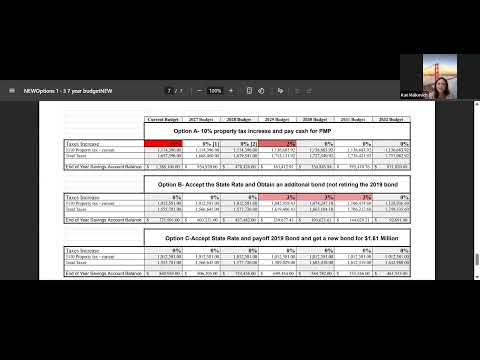
Why it matters: Woodland Hills officials said roads, water infrastructure and public safety are the largest parts of the city—s budget. Council and staff presented three financing options for the pavement management plan: (a) a four-year plan that would draw heavily from savings, (b) a seven-year plan funded in part by a new bond and smaller tax increases later, and (c) a single bond now to complete the work in 12'18 months while paying off an existing 2019 sales-tax revenue bond. Council members and staff emphasized that option C would avoid raising the certified tax rate now and would lock a known construction cost and interest payment rather than risking higher construction prices later.
What council and staff said: Finance director Chris (last name not specified in the record) and members of the finance committee described recent contractor bids and a pavement management report that ranks roads by condition and prescribes treatments (microsealing, mill-and-fill, full replacement) to extend pavement life. Tim (finance committee) said road-construction input costs have risen faster than CPI and cited a figure of 13.8% year-over-year for road construction costs, arguing that completing the project now reduces risk of higher future costs.
Public comment and council response: More than two dozen residents spoke, raising concerns about tax affordability, accountability for contractor performance, drainage and water infrastructure, and the distribution of property-tax burdens (including school district levies). Resident Daryl Sorensen said, "I can't afford to live here anymore because my taxes are almost 400 a month." Others asked for clearer, itemized public reporting of city revenues and expenditures and for accessible budget spreadsheets; councilmembers and staff pointed to the tentative budget, the upcoming public hearing on the fiscal-year 2026 proposed budget (scheduled for Aug. 26 in the meeting), and the state—s transparency portal as sources for more detail.
Key figures and options presented (as stated in the hearing): - Certified tax rate presented by the county: 0.003093 (city motion adopted this rate). Estimated revenue at that rate: $1,012,581. - Option A: Four-year pavement plan; would pull roughly $650,000 from savings in year one (staff said savings exist but council wanted to avoid draining emergency reserves). - Option B: Seven-year plan with supplemental bond payments (estimated added loan payment roughly $260,000 per year) and potential smaller tax increases in later years. - Option C: Bond-based approach to complete the pavement management project in 12'18 months; proposed bonding amount around $2,100,000 (figures presented as estimates dependent on final rates). Option C included paying off the 2019 sales-tax revenue bond by drawing about $690,000 from savings in year one.
Staff noted water infrastructure is accounted for in a separate enterprise fund and pointed to two outstanding water loans: one from 2014 (maturing Oct. 2034, rate ~2.9%) and a state 0% loan from 2021 (maturing Oct. 2051). Councilmembers also described completed well upgrades, replacement of a Maple Canyon well casing (jointly owned with Salem), and ongoing needs for additional storage for firefighting.
Votes at a glance: - Resolution 2025-19 (setting the certified tax rate at 0.003093; revenue estimate $1,012,581): Motion to adopt by Jody (mover), seconded by Janet. Roll call as recorded in the meeting: Janet — Yes; Harry — Yes; Bridal — Yes; DeRuell — Yes; Ben — Yes. Motion carried; certified rate adopted.
What the vote does and does not do: The adoption of the county-certified rate means the council accepted the certified rate that yields the stated revenue total; council and staff repeatedly said they did not plan to raise the certified rate above that county figure at this meeting. Council members and staff said the decision preserves the ability to pursue bonds or other financing to complete the pavement management project without increasing the certified tax rate immediately.
Next steps and transparency: Councilmembers said the proposed fiscal-year 2026 budget will be available before the final adoption (public hearing set for Aug. 26) and encouraged residents to request detailed line-item information from the finance director or to use the Utah transparency portal (transparent.utah.gov) to review invoices, loan schedules and audited figures. Councilmembers also invited residents to contact them directly with questions and said the finance committee will continue evaluating timing and financing options for the pavement program.
Ending note: The council closed the public hearing and adjourned after the roll call vote. Staff and council repeatedly emphasized the preference to avoid increasing the certified tax rate now, while acknowledging the council must choose among financing options that balance reserve levels, contractor availability, construction-price inflation risk and near-term taxpayer impact.