Get Full Government Meeting Transcripts, Videos, & Alerts Forever!
Get email alerts on the Utilities Water Sewer Rates topic
No spam. Unsubscribe anytime.
Highland Village staff warns modest 2026 utility rate changes could presage larger future increases
Summary
City finance staff briefed the Highland Village City Council on the utility fund, proposing small water and sewer rate adjustments for fiscal 2026 and outlining rising wholesale costs, higher operating expenses and a projected need for about $700,000 in additional annual revenue by 2027 to preserve fund balance targets.
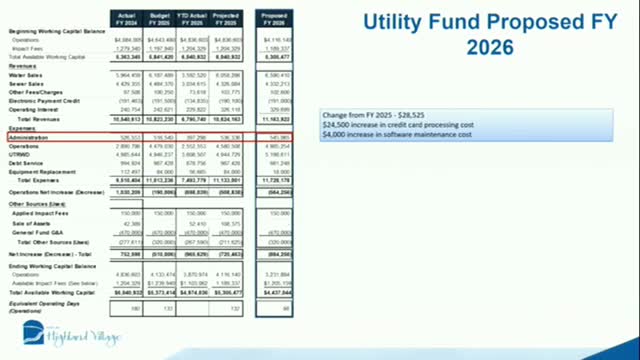
City finance staff told the Highland Village City Council on Aug. 12 that the city expects a modest net position for the utility fund in fiscal 2026 if the council approves the staff-proposed rate adjustments, but cautioned that larger increases may be needed in later years to preserve reserves.
Staff said water sales were lower than budgeted this summer because of wetter weather, and that some operational expenses have risen. Staff described a $19,000 increase in administration costs (about $16,000 of that tied to credit-card fees), higher bill-printing and postage costs, and unplanned operations spending: an emergency sanitary structure repair that raised sewer-line maintenance above budget and a camera purchase this year that should reduce future line-inspection costs.
To recover higher wholesale charges from Upper Trinity Regional Water District (staff said Upper Trinity and Dallas-area wholesale charges are rising roughly 10%), staff proposed changing the city’s retail structure for 2026: increasing the water demand charge to $24.25 and water volume charge to $1.37 per 1,000 gallons; increasing the sewer demand charge to $22.40 and sewer volume to $1.54 per 1,000 gallons. Staff estimated those changes would leave the utility fund roughly even in 2026 under current assumptions.
Nut graf: Why this matters — Wholesale supplier increases and rising personnel and maintenance costs are forcing the city to consider incremental rate changes now while warning of a larger, structural revenue need in coming years.
Staff said the city’s working-capital goal is about 90 days of operations and that to preserve that level into the midterm it will likely need about $700,000 of additional, recurring revenue (staff estimated that equates to roughly $12 per year per typical residential account or roughly $12 monthly per account when annualized across accounts; staff also described that as about $12 per year per resident/account). The presentation showed the last city-wide retail rate change for the city side occurred in 2017 and noted that wholesale and capital demands (including two tank repaint projects) could force supplemental rate adjustments starting in fiscal 2027.
Council members pressed staff on specifics the presentation raised. Questions included whether the city charges convenience fees for credit-card payments (staff said the vendor receives a per-transaction convenience fee and the city does not keep that fee), the size of annual credit-card processing costs (staff estimated roughly $80,000 per year), how the city estimates usage (historical four- to five-year averages to normalize wet/dry years), and whether the proposed retail changes would cover projected 2027 shortfalls (staff said the 2026 proposal covers only 2026 and larger structural adjustments will likely be needed in later years).
Staff also described non-rate revenue drivers the council could expect: limited impact-fee receipts tied to pending development, use of impact-fee reserves to cover some debt-service costs, and a proposed transfer of impact-fee balances to pay utility debt service. Staff noted that if the city continues to delay broader retail increases, cumulative shortfalls would grow and voters could be asked to consider other revenue sources or service cuts in future years.
Ending: Council members asked staff to refine multi-year rate scenarios and return with options showing levelized increases versus larger single-year adjustments; staff said it will present wholesale-rate updates and a refined multi-year rate path at future workshops.