Get Full Government Meeting Transcripts, Videos, & Alerts Forever!
Get email alerts on the Land Use topic
No spam. Unsubscribe anytime.
Teton County planning panel denies request to rewrite workforce home-business zoning to allow contractor yards
Summary
The Planning Commission voted unanimously to recommend denial of a text amendment that would have allowed light and heavy contractor businesses as primary uses in the Hog Island workforce home business zone; commissioners and neighbors cited predictability, comprehensive plan alignment and water and wildlife concerns.
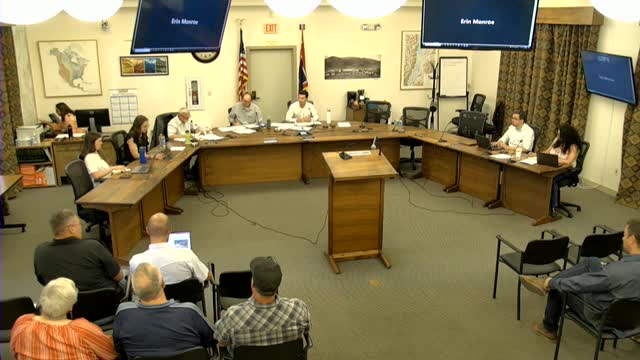
The Teton County Planning Commission unanimously recommended denial Monday of a proposed amendment to the county Land Development Regulations that would have allowed light and heavy contractor businesses to be primary uses in the Hog Island workforce home business (WHB) zone.
Erin Munro, associate long-range planner for Teton County, told commissioners the amendment (AMD 2025-00001) would add building and special-trade contractors, paving, excavation, hauling and other services that rely on heavy equipment to the WHB use table for properties that lie at least partly within 200 feet of South Highway 89. The applicant is Montana Wyoming Capital LLC (doing business as Ridgeline Excavation); the agent is Alex Norton of OPS Strategies and the owner/operator, Kirk Hogan, spoke in support.
The commission’s recommended denial follows the planning director’s recommendation. In presenting the staff analysis, Munro said the WHB zoning was adopted in June 2022 to implement the comprehensive plan’s sub-area vision for Hog Island — “a stable sub area defined by families living and working in residences accompanied by a shop or small contractor yard” — and that allowing primary industrial uses could conflict with that vision. Munro read the WHB home-business definition and highlighted staff concerns that changing a use from accessory to primary would permit greater intensity and undermine predictability for property owners who relied on the 2022 rules.
Supporters, including the applicant’s agent Alex Norton and business owner Kirk Hogan, argued the county lacks viable land for contractor yards and that locally based contractors are needed for emergency response and routine public-works work. Norton said the proposal attempted to limit impacts with zone-specific standards: a site cap of three acres, operation hours of 7 a.m. to 10 p.m., required conditional use permits with operations plans, screening, and that a primary or accessory residence remain on-site. Hogan described his company’s emergency work and county contracts and said, “We can respond to that, but we can’t do that from Alpine or Star Valley.”
Opponents, including multiple neighbors and water-quality advocates, told the commission the change would erode the residential character, increase truck traffic and create risks to groundwater and wildlife. Jen Evans, advocacy director for Protect Our Water JH, said the Hog Island area contains “some of the most pristine groundwater sources in southern Teton County” and urged denial. Several residents said the zoning rules adopted in 2022 shaped their expectations, and that amending the code for a single property owner would set a harmful precedent.
Planning Director Chris Neubecker and staff confirmed that the application is a legislative text amendment — not a site-specific quasi-judicial permit — and that a primary consideration is whether the change would implement the comprehensive plan’s community vision. Staff made two of six approval factors (the amendment responds to a demonstrated need for contractor lands and it does not conflict with county resolutions) but recommended denial because staff could not find consistency with the comprehensive plan’s stated character for Hog Island and concluded the amendment would reduce predictability in the land-development regulations.
After public comment and discussion the commission voted on a motion to recommend approval. The motion failed, recorded in the meeting minutes as “Motion fails, as a unanimous denial.” The denial recommendation will be forwarded to the Board of County Commissioners for final action.
The commission and staff discussed alternatives — narrower search radii from the highway, limiting uses or applying only to a property owner’s lot — but commissioners repeatedly returned to two themes: (1) the county needs a plan-level solution to locate contractor yards and light industrial uses in appropriate places, and (2) changing the WHB code now would break the promise of predictability made to property owners during the recent zoning update.
The planning director and several commissioners encouraged a broader policy review (business-park zoning and industrial lands) rather than a text amendment initiated by a single landowner. The applicant and supporters said they would continue to press the county for solutions to provide local sites for essential contractor businesses.
Ending: The Planning Commission’s recommendation of denial moves the matter to the Board of County Commissioners. The County will now have to weigh whether to accept the Planning Commission’s recommendation or to direct staff to craft alternative zoning or site-specific measures; staff and commissioners signaled interest in a countywide, policy-focused approach to identifying and permitting suitable industrial lands.Appeal or next steps were not decided at the meeting and were not stated by staff or commissioners.