Get Full Government Meeting Transcripts, Videos, & Alerts Forever!
Get email alerts on the Solid Waste Finance topic
No spam. Unsubscribe anytime.
Clark County solid waste finance update: department transition, fees under review and professional-services cuts
Summary
Staff said solid waste financial administration is transitioning from public health to public works, the county is reviewing the administrative and tipping fees, and earlier consultant spending has been cut approximately in half to bring more work in‑house.
County staff reported that financial administration for solid waste services is transitioning from the Public Health Department to Public Works, and that the change is affecting how budget reporting appears in the near term.
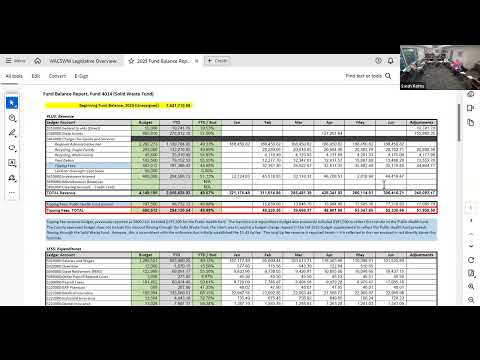
A county staff member reported that the financials presented reflect actual revenues through June and include items such as an administrative fee under the master services agreement, recycling revenues tied to single‑family and multi‑family collection, yard debris and tipping fees. Staff noted that the tipping‑fee line includes a health fee of $1.43 that is referenced in the solid waste management plan, and said the county is evaluating indirect allocations tied to the department transition.
Staff said one revenue line for the Leitner Landfill had been recorded incorrectly in the presentation and should read $80,000 rather than $60,000; that amount represents an administrative reimbursement from the Leitner account to the solid waste enterprise fund. “It is supposed to be 80,” a staff member said.
The county reported it has reduced spending on external professional services roughly by half and has brought more work in-house, citing examples such as plan writing and editing for the solid waste management plan. Staff said the reduction in consultant spending reduces the risk that program work would be cut if some state grant funds (from the Model Toxics Control Act/local solid waste financial assistance grants) are reduced.
Committee members asked whether the financial slides include subsidy arrangements that offset recycling processing shortfalls. Staff said the spreadsheet shown did not include an itemized breakdown of negotiated collection/subsidy fees; those details are handled in separate contract terms with haulers. Will Elder (City of Vancouver) added that some cities have built targeted subsidies into commercial collection contracts to maintain service during market disruptions.
Staff said the special revenue fund created by the master services agreement is restricted to capital improvements at transfer stations and that investment interest is being captured in county pooling accounts and reflected when available. The finance presentation will be repeated at a future meeting after Public Works staff have fully taken over the budget presentation and reconciled allocations.
No formal county decisions were taken at the meeting; staff asked members to submit questions in writing and indicated a fuller presentation would be provided when the transition is complete.