Get Full Government Meeting Transcripts, Videos, & Alerts Forever!
Get email alerts on the Land Use Development topic
No spam. Unsubscribe anytime.
Sunnyvale council approves first reading to allow temporary concrete batch plant for Homestead Phase 7
Summary
Sunnyvale Town Council on Aug. 11 approved on first reading an amendment to the Homestead Planned Development to permit a one‑time temporary on‑site concrete batch plant to support construction of 34 single‑family home sites in Homestead Phase 7.
Sunnyvale Town Council on Aug. 11 approved on first reading an amendment to the Homestead Planned Development to permit a one‑time temporary on‑site concrete batch plant to support construction of 34 single‑family home sites in Homestead Phase 7.
The amendment, introduced during the council’s public hearing for ordinance 2025‑O9, would allow a concrete batch plant on Lot 4, Block B (about 1.4 acres) for a single period of up to 25 calendar days with a one‑time five‑day extension if weather delays occur. Town staff and the applicant said the plant would reduce the number of ready‑mix truck loads traveling town roadways during the street pours.
Planning and development director Rachel (Director of Planning and Development Services) summarized the proposal and explained the conditions included in the amendment. She told council the Planning & Zoning Commission recommended approval on July 16 after staff initially recommended denial; staff changed its recommendation after the applicant and contractor presented additional erosion and dust controls at the P&Z hearing.
Developer Jim Douglas of Douglas Properties and Brian Caudle of CHC Construction described operational controls they propose to limit off‑site impacts. Those measures, which are reflected in the ordinance and staff report, include perimeter containment (described in the hearing as an "arden barn" around Lot 4), storage silos with filtration for cement, sprinkler systems over aggregate stockpiles, continuous watering of haul routes, and removal of any concrete washout off‑site at the end of the permit period. The applicant also agreed to hire a private stormwater inspector to perform weekly inspections and to inspect after measurable rain events in addition to Town inspections.
Council members repeatedly asked for clarification about the inspection schedule and enforcement. Rachel said the town could issue stop‑work orders and withhold final subdivision acceptance if required erosion‑control measures are not completed or the site is not restored at the end of the permit period. Jim Douglas said subdivision acceptance and final plat approval would not occur until Lot 4 was returned to the required condition.
Several council members, and a public commenter who lives in Homestead, said past phases of Homestead have used temporary batch plants without reported long‑term impacts and that an on‑site plant would limit hundreds of concrete trucks on neighborhood streets. Resident Jerry Johnson told the council the neighborhood supports the plant, citing safety and traffic concerns if all concrete were delivered by ready‑mix trucks.
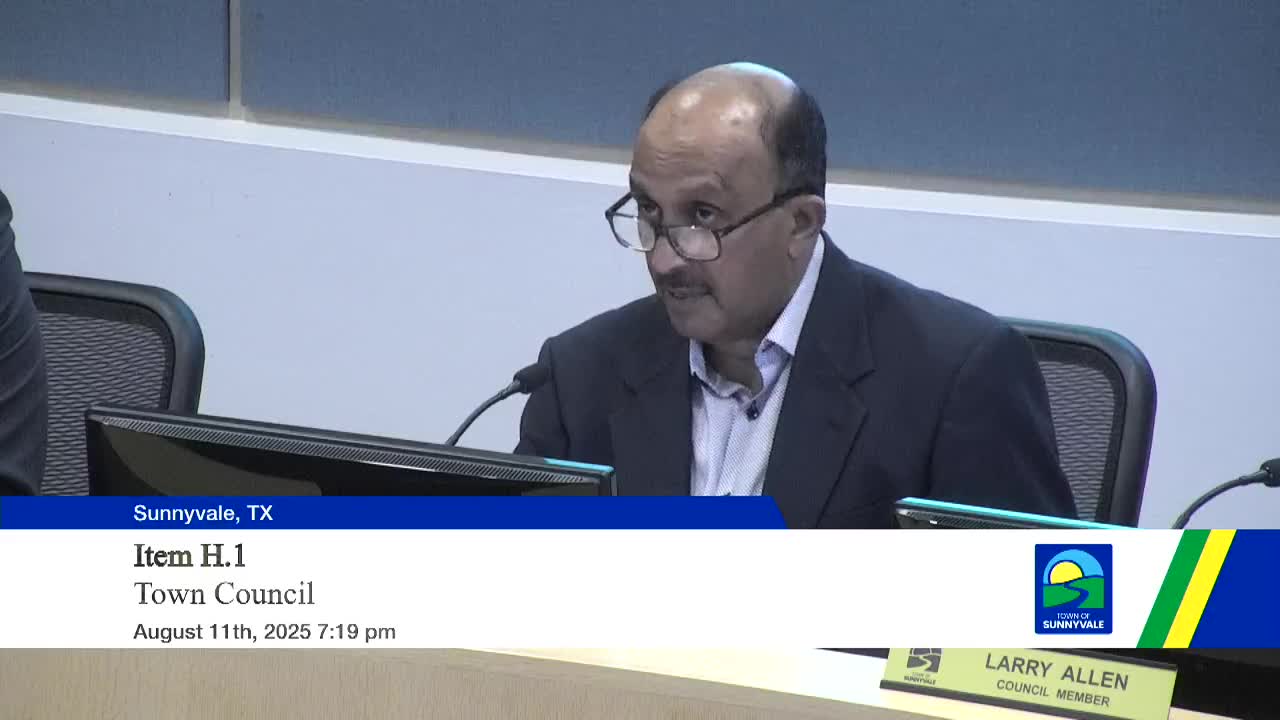
Councilor Allen moved to approve the ordinance on first reading; Dr. Woodrow seconded. The motion passed on first reading by the vote recorded at the meeting.
The ordinance as presented requires compliance with the town code (chapter 4.01003) for construction hours and noise, adherence to Texas Commission on Environmental Quality (TCEQ) batch plant regulations, an amended site sweep and stormwater plan before permits are issued, containment measures around the batch plant, weekly inspections plus inspections after any measurable rain event, and the requirement that any concrete washout material be removed from site at permit expiration. If the town observes violations, staff said it will issue notices, escalate to stop‑work orders and withhold subdivision acceptance until corrections are made.
Council directed staff to verify public‑notice procedures and to return with any required changes at second reading; Rachel said she would research prior PD notes about internet service the council had discussed earlier and report back at second reading.
Proponents said the plant would shorten the street‑pour schedule (CHC estimated about 10 working days for the pour in ideal weather) and limit heavy truck traffic on Towne East and New Hope. Opponents did not appear at the hearing, and two written responses were included in the packet; staff told council those concerns were addressed at the P&Z meeting.
The council’s first‑reading approval does not yet authorize operation; a building permit and the required site‑specific stormwater and TCEQ approvals must be obtained before the plant may operate.