Get Full Government Meeting Transcripts, Videos, & Alerts Forever!
Get email alerts on the Water Sewer Billing Audit topic
No spam. Unsubscribe anytime.
County auditors find data-quality problems in water-sewer delinquency reports and open application review
Summary
The Office of Independent Internal Audit reported data-quality issues in recent presentations of DeKalb County water and sewer delinquent billing totals, and the auditors are conducting a system-level review of the utility-billing application (Inquesta) and reporting processes.
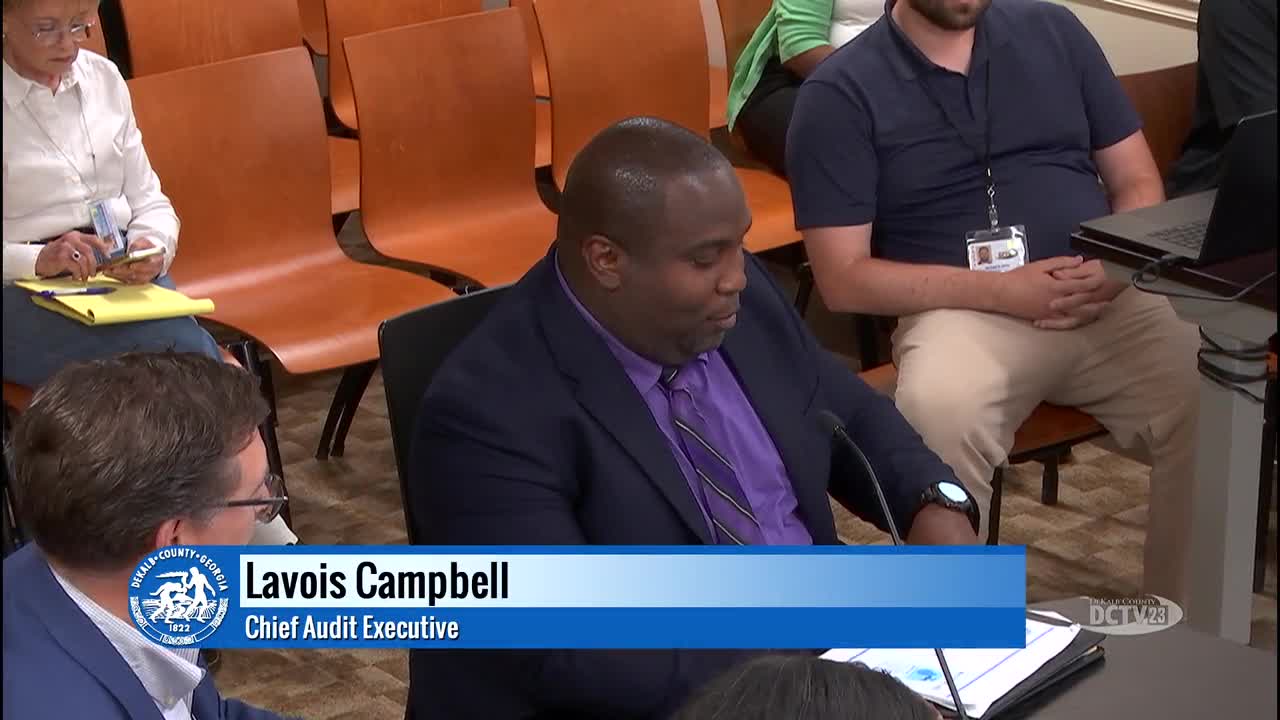
DeKalb County’s Office of Independent Internal Audit told the Finance, Audit and Budget Committee that recent presentations on water and sewer delinquencies contained reporting inconsistencies and incomplete fields that make headline delinquency totals difficult to verify. Director of Audit Patrice Campbell said the office has begun a formal application and data review.
"About approximately $10,000,000 or 9% of those bills were actually flagged as current," Director Campbell said while summarizing the May 20 presentation and subsequent data pulls. The audit team compared the May presentation, a June data extract and a July 2025 report and found divergent totals driven largely by which account statuses and account types were included in the various exports.
Campbell told the committee the May 20 presentation had been limited to four customer types and active accounts at the request of commissioners; when the audit team requested more expansive extracts that included inactive and final accounts, the total outstanding delinquency figure rose substantially. The July summary, which included active, inactive and final accounts, reported a gross delinquent balance markedly higher than the May active-only number.
The auditors flagged multiple data-quality problems, including missing or inconsistent ZIP codes and addresses, frequent misspellings of city names, blank customer-name fields and account-classification mismatches. The audit team said those issues make reconciling summary aging reports to detailed account-level reports difficult. In one example, audit staff identified a list of roughly 135 property liens in a summary report but found no corresponding balances on the underlying account detail provided by the billing system.
Campbell recommended the audit office perform a full review of the Inquesta application, including: data migration integrity from legacy systems, input and processing controls, accuracy of balances and aging across account statuses, and the reporting and export tools that produce the summary figures. She said the review will also work with finance staff on a practical “cutoff” or freeze process to allow consistent report extracts; department staff reported that the current application does not support a clean transaction cutoff and that payments processed concurrently can cause aging summaries and detailed reports to disagree.
County Attorney William Lankus said legal staff is researching the county’s options around long‑delinquent balances; Campbell noted many delinquent balances are older than four years and would present collection challenges through ordinary civil remedies.
The audit team estimates the application review and data verification work could take roughly two more months and said it will return to the committee with findings and recommended controls. The committee requested follow-up on outstanding liens, enforcement activity and the administration’s plan for reconciling prior district allocations tied to camera and other equipment purchases.