Get Full Government Meeting Transcripts, Videos, & Alerts Forever!
Get email alerts on the Zoning Land Use topic
No spam. Unsubscribe anytime.
Committee gives consensus to pursue zoning change to allow utility training center in rural-residential area
Summary
Bangor City committee signaled consensus to draft a zoning change to allow a Versant training center in the rural residential/agriculture district along Union Street, with staff to bring final language after planning board input and consideration of conditional-use controls.
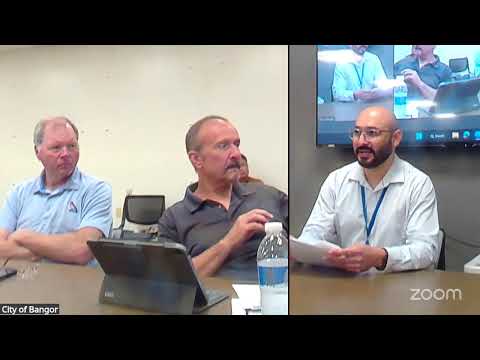
The Bangor City Business Economic Development Committee on Monday, Aug. 4 signaled general consensus to pursue a zoning amendment that would allow Versant to develop a training center on a property along Union Street in the city's rural residential-agriculture area, staff told the committee.
Anne Krieg, the city’s economic development director, told the committee that staff had met with Versant and was proposing to “allow this use sort of mixing it in with private school, and recreation and adding that to the rural zone, but limiting it to ... your heavier traveled roads, your what are called arterials.” Krieg said the proposed change aims to reflect limited commercial activity anticipated in the comprehensive plan while keeping the use restricted to higher-traffic corridors such as Union Street.
The change would add the training facility use to the rural residential/agriculture district’s permitted list, Krieg said, and she asked the committee for feedback before starting the formal amendment process and public notice. Councilor Beck suggested placing the use under conditional uses to give the planning board more ability to address potential traffic and site impacts; Krieg said staff would consider that option before returning with final language.
Committee members asked for planning-board review. Krieg said she had not yet started the formal public-notice process and wanted the planning board’s input at its meeting the following night. Councilor Fournier asked whether the council wanted a motion; members agreed that a general consensus to proceed was sufficient at this stage. Krieg said she would return to the committee at a subsequent meeting with final ordinance language after planning-board feedback.
Council members discussed which streets qualify as arterials for the proposed limitation. Krieg identified a set of major arterials that would be used to restrict the new use, listing several streets including Union Street; she also noted that the area is designated “neighborhood residential” in the comprehensive plan (a plan designation), while remaining zoned rural residential/agriculture under the zoning code. That distinction led to clarifying questions about whether the training use would be allowed under different plan labels; Krieg clarified that “neighborhood residential” is a comprehensive-plan term, not a zoning district.
No formal vote was recorded; the committee’s action was a direction for staff to proceed with a draft amendment, consult the planning board, and return with final language. Krieg said she would not advertise the ordinance until the committee and planning board had provided direction.
The committee’s next meeting will consider Krieg’s returned language after the planning-board review.