Get Full Government Meeting Transcripts, Videos, & Alerts Forever!
Get email alerts on the Speed Limits Ab43 topic
No spam. Unsubscribe anytime.
City presents informational speed-limit evaluation under AB 43; no decisions yet
Summary
City traffic staff presented a citywide speed-limit evaluation under Assembly Bill 43 showing methodology based on 85th-percentile speeds, identification of safety corridors and criteria for 5 mph reductions; staff said any posting changes would come back to the commission and then to city council.
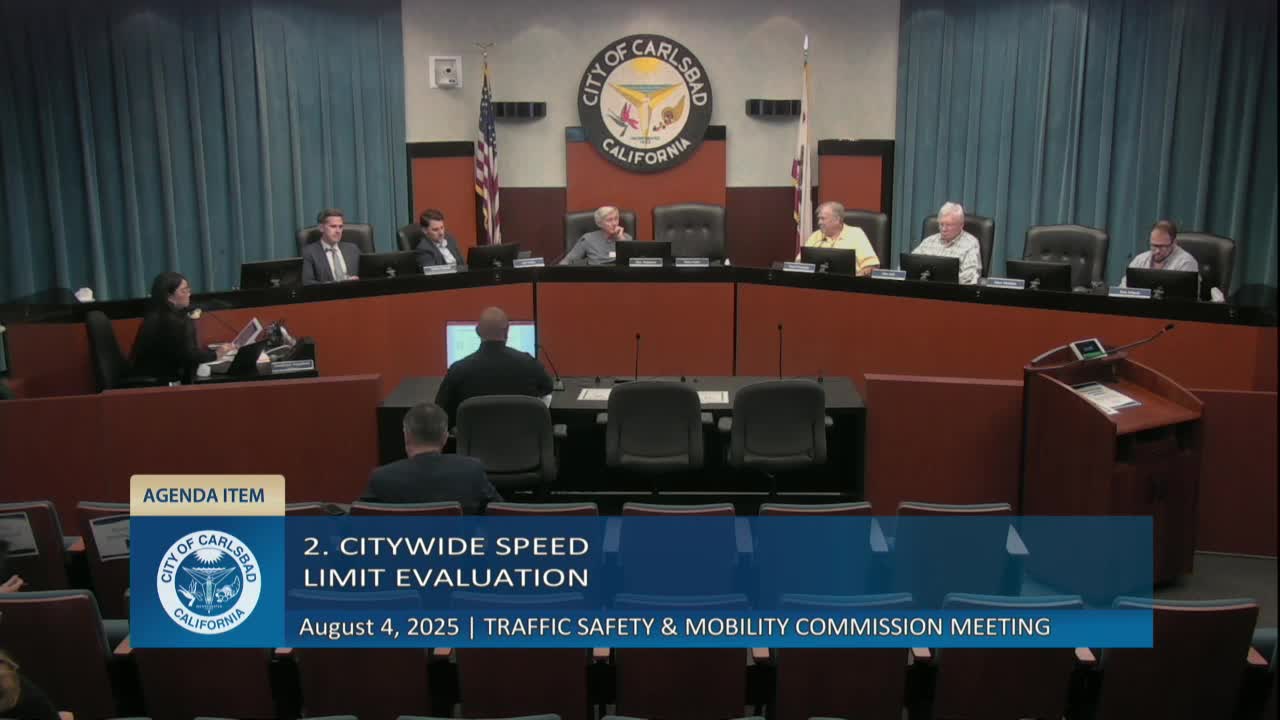
John Kim, city traffic engineer, and Miriam Jim, senior engineer, presented an informational evaluation of the city's speed limits under Assembly Bill 43 and accompanying guidance in the California Manual on Uniform Traffic Control Devices.
Kim described the engineering process used to set speed limits, including the use of the 85th-percentile speed (described in the presentation as the speed at or below which 85% of traffic travels) and collision history as key inputs. He said AB 43 and the MUTCD provide local agencies the flexibility to designate safety corridors and to consider a 5-mile-per-hour reduction from measured speeds for qualifying segments.
Jim said the city's evaluation reviewed five years of collision data (2018—2022) and identified a proposed safety-corridor network that covers roughly 18% of Carlsbad's roadway network. "Per MUTCD, we can designate up to 20% of the overall roadway network as safety corridors," she said. The evaluation also flagged roadways near high pedestrian and bicycle generators'including schools, transit stops and parks'as candidates for speed-limit reductions under AB 43.
Both staff cautioned that posting lower speed limits alone is unlikely to reduce driving speed without complementary measures. "Signage alone has limited effect on driver behavior," Jim said, and the presentation emphasized pairing any regulatory change with enforcement, roadway design changes (horizontal/vertical deflection, lane-width adjustments, striping) and education.
Staff said the city would coordinate with the police department on any recommended speed-limit changes. Potential revisions would be presented to the Traffic Safety and Mobility Commission for comment and then to the City Council for ordinance adoption. No formal actions or timeline were adopted at the meeting; staff said they'll return with corridor-specific recommendations for commission review prior to any council ordinance.