Get Full Government Meeting Transcripts, Videos, & Alerts Forever!
Get email alerts on the State Legislation Public Safety topic
No spam. Unsubscribe anytime.
City staff brief Public Safety Commission on 80th/89th Texas legislative actions affecting public safety
Summary
City intergovernmental-relations and law staff summarized bills from the regular and special legislative sessions, including firefighter pension reform, Austin’s collective-bargaining carveout, paramedic tuition exemptions and less-lethal defense changes.
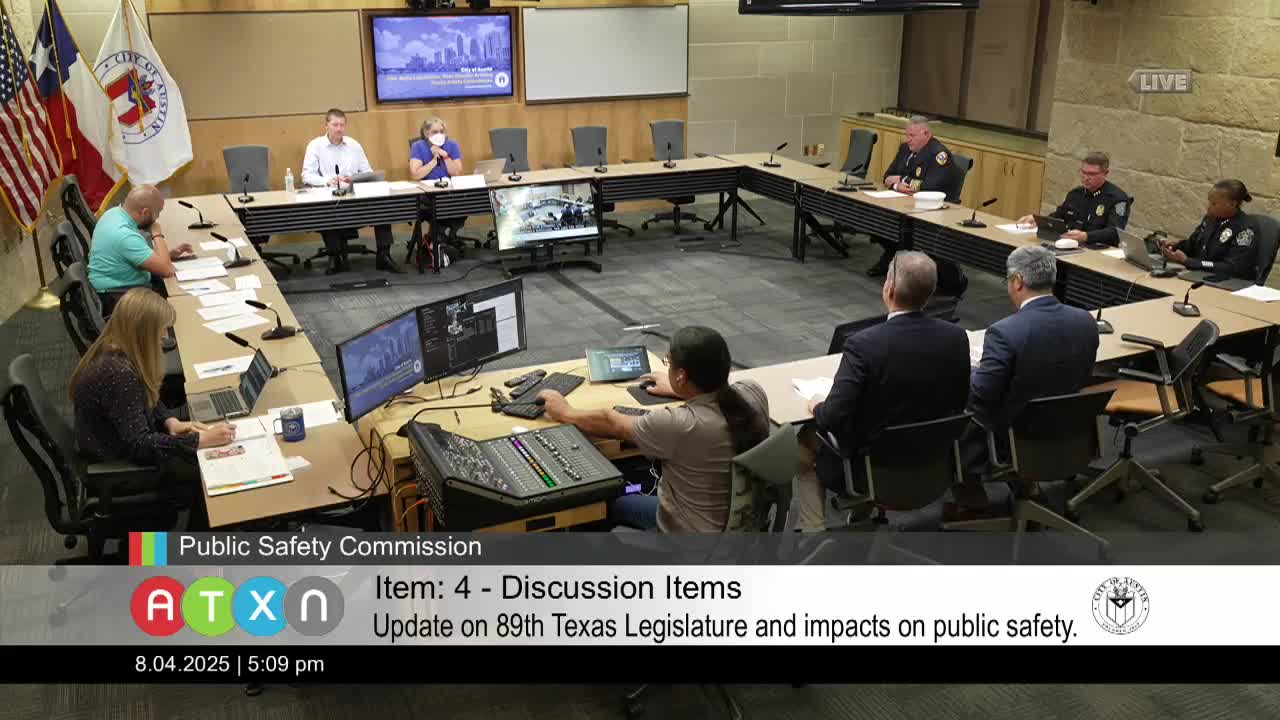
Rick Ramirez, deputy intergovernmental relations officer for the City of Austin, and Chris Coppola from the city law department briefed the Public Safety Commission on key legislation from the 80th/89th regular and special sessions that the city is tracking.
Ramirez summarized major public-safety bills and city priorities. He said the Legislature and governor had concentrated on water and land-use issues but that many public-safety measures reached the finish line. He listed measures discussed during the briefing, including HB 2802 (firefighter retirement reform establishing actuarially determined contributions and new benefit provisions for fires hired on or after Jan. 1, 2026), SB 777 (a statutory carveout agreed with Austin firefighters to preserve the city charter impasse procedure), HB 1105 (paramedic tuition exemption at institutions of higher education for students employed as paramedics by a city), HB 1620 (forensic analyst apprenticeship pilot program), SB 836 (changes to confidentiality rules for sexual-assault victims and discovery), and SB 345 (a measure Ramirez summarized as requiring Texas A&M Forest Service to create a statewide wildfire-fighting equipment database). Ramirez also described bills on active-shooter reporting and training, less-lethal defenses for police officers (identified in the briefing as SB 2570), and multiple land-use, water, and homelessness-related proposals.
Chris Coppola described legal aspects of SB 2570 (less-lethal-defense legislation as presented): he said the statute revises criminal law to create a justification defense for officers charged in connection with use of less-lethal weapons when the officer used the device according to training. Coppola said the change primarily affects the criminal process rather than day-to-day city operations. Chief Henderson (APD) said APD’s less-lethal training and recertification processes are robust and that training records are maintained; annual recertification and documented training are required before an officer may deploy a new platform.
Ramirez and Coppola also noted measures that failed to pass or were vetoed, including several high-profile preemption proposals and a consumable-hemp bill that later was vetoed; Ramirez flagged significant bills going to the November ballot related to water infrastructure. Staff offered to provide commissioners with bill analyses and to follow up on specific items (for example, EMT tuition exemption details and the emergency-mental-detention bill’s effect on detention criteria).