Get Full Government Meeting Transcripts, Videos, & Alerts Forever!
Get email alerts on the Fire Department topic
No spam. Unsubscribe anytime.
Austin Fire Department reports flood response deployments, station renovations and hiring gains
Summary
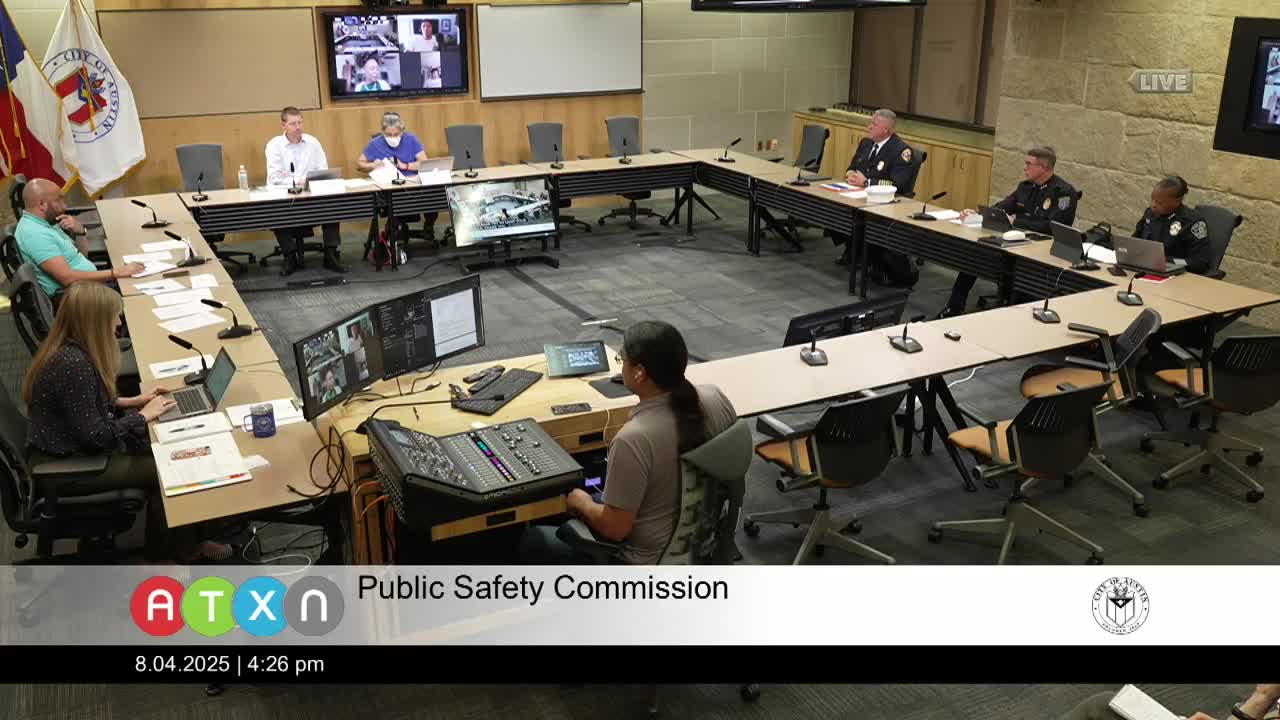
At its August Public Safety Commission meeting, Austin Fire Department leaders summarized mutual-aid flood deployments in July, recent station renovations and recruiting progress that reduced sworn vacancies from about 100 to 60.
At an Austin Public Safety Commission meeting, the Austin Fire Department reported July flood-response deployments to multiple Central Texas communities, progress on station renovations and continuing recruitment that cut sworn vacancies from about 100 to 60.
Fire Chief Byers said the department deployed personnel and equipment during the early-July floods, including three rescue swimmers embedded with a helicopter search-and-rescue team on July 4, a battalion chief, a rescue truck and an AFT boat assigned to ESD 1 (Lago Vista) and six additional personnel sent on July 7 to augment Texas Task Force 1 for search-and-recovery operations in the Kerrville area. On July 8 the department deployed a battalion chief to support communications (mobile radio towers) for areas with damaged radio infrastructure, and sent drone teams to Williamson County, Liberty Hill and Leander; a boat team responded on July 11 to continuing flooding, including in the Marble Falls area.
The chief also reviewed facility work: Station 8, Station 20 and Station 29 reported completion on May 12; Station 21 received a driveway adjustment; Station 10 Blanco was noted as more than 100 years old and in need of modernization. Some renovations required follow-up work after mold issues and HVAC adjustments, the chief said.
Byers highlighted specialized units and outreach. Arson investigators are required to be certified peace officers and undergo a 33-week course; the department’s arson clearance rate is more than double the national average, he said. The wildfire division reported high demand for structure ignition-zone evaluations and a “train-the-trainer” approach that lets community volunteers perform size evaluations after training. The department also uses a Situational Awareness Tool to provide an incident snapshot to off-scene managers.
Recruitment and training remains a central topic. The department recently graduated Cadet Class 139 (40 cadets on July 25), reduced sworn vacancies from roughly 100 to about 60, and reported civilian vacancies of about 10. Class 140 was said to be slated to graduate Oct. 3 with 37 cadets; another class starting in August was described as having 42 cadets. The department runs outreach programs including Austin Fire Explorers (teens) and “Pass the Torch” (adults). The chief noted typical firefighter careers span multiple decades, and urged interested applicants to visit joinafd.com.
The department also discussed ongoing work to maintain life-safety systems under a compliance engine that tracks permitted buildings with fire alarms or sprinklers, and a free smoke-alarm installation program (phone number shown as 974-0299). Byers described the compliance engine as a third-party process that improved maintenance tracking after earlier in-house efforts.
Commissioners asked clarifying questions about the compliance engine’s coverage of city-owned properties and the staffing impacts of budget proposals; the department said any permitted property with fire protection systems should be captured by the compliance engine, whether city or privately owned. The department said some personnel had been temporarily reassigned to operations during a mid-year 1.5% general-fund reduction and that those positions are intended to return to normal assignments as the FY26 budget process continues.
The presentation closed with an offer to answer further questions and to provide more detail on items requested by commissioners.