Get Full Government Meeting Transcripts, Videos, & Alerts Forever!
Get email alerts on the Medicaid 1115 Waiver topic
No spam. Unsubscribe anytime.
Nebraska DHHS seeks CMS approval to add psychiatric IMD stays and medical respite to Medicaid 1115 waiver
Summary
The Nebraska Department of Health and Human Services told the Legislature’s Health and Human Services Committee it will seek a Section 1115 Medicaid demonstration waiver amendment to pay for up to 60‑day psychiatric stays in institutions for mental disease for people with serious mental illness or serious emotional disturbance and to cover medical respite for people discharged from hospitals who lack stable housing.
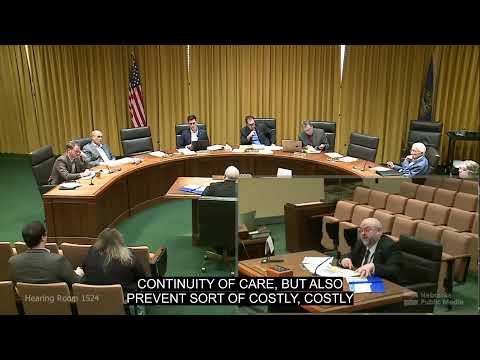
The Nebraska Department of Health and Human Services (DHHS) on Tuesday told the Legislature’s Health and Human Services Committee it plans to submit an amendment to its Section 1115 Medicaid demonstration waiver to allow two new services: short-term stays in institutions for mental disease for people with serious mental illness or serious emotional disturbance, and Medicaid payment for medical respite facilities for people without stable housing.
DHHS Director Drew Gonshorowsky, director of the Division of Medicaid and Long‑Term Care, told the committee the IMD authority would permit coverage for psychiatric hospital stays of up to 60 days for beneficiaries in crisis, and that the respite service would provide a place for people experiencing homelessness to recuperate after discharge from medical facilities. "We anticipate that providing this service will allow people undergoing a crisis to receive prompt quality care in an appropriate setting," Gonshorowsky said.
The department said it expects the IMD authority to take effect Jan. 1, 2026, and medical respite to be effective April 1, 2026, if approved by the Centers for Medicare & Medicaid Services (CMS). The presentation and the committee discussion were part of a public hearing required under Nebraska Revised Statute §81‑604 when DHHS proposes a Section 1115 demonstration waiver amendment.
Why it matters: DHHS told senators the changes aim to improve timely access to appropriate settings, reduce emergency‑department and hospital readmissions, and better coordinate care for people with behavioral health needs. Committee members pressed DHHS staff on budget neutrality and federal guidance, given recent federal legislation referenced in testimony as "HR 1." Gonshorowsky said Section 1115 waivers must meet budget neutrality requirements and that DHHS does not currently anticipate the amendment would jeopardize the state’s waiver status.
Committee questions and department responses
Senators asked how the federal HR 1 language and other federal guidance might affect the waiver, whether work‑requirement provisions could apply to the affected populations and whether co‑pays would apply. Gonshorowsky said he and his team are seeking guidance from CMS; he said DHHS’s view is that people with serious mental illness or substance‑use disorders would fall under exclusions for any work requirements described in the federal bill and that co‑pay details are another open question awaiting CMS guidance.
Senators also asked about program scale and site location. The DHHS draft cited by staff projects roughly 504 member‑months of IMD enrollment in fiscal 2026 and "a little more than double" in the following year; Gonshorowsky said staff would follow up with precise multi‑year projections. DHHS has identified a site in Omaha — Siena/Francis House was named in testimony — and is continuing to identify a Lincoln location. Committee members asked whether the model could be extended to serve rural areas such as Grand Island; Gonshorowsky said that is possible but noted the amendment and the originating legislation (cited in testimony as LB 905 from 2024) describe a smaller demonstration scope.
Funding and cost context
Committee discussion referenced a recent state hospital payment program enacted in LB 1087, which Gonshorowsky said brought additional dollars into hospital systems and was a factor in hospital support for respite options. Witnesses provided a cost comparison in committee discussion, saying inpatient hospital care can cost about $2,000 per day while respite placement might run about $250 per day; DHHS cited the respite model as a way to reduce costly hospital stays and prevent readmissions.
Support and next steps
Gonshorowsky said DHHS is in a public comment period, after which the department will submit the waiver amendment to CMS. Committee members asked for follow‑up information, including detailed enrollment projections beyond the first two fiscal years and operational details such as referral processes and bed availability; Gonshorowsky said staff would provide additional materials and that the department’s behavioral health division is coordinating with providers on care coordination.
No committee action or vote occurred during the hearing. The record remained open for written comments submitted through the Legislature’s website as required by committee procedure, and DHHS will proceed with its planned CMS submission after the public comment period ends.