Get Full Government Meeting Transcripts, Videos, & Alerts Forever!
Get email alerts on the General Government Operations And Appropriations topic
No spam. Unsubscribe anytime.
Guam Legislature advances bill to let Department of Education lease underused school property amid debate on lease terms
Summary
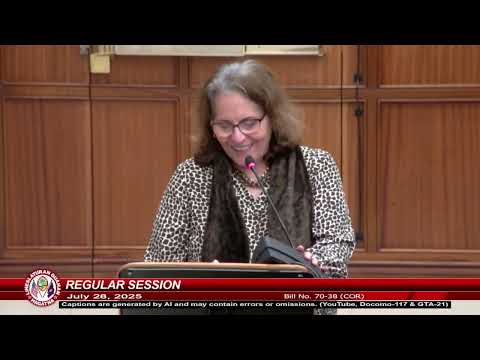
Senators on the Guam Legislature took up Bill 70-38, an act to add a new subsection to Title 17 of the Guam Code that would authorize the Guam Department of Education (GDOE) to lease underused or unoccupied school properties, create a procurement team to approve leases, and direct lease revenue into a fund separate from the general fund for reinvestment in schools.
Senators on the Guam Legislature took up Bill 70-38, an act to add a new subsection to Title 17 of the Guam Code that would authorize the Guam Department of Education (GDOE) to lease underused or unoccupied school properties, create a procurement team to approve leases, and direct lease revenue into a fund separate from the general fund for reinvestment in schools.
The bill’s sponsor, Senator Shlaugustin, said the measure is intended to “turn underutilized or unoccupied school properties into possibilities for advancement, sustainability, and reinvestment in our educational system.” He told colleagues that the bill would allow GDOE to execute longer-term leases beyond the short-term community-use fee schedule authorized in Public Law 23-67 and that “every dollar generated from these leases will help to repair leaking roofs, plumbing, upgrades to classrooms, and provide better learning environments for our students.”
The bill as introduced sets a minimum lease price at 90% of appraised value, creates a procurement team, and directs revenue to a fund separate from the general fund that requires Board of Education approval to expend funds for school reinvestment.
Nut graf: Supporters said the bill aims to create a new revenue stream to maintain and upgrade school facilities; opponents pressed for stricter guardrails after amendments were proposed that would allow certain lessees to pay less than the 90% appraisal floor or use appropriated funds to make payments. Lawmakers adopted some amendments and rejected others; final disposition of the bill was deferred when the session recessed until 9 a.m. the following day.
Key actions and amendments
- Motion to place Bill 70-38 on third reading: Senator Shlaugustin moved the bill to third reading and was recognized to proceed with debate.
- Procurement-team membership amendment (proffered on behalf of Senator Tina Rose Muñoz Barnes): The committee language was amended to change the procurement-team composition by reducing the number of Board of Education members included. The amendment changes the Board representation from five members to three, to sit alongside the superintendent and the chief financial officer. There were “no objections” and the change was adopted.
- Exemption-for-educational-institutions amendment (proffered on behalf of Senator Chris Draines / identified at 07:04 p.m.): That amendment would have added language reading in effect that leases could be executed “except when the prospective lessee is an educational institution or government agency provided that the prospective lessee requires cash rent payments,” allowing entities such as schools or agencies to pay less than the 90% appraisal floor if paying in cash. After floor debate and expressions of concern that cash payments could amount to a token $1 rent, the amendment drew an objection and was put to a hand/voice indication; the amendment failed.
- Charter-school/agency-appropriation payment amendment (proffered on behalf of Senator Chris Raines; time recorded 06:39 p.m.): Lawmakers adopted an amendment adding a provision that, if the lessee is a charter school approved under 17 Guam Code Annotated, Chapter 12 (including subsection cited in the bill) or an agency of the Government of Guam, lease payments may be derived from legislative appropriations or existing funds available for rental expenses. Supporters said the change would ensure GDOE receives guaranteed payments and avoid unpaid obligations; the amendment was adopted (motion carries).
- Wording change from “agency” to “entity”: Senators agreed to substitute the word “entity” for “agency” to make the provision inclusive of branches such as the Legislature; the change passed without objection.
- Amendment to require GDOE to develop a lease plan/parameters in consultation with Guam Economic Development Authority (GEDA), Department of Land Management (DLM), Department of Administration (DOA), and other government entities: Senator Parish proffered an amendment directing GDOE to develop lease parameters in consultation with GEDA, DLM, DOA and other entities “as deemed necessary” prior to solicitation to protect GDOE’s interests and help ensure consistent, revenue-maximizing lease terms. The amendment prompted extended debate about vagueness (what a “plan” or “parameters” would mean in practice), authority to approve or block solicitations, and the potential for delay; Speaker Blas objected to the amendment as drafted. The body did not complete a final recorded vote on that amendment before the session recessed.
Votes at a glance
- Amendment allowing exceptions to the 90% appraisal-floor for educational institutions (cash-payment exemption): failed (objection and body vote indicated; no roll-call tally recorded in the transcript).
- Amendment reducing Board representation on procurement team (from five to three board members, plus superintendent and CFO): passed (adopted by unanimous consent/no objection).
- Amendment permitting charter schools or Guam government entities to pledge appropriations or available funds for rent: passed (adopted; “motion carries”).
- Amendment changing the word “agency” to “entity” to include the Legislature and similar bodies: passed (no objections).
- Amendment requiring development of lease plan/parameters in consultation with GEDA, DLM, DOA and other entities: objected to on the floor; no final disposition before recess.
Discussion points and concerns raised
- Floor members pressed GDOE and amendment proffers on the risk that carve-outs or overly broad exemptions would allow below‑market or token cash payments (one senator warned, “They could pay cash $1 and that’s it”), which would undermine the bill’s revenue purpose.
- Supporters said GDOE should retain discretion to set rates “50, 75, or even 80% of the appraisal value” where appropriate, and that carve-outs for non‑profit schools or government agencies could be limited by requiring cash payments or legislative appropriation pledges.
- Several senators urged clearer contractual safeguards and a coordinated approach so GDOE would not negotiate leases without guidance from agencies with real estate, valuation, or procurement expertise (GEDA, DLM, DOA). The lease-parameters amendment was proposed to create that coordination; opponents said the language was vague and might impede GDOE’s ability to execute leases in a timely manner.
What the bill would change (text cited in debate)
- Adds a new subsection (proposed subsection 3135) to Article 1, Chapter 3, Title 17, Guam Code Annotated to authorize GDOE to lease property within its jurisdiction and to create a procurement team to execute the leasing process.
- Sets a minimum lease threshold (as amended prior to some floor debate) of at least 90% of appraised value for lessees, with earlier discussion clarifying that the bill as amended allows GDOE to ask for a higher percentage if appropriate.
- Directs lease revenue into a special fund separate from the general fund, to be expended for school maintenance and improvements with Board of Education approval.
Next steps / status
The bill remained on the floor for third-reading debate. The Legislature recessed and the body agreed to reconvene at 9 a.m. the following day to continue discussion and votes on Bill 70-38 and other pending business.
Ending note: Lawmakers repeatedly said the intent is to generate revenue that can be reinvested in school facilities; however, several senators asked for firmer statutory guardrails and clearer procurement parameters to prevent token or below-market deals and to ensure GDOE secures meaningful revenue for school maintenance.