Get Full Government Meeting Transcripts, Videos, & Alerts Forever!
Get email alerts on the Capital Budget topic
No spam. Unsubscribe anytime.
Columbus council committee hears capital requests from conservatory, health centers, nonprofits; chair to file amendments Monday
Summary
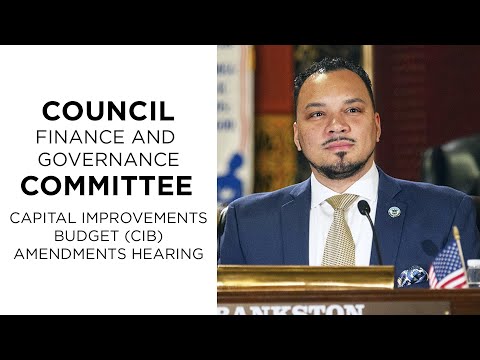
Columbus City Council’s Finance and Governance Committee held its second and final public hearing on the capital improvements budget, hearing direct presentations from external organizations that appear in the mayor’s proposed capital budget and capital improvements program.
Columbus City Council’s Finance and Governance Committee held its second and final public hearing on the capital improvements budget, hearing direct presentations from external organizations that appear in the mayor’s proposed capital budget and capital improvements program. Committee chair Council Member Noelle Bankston said council will advance a set of amendments when it considers the capital improvements budget on Monday.
The hearing matters because the capital budget is being used, in part, to fund nonprofit infrastructure — from museum restoration and historic preservation to new behavioral-health facilities, community clinics and workforce hubs — projects presenters said will expand services and leverage private philanthropy.
Bruce Harkey, president and CEO of Franklin Park Conservatory and Botanical Gardens, asked the committee to support work that the conservatory says will be part of a 25-year “North Star” master plan. Harkey said past city capital investments helped leverage private matching funds and grow the conservatory’s earned revenue; “Every dollar of public support has been matched 2 to 1 by the private sector,” he said. He described restoration of the John F. Wolfe Palm House, a 19th-century glass house, improved ventilation, and a proposed 35,000-square-foot visitor center to sit between the public park and the conservatory. He said the conservatory has completed about $45,000,000 in capital investments since he became CEO in 2007 and reported organizational revenue growth from roughly $4,000,000 to $16,000,000.
Mental-health and youth-care requests featured prominently. Sarah Book and Abby Manley of Buckeye Ranch requested $500,000 to help close the final funding gap for Ohio’s first psychiatric residential treatment facility (PRTF), a project they said has a total cost of $35,000,000 and is backed by $29,000,000 raised to date. “The facility fills a critical gap in our behavioral health continuum,” Book said, and presenters said the PRTF is expected to open in 2025.
Nonprofit co-location and service expansions were another theme. Tony Cunningham, president and CEO of Godman Guild Association, and Elizabeth Martinez, president and CEO of Big Brothers Big Sisters of Central Ohio, described a joint headquarters at 555 Front Street in the Brewery District to link mentorship and workforce programs. They said the shared space will reduce operational costs while expanding coordinated services.
Dress for Success Columbus, represented by interim director of development Summers Hamill and board chair Hillary Sievers, presented a capital campaign and a planned move to a larger Warehouse District location. Sievers said “When a woman steps through the doors at Dress for Success Columbus, the trajectory of her life changes,” and detailed mobile career-center work and partnerships that the nonprofit said will scale with a new facility. Dress for Success’s campaign total is $4,000,000, the presenters said; they asked the city for $750,000 toward renovation and relocation costs.
Lower Lights Health Center said capital support would allow it to expand a Cooper Road location in Northland from a roughly 1,200-square-foot site to an 8,000-square-foot clinic, increasing provider capacity from two to seven and projected annual patients from about 2,100 to more than 7,800. Kate Wilson, director of marketing and development, described the clinic as a federally qualified health center serving uninsured and underinsured residents across multiple Columbus neighborhoods and said the campaign goal for the Northland expansion is $3,000,000 with roughly $988,000 raised so far.
Saint Stephen’s Community House described a $7,000,000 renovation campaign to replace 24 rooftop HVAC units, repair or replace roof sections and refresh interior space after 43 years without major upgrades; presenters said about $5,000,000 has been raised to date and that gym renovations will begin in August using a grant from Nationwide Insurance.
Junior Achievement of Central Ohio President Mike Davis described a $10,000,000 campaign to refurbish and expand a central “lighthouse” facility that serves students across the region. Davis said the organization engaged more than 50,000 students last year across 25 counties and noted Junior Achievement’s work with Columbus City Schools and business partners that help give students early exposure to careers.
Keisha Garrett, chief operating officer of the Columbus Urban League, outlined a $2,000,000 project to modernize the Urban League’s building and technology to expand workforce, entrepreneurship and AI/tech training. Garrett said the league served 1,600 adults in its workforce program last year and runs entrepreneurship supports that helped generate millions in new sales and contracts for small businesses.
The Columbus Historical Society’s Doug Tracy described progress on Engine House Number 6 in Franklinton, a building the society acquired in 2021 for $700,000. He estimated total renovation costs at roughly $2.5 million to $3.5 million and said roughly $900,000 has already been invested in repairs and completed interior rooms; the society plans to open finished first-floor spaces for tours and fundraising before completing work on the front exhibit room and the second floor.
Public comment included testimony from Nate Wilkins, who urged presenters and council to ensure accessibility for residents with disabilities, including Braille signage and automatic doors in renovated facilities. Chair Bankston acknowledged the point and asked Saint Stephen’s staff to follow up with Mr. Wilkins.
Committee chair Bankston closed the hearing by listing the amendments her office will file Monday as council considers the capital improvements budget and program. The proposed amendments include design funding for Freedom Park and Joanne Park ($450,000), design work for Shiller Park Pond ($175,000), a $100,000 purchase for a new police horse trailer, sidewalk design funds for Billingsley Road ($250,000), and $1,000,000 for Star House expansion. She also said council will amend the five-year capital improvements program to reserve $9,000,000 for a pilot participatory budgeting program to be allocated across the city’s nine council districts.
No formal votes were recorded during the hearing; council members and nonprofit leaders said the presentations are part of the mayor’s proposed capital budget and that the council will act on amendments and the CIP at a future meeting.
Looking ahead, the organizations that presented said their projects depend on a mix of private philanthropy, other public funding and timely capital appropriations. Council will consider the amendments and the capital budget during its scheduled meeting on Monday.