Get Full Government Meeting Transcripts, Videos, & Alerts Forever!
Get email alerts on the Vision Zero Traffic Safety topic
No spam. Unsubscribe anytime.
Syracuse committee hears Vision 0 action plan; administration eyes $5 million federal grant and coordinator hire
Summary
City staff presented a draft Vision 0 action plan aimed at eliminating traffic deaths and serious injuries, outlined priority corridors and intersections, and discussed applying for a $5 million Safe Streets for All federal grant that would require a 20% local match.
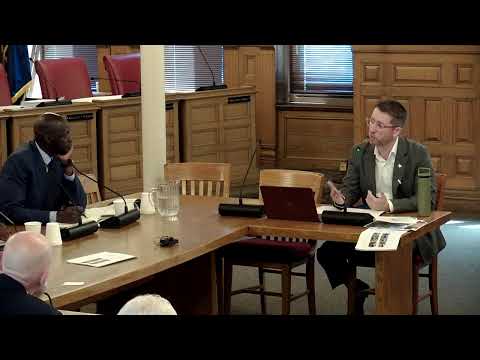
City of Syracuse officials presented a draft Vision 0 action plan to the Department of Public Works committee on Oct. 25, outlining a data-driven strategy to eliminate deaths and serious injuries from traffic crashes and identifying priority locations for engineering, education and enforcement interventions.
"Vision 0 is a commitment to eliminating death and serious injuries from traffic crashes," Connor Muldoon, chief operating officer in Mayor Ben Walsh's office, told the committee. Muldoon said the plan draws on five public meetings and roughly 1,000 public comments collected over about a year of outreach and analysis.
The plan analyzes crash data from 2019–2023 and, according to city staff, found 567 crashes that resulted in fatal or serious injury, 42 fatalities and about 608 people seriously injured over that period. Staff said 25 miles of roadway and 25 intersections—about 6% of city road miles and 1% of intersections—account for roughly half of the city’s fatal and serious crashes, and the draft identifies those locations as priorities for investment.
Muldoon said the plan is intended to combine engineering, education and enforcement strategies and to be incorporated into future road reconstruction and multimodal projects. He and other staff noted the plan may unlock federal and state funding opportunities; in particular the administration discussed applying for a federal Safe Streets for All grant of up to $5,000,000 for design and construction work. That program would require a roughly 20% local match — about $1,000,000 if Syracuse sought the full award — and the city would seek council approval for any local funding and for a formal grant application when brought forward.
Committee members asked about near-term steps if the plan is approved. Muldoon said the administration plans to hire a Vision 0 coordinator, a position included in the Department of Public Works operating budget for the current year; the coordinator would manage implementation, prepare grants and coordinate with partners including the Syracuse Metropolitan Transportation Council and NYSDOT.
The presentation described a toolbox of site-specific engineering fixes (for example daylighting intersections, raised pedestrian crossings and signal timing changes), education efforts in multiple languages, and enforcement approaches including automated school-zone speed cameras and red-light cameras. "It's easier to do a lot of those things than it is to reimagine entire corridors," Neil Burke of DPW said when discussing quick-build and signal-timing changes designed to reduce conflicts.
Council members and attendees raised specific locations they said they wanted prioritized for study and near-term fixes, including Grand Boulevard and Court Street, Hiawatha Boulevard, portions of James Street and Geddes Street, Senator Turnpike at Bridal Avenue, and several North Side corridors where staff said pedestrian activity and freight access create safety concerns. Staff said many of those locations had already been noted in prior studies or TIP projects and that Vision 0 aims to align and standardize safety practices across those efforts.
Committee members pressed on funding uncertainties and timing. Muldoon said the Safe Streets for All grant application is active nationally and that awards can be for the full requested amount or less; he estimated an award decision could arrive in about two months but provided no firm timeline. He emphasized the plan itself is an action plan, not a funding authorization, and that any required legislative approvals for spending, changes to citywide speed limits, or other ordinance changes would come back to the council.
The committee did not record a formal vote on the draft plan during the session. Staff asked for committee approval of the strategy as a citywide framework; several councilors signaled support for hiring a coordinator and moving forward with grant applications, while reserving formal approvals for future legislative items that would obligate local funds.
Members of the public and council asked for continued outreach to biking communities, translated education materials, and attention to school-zone enforcement. Staff said automated enforcement and other technical responses to school-zone safety would be discussed in greater detail at an upcoming special committee meeting.
The committee concluded with staff saying they would provide additional memos and that the administration would bring specific grant application and funding items to the legislative agenda for approval as needed.