Get Full Government Meeting Transcripts, Videos, & Alerts Forever!
Get email alerts on the Property Maintenance topic
No spam. Unsubscribe anytime.
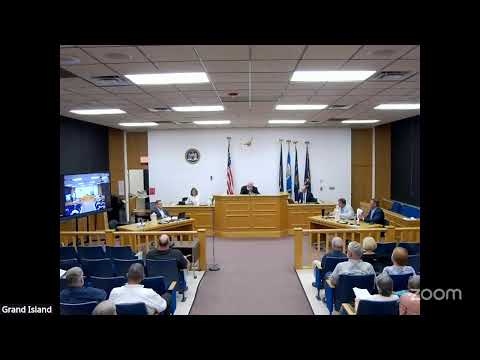
Grand Island board adopts law to speed up enforcement on derelict properties
Summary
The Grand Island Town Board approved Local Law Intro No. 1 of 2025, amending the town's property-maintenance code to create faster administrative enforcement (including a 10-day notice and contractor cleanup billed to property taxes). The action responded to persistent resident complaints about a derelict house at 156 Marlin Drive.
The Grand Island Town Board approved Local Law Intro No. 1 of 2025 to expand the town's property-maintenance code and create administrative remedies for nuisances such as overgrown grass, debris and unsafe structures.
Supporters and multiple residents urged action during the meeting, repeatedly citing an abandoned house at 156 Marlin Drive. Dave Nardozzi, who said he lives at 163 Marlin, told the board, "156 Marlin Drive, which is a derelict property, a zombie property," and described overgrown grass, mold and trash on the lot.
The measure, described by staff as an amendment adding section 2-19 and revising chapters referenced as 323-8, 323-9 and 309-8(c) of the town code, was approved after a modification suggested by "Mr. Godfrey" to include section 323-9 alongside 323-8 to broaden enforcement options. The board moved to approve the local law "as written with the modification that was given from mister Godfrey to include section 323-9 in the section 323-8 to give our enforcement options." A roll-call vote recorded board members voting in the affirmative.
Residents told the board the troubled 156 Marlin property has posed health and safety concerns for years. Jeffrey Jess said water and animal infestations had left the basement unsafe; Mike Heil, a neighbor, estimated the house would require substantial rehabilitation and said he had previously tried to buy it. Lynn Blanchard and other neighbors used the public comment period to urge quicker action.
Town officials and staff described how the new law changes the town's enforcement timeline. The supervisor explained the prior process required longer notices and court proceedings; under the new procedure, officials will issue a notice giving a property owner 10 days to take corrective action. "Now when we go, we make notice they have 10 days to take correction to act corrective action. And once those 10 days have expired, then we hire a company to take that action. We send them a bill. If they don't pay the bill, it goes under taxes," the supervisor said.
Supporters from outside the town encouraged prompt adoption. Mike Balani, who said he serves on an Erie County initiative that targets abandoned or "zombie" properties, told the board, "I urge this honorable body to pass this law tonight," and said Erie County has tools to pursue negligent owners when local efforts are coordinated.
Board members compared the draft to enforcement in nearby municipalities and described the change as adding "tools in the toolbox" for code enforcement. The board recorded its approval in a roll call after discussion and public comment.
Residents who said they had dealt with the specific 156 Marlin property asked the town to move quickly to address current health risks while staff implements the new administrative process. The supervisor acknowledged the health concerns and said staff would begin implementing the new process now that the law is adopted.
The board did not specify an exact timeline for when the first administrative cleanups under the new law will occur; staff said the town would need time to set up procedures and notify property owners. Residents also urged the town to use legal counsel to pursue owners that are difficult to locate.
The town board passed the measure and directed staff to implement the revised enforcement procedures. The board also heard multiple other agenda items and routine motions during the meeting; the property-maintenance law was listed under "unfinished business."