Get Full Government Meeting Transcripts, Videos, & Alerts Forever!
Get email alerts on the Federal Funding topic
No spam. Unsubscribe anytime.
Prince William leaders outline federal shutdown and HR1 impacts on schools, county services
Summary
County and school officials said the federal shutdown and proposed HR1 changes could hit school nutrition, SNAP/WIC benefits, housing and social services funding; county staff provided figures on local federal dependence and urged monitoring.
Prince William County and Prince William County Schools officials told a joint meeting that the federal government shutdown and proposed federal changes labeled in the meeting as “HR1” have the potential to disrupt local services tied to federal funding and workforce pay.
Dave Sinclair, director of the county Office of Management and Budget, briefed both boards on how the federal shutdown that began Oct. 1, 2025, affects programs and payroll. He said mandatory entitlement programs — Social Security, Veterans Affairs, Medicare and Medicaid — continue to pay benefits, but services funded by annual appropriations and many federal contractors face interruptions. "Essential services will continue to function," Sinclair said. "Nonessential services will cease, and employees will be placed on furlough status without pay." He also noted that, if the shutdown persisted into mid-October, some service members could miss scheduled paydays and that back pay is provided by the Government Employee Fair Treatment Act (2019) once government operations resume.
Sinclair gave county-level estimates of federal exposure: roughly 450,000 federal workers in the Washington region and about 31,000 federal employees in Prince William County as of February 2025. He said combined direct federal funding to the county and schools is about $169,000,000, with roughly $92,000,000 to the schools and $77,000,000 to county government. Of the schools’ federal total, Sinclair said about $44,000,000 supports the school lunch and breakfast program (USDA-funded) and about $48,000,000 appears in the schools’ operating budget. On the county side, he said nearly $50,000,000 is in housing and community development funding and about $20,000,000 is in social services funding.
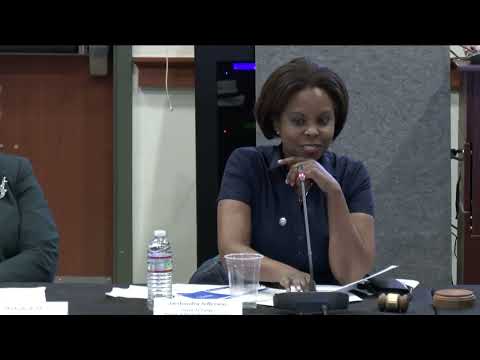
Phyllis Jennings Holt, director of Prince William County Department of Social Services, detailed provisions in HR1 that would change administrative cost sharing for SNAP (food assistance) and add work requirements for certain SNAP and Medicaid recipients. She summarized the local consequences she expects if the provisions are enacted as described in the presentation: Virginia would face a higher administrative match, and localities would share responsibility for reducing payment error rates. "With that 25% match … Virginia is looking at having to cover an additional $90,000,000," Jennings Holt said, referring to the state budgetary exposure discussed in her slides. She said SNAP carryover funds should keep benefits flowing through October but cautioned that WIC funding could be exhausted in the near term if federal appropriations remain paused.
School staff addressed short-term cash-flow risks for nutrition reimbursements and grant reimbursements. Latanya McDade, superintendent of Prince William County Schools, said some Title I and Title II funds were advanced and are likely to be available, but school nutrition reimbursements and other reimbursements rely on timely federal or state processing and could face delays. Shaquille Youssef, chief financial officer for the school division, said the division is monitoring Medicaid billing revenue, which represents a material revenue stream for special education services, and that he would provide an exact revenue figure after the meeting.
County speakers emphasized uncertainty and the need for daily monitoring. Sinclair said agencies sometimes use prior-year appropriations to extend services for a month or two, but continuation is not guaranteed. He told the boards the county’s Office of Management and Budget would continue to track federal updates and report changes.
Ending: County and school leaders said they will continue monitoring federal developments and assess specific program-by-program impacts as details from federal agencies arrive. Officials urged the public to recognize the difference between programs guaranteed to pay (entitlements) and services that depend on annual appropriations and reimbursement timing.