Get Full Government Meeting Transcripts, Videos, & Alerts Forever!
Get email alerts on the Psps Power Shutoffs topic
No spam. Unsubscribe anytime.
Southern California Edison outlines PSPS triggers, customer programs to Villa Park council
Summary
A Southern California Edison official briefed the Villa Park City Council on thresholds and customer resources for Public Safety Power Shutoffs, describing wind-speed baselines, inspection cycles and enrollment programs for medically dependent customers.
Southern California Edison (SCE) government-relations manager Cynthia Quimby told the Villa Park City Council that the utility uses a range of meteorological and operational data to decide whether to implement a Public Safety Power Shutoff (PSPS).
Quimby said PSPS events are triggered after the utility evaluates two key factors: a fire potential index and wind speeds. "In terms of wind speeds, the kind of baseline for the bare overhead wires is 31 miles per hour sustained, 46 mile per hour gusts," she said, adding that covered conductors have higher baselines: "we're looking at wind speeds that are raised at 40 miles per hour sustained, 58 mile per hour gusts." She noted those baselines can be lowered if other conditions — for example, firefighting resources being diverted — make the risk higher.
Quimby described recent circuit work in and near Villa Park: all overhead lines in high-fire areas on one local circuit have been upgraded with covered conductor and annual inspections of high-fire-area assets are complete for the year except for one asset expected to be finished next month. She said the utility continues to evaluate options including additional switching and targeted undergrounding as funding allows.
Why it matters: PSPS decisions can leave customers without power for safety reasons during high-fire-risk weather. Quimby emphasized tools and programs that can reduce harm to vulnerable residents, including notice systems and financial assistance for backup power.
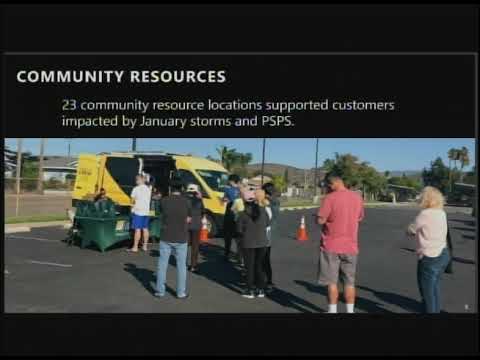
SCE programs and customer steps Quimby urged residents who rely on electrically powered medical equipment to enroll in SCE’s medical baseline program, which provides additional kilowatt-hours at the lowest baseline rate and puts customers on a private list shared with the city emergency manager so welfare checks can be prioritized. She also referenced incentive programs for battery storage (SGIP), rebates for portable power stations, and a critical-care battery-backup program that can cover the full cost of a battery backup for qualifying customers.
Quimby recommended signing up for outage alerts and using SCE’s outage map (sce.com/outage) to see whether an outage is a PSPS event or a repair outage and get estimated restoration information. She said the utility will divert aircraft and additional patrol resources during large events and will increase drone use for post-event patrols.
Council follow-up: The mayor noted the presentation was not agendized for Q&A and suggested council members direct technical questions to Quimby by email; the council agreed the presentation slides would be posted on the city website.
Ending: Quimby concluded the presentation by offering resources and websites for residents and asked council members to contact her with follow-up questions.