Get Full Government Meeting Transcripts, Videos, & Alerts Forever!
Get email alerts on the Manufacturing Workforce And Legislation topic
No spam. Unsubscribe anytime.
Commission hears legislative update and VirginiaWorks briefing on apprenticeships and manufacturing workforce
Summary
Legislative services summarized 2025 bills affecting manufacturing, and VirginiaWorks presented workforce data and strategies to expand registered apprenticeships. Commissioners discussed THC impairment rules for worksites, incentives for apprenticeships, and workforce‑development alignment with economic development plans.
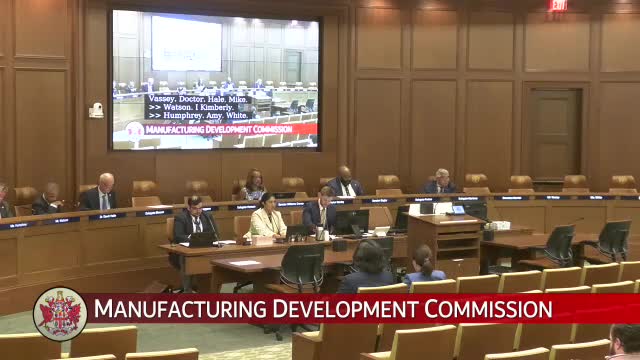
The Manufacturing Development Commission received an update Aug. 20 on 2025 legislation affecting manufacturing and a presentation from VirginiaWorks on the state of the manufacturing workforce, including registered apprenticeship as a talent strategy.
Marvy Ali of Legislative Services reviewed bills the commission had considered and other manufacturing‑related legislation from the 2025 session. He said the commission’s 2024 drafts included proposals on forced and child labor prohibitions in procurement, THC impairment testing for worksites, expanded renewable energy portfolio eligibility and a Virginia Recycling Development Center. Ali identified three enacted bills he considered most relevant to the commission: SB 913 (amending the Virginia Public Procurement Act to prohibit suppliers that use forced or indentured child labor in contracts over $10,000), HB 2024 (prohibiting state and local agencies from excluding U.S.‑made solar photovoltaic materials from procurement), and HB 2179 (amending the Virginia Investment Performance Grant program to allow more flexible awards in distressed localities and to modify prevailing‑wage requirements under specified conditions).
Ali noted some introduced measures affecting manufacturing were not enacted: SB 302 (Virginia First Manufacturing Incentive Program) was left in appropriations; SB 1190 (energy facility review board and local energy plan requirements) did not pass the Senate; HB 1616 (offshore wind workforce development) passed both chambers but was vetoed by the governor; and HB 2510 (THC impairment standards rulemaking) was left in the Labor and Commerce Committee.
A staff member encouraged commissioners to tell Legislative Services if they wanted further discussion or patron outreach on bills that failed so the commission could consider endorsing or inviting patrons to present at future meetings.
Following the legislative update, a representative of VirginiaWorks — the Commonwealth’s workforce agency — described the agency’s services and the state of manufacturing employment. The presenter said VirginiaWorks connects “people to careers and employers to skilled talent” and noted the agency coordinates about 330 state employees across Virginia Career Works centers and local workforce development boards.
The VirginiaWorks representative provided labor data: about 239,500 manufacturing jobs in July 2025, and an average annual pay for private‑sector manufacturers near $75,000 in 2024. The presenter gave a top‑10 list of high‑demand manufacturing occupations (assemblbers and fabricators; first‑line supervisors of production; welders; inspectors and testers; machine operators; bakers; machinists; general production workers; electrical/electronic assemblers; and coating/painting machine operators) and said manufacturing wages in Virginia rose about 32% from 2014 to 2024.
VirginiaWorks highlighted registered apprenticeship as a central work‑based learning model for manufacturing. The presenter said apprenticeship participation in Virginia reached about 13,400 active participants in 2025 and summarized a state return‑on‑investment study finding that “for every dollar that was spent on registered apprenticeship, the Commonwealth gets an additional 3 in tax revenue, and economic output for a net of 4 dollars” over the investment period.
The agency also described the Hired Apprenticeship Fund, created with a federal apprenticeship expansion grant, which provided roughly $283,000 for employer incentives and supports; incentives were roughly $3,000 per apprentice and could cover supplies, equipment and supportive services (transportation, childcare). The presenter said the state provides approximately $2.5 million annually to administer registered apprenticeship programs and that most employer incentives in recent expansion rounds have been federally funded.
Commissioners asked about wages, local variations in prevailing wages, and whether apprenticeship pay is sufficient to attract workers from other sectors. Mike Watson and Delegate Bloxham raised questions about wage comparability, incentives, and employer burdens. The VirginiaWorks representative acknowledged that wages vary by locality and industry, said employers generally find apprenticeships attractive because they combine pay with training and career pathways, and offered to provide follow‑up wage data and the agency’s return‑on‑investment report.
Commissioners also discussed THC impairment standards for manufacturing worksites. Some members supported revisiting HB 2510 or related policy language, noting other states’ approaches could inform Virginia policy. The chair said staff could invite bill patrons to present to the commission if members request follow‑up.
The commission closed by reminding members of a planned retreat in Norfolk on Sept. 16 to visit manufacturers in the Hampton Roads region and to continue workforce‑and‑economic development discussions.