Get Full Government Meeting Transcripts, Videos, & Alerts Forever!
Get email alerts on the Street Sweeping topic
No spam. Unsubscribe anytime.
West Covina council votes to revise street‑sweeping program to alternate‑side schedule
Summary
After weeks of public comment about parking hardship and unclear signage, the West Covina City Council voted 4–0 to instruct staff to pursue an alternate‑side street‑sweeping plan and negotiate a contract amendment with the vendor to implement changes.
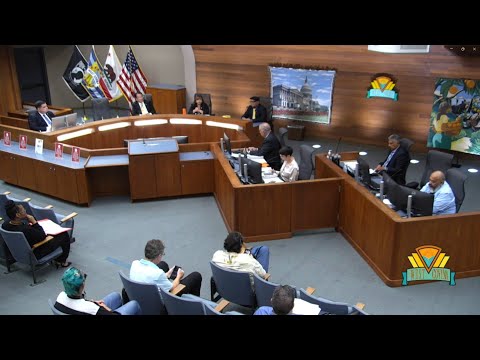
The West Covina City Council on Aug. 5 voted 4–0 to revise the city’s street‑sweeping program to an alternate‑side schedule, after extended public comment about parking access, unclear signage and citations.
City staff presented three options and recommended changing to alternate‑side sweeping to address resident concerns while maintaining air and water quality compliance. "Staff is asking that the city council provide direction on our current street sweeping program," the acting city manager told the council during the presentation.
The council’s action directs the acting city manager to negotiate with the city’s street‑sweeping contractor and return with a contract amendment for council approval. Councilmember Gutierrez moved the motion; Councilwoman Diaz seconded. The roll call showed Councilmembers Cantos, Diaz and Gutierrez and Mayor Wu voting aye; Mayor Pro Tem Lopez Villada was absent.
Why it matters: Residents said the current signs and schedule — which place no‑parking restrictions on both sides of many streets on the same day and often for multi‑hour blocks — leave households with multiple cars without nearby places to park. Several speakers said they must walk blocks to reach their vehicles or received warning citations shortly after the signs and enforcement began.
Public input and staff analysis: At least a dozen speakers during oral communication raised the issue. Residents described driveways that accommodate one or two cars but households with more vehicles, limited alternative parking in cul‑de‑sacs and unclear signage where only one side of a block shows sweep‑day arrows. One speaker suggested following models used in other cities where sweep days alternate by side; another called for clearer signs indicating the “entire block” or arrowed directions.
Staff told the council the city is currently divided into five zones with same‑side sweeping scheduled the day after trash collection; within zones, streets are subdivided into multi‑hour time slots. Areas of high‑density housing already have an “alternate side” approach. Staff estimated the one‑time cost to cover signage modification at about $86,237 (approx. $16.50 per sticker for roughly 5,200 signs) and annual contract increases of about $935,124 to implement alternate‑side sweeping citywide. Staff estimated first‑year implementation costs at just over $1.33 million and an ongoing annual cost of about $1.09 million.
Council discussion and next steps: Councilmembers asked staff about cost offsets, whether lower‑need streets could be swept less frequently, and whether some savings could reduce the contract increase. One councilmember proposed giving staff limited authority to tailor frequency by neighborhood to reduce costs; councilmembers discussed case‑by‑case adjustments versus a citywide approach. Several councilmembers emphasized the program’s goal — cleaner streets — while seeking ways to reduce parking impacts for residents.
The motion approved directs staff to negotiate an amendment with the city’s vendor (identified in staff materials as Nationwide) and return to the council with proposed contract language, updated schedules and implementation costs. Staff said stickers or other custom signage would be used to convert existing signs to the alternate‑side schedule, and that any amended contract will include updated operational routes for the sweeping vendor.
The council did not adopt a narrower, case‑by‑case enforcement moratorium; instead it approved the alternate‑side direction and asked staff to pursue cost‑mitigating measures and report back to council when negotiations are complete.
Community impact and follow up: Staff noted that the city received hundreds of resident contacts about signage and alternate‑side requests; the acting city manager said staff will follow up directly with residents who provided addresses. The council’s direction will require negotiating additional contractor capacity and updating signage before the new schedule can be implemented. Staff estimated the vendor and enforcement changes could take weeks to months to finalize and said cost figures would be refined in the amendment packet that returns to council.
Quotes from speakers are limited to those recorded on the public record: the acting city manager said, "Staff is asking that the city council provide direction on our current street sweeping program." Residents who spoke during oral communications repeatedly urged the council to adopt an alternate‑side schedule so neighbors would have nearby parking on sweep days.
The council’s action is implementation direction rather than a budget appropriation; any contract amendment and related budget changes will return to council for approval.