Get Full Government Meeting Transcripts, Videos, & Alerts Forever!
Get email alerts on the Transportation Funding topic
No spam. Unsubscribe anytime.
Goshen council advances municipal wheel and vehicle excise tax on first reading after public debate
Summary
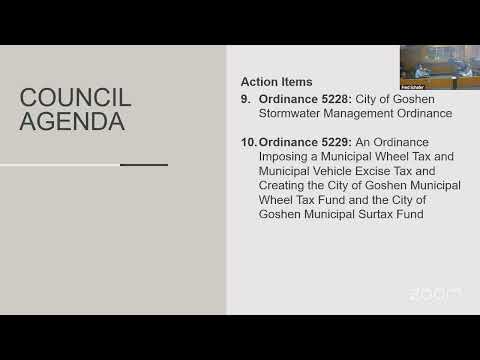
The Goshen Common Council voted 6–1 on first reading July 28 to advance Ordinance 52-29, imposing a $40 annual wheel tax on heavier vehicles and a $25 annual vehicle excise surtax to fund streets and sidewalks and to qualify the city for a new state lane‑mile distribution program.
The Goshen Common Council voted 6–1 on first reading July 28 to advance Ordinance 52-29, a local wheel tax and municipal vehicle excise surtax that would levy $40 annually on heavier vehicles (trailers, certain trucks and RVs) and $25 annually on standard passenger vehicles, with revenues restricted to road and sidewalk work within Goshen.
Mayor Gina, who introduced the measure, called it “the wheels for walks proposal,” saying the ordinance would generate an estimated $750,000 a year dedicated to pothole repair, paving, curb repair and sidewalk maintenance and would make the city eligible for a state lane‑mile distribution created by House Enrolled Act 1461. “Nobody believes that $750,000 is gonna solve a $52,000,000 problem, but it gives us a start,” Mayor Gina said.
Why it matters: the ordinance is intended to create a small, dedicated revenue stream to reduce pressure on the general fund and to preserve Goshen’s eligibility for new state funds tied to locally adopted wheel/excise taxes. Council members and public speakers framed the issue against the backdrop of recent state legislation that reduced local revenues: several commenters and councilors linked the proposal to revenue losses from Senate Bill 1.
Details and debate: proponents said the fee is modest, targeted at vehicle users who create wear on roads and would leverage additional state dollars. Mayor Gina explained the ordinance’s two components and the urgency: the state’s lane‑mile program requires adoption by late August to be effective for the next distribution cycle. “If we don’t adopt, we miss out while other cities have the option to move forward,” she said.
Opponents and concerns included double taxation and fairness. Several speakers — and one councilor who voted no — warned about layering a city levy on top of county wheel taxes and asked whether the county, if it adopts or increases its own wheel tax, would create duplication for local motorists. Public commenters asked how small‑trailers, motorcycles and e‑bikes will be categorized; staff said the state defines registration categories and that the city will follow state categorizations.
Public comment: about a dozen residents addressed the council. Supporters said the tax is small relative to vehicle repair costs caused by deteriorated streets and noted the heavy‑vehicle surcharge better aligns use with cost: “A 9‑ton vehicle exerts over 3,000 times as much wear and tear on a road as a 1‑ton vehicle,” one commenter said in support. Opponents argued the city should first exhaust deeper budget cuts and warned that promised dedicated revenue has in other contexts been shifted; one resident described the annual amount as unlikely to fund meaningful reconstruction.
Vote and next steps: The council used a written roll-call process for first reading. Votes read aloud by the clerk were recorded as: Counselor Reesacker — yes; Counselor Letterock — yes; Counselor Weddle — yes; Counselor Gerber — yes; Counselor Nisley — no; Counselor Peel — yes; Youth advisor Reyes — yes. Because the motion did not receive unanimous consent, the ordinance will return for a second and final reading at the council’s August meeting (scheduled Aug. 25). If passed, the surtax and wheel tax would be collected through state registration processes per the enabling statute and placed in a restricted local fund for street and sidewalk use.
Uncertainties and implementation risks: City staff said the precise amount Goshen would receive from the state lane‑mile distribution is unknown because the state will divide the allocated pool among participating municipalities. The council and members of the public emphasized that the county also may adopt or change its wheel tax, affecting residents’ total bills and the local distribution of funds. Mayor Gina and staff urged residents and officials to press state legislators for clarifying fixes but said delaying adoption risks losing guaranteed state support.
What remains unresolved: how much the state lane‑mile allocation will be, whether the county will change its wheel tax, and whether future county or state action will eliminate or reduce perceived double taxation. The council will take a second reading on Aug. 25.
Ending: First‑reading approval moves the ordinance to the council’s August agenda for the required second and final reading; voters and interested residents can follow the council calendar for the Aug. 25 meeting when the council will take the final vote.