Get Full Government Meeting Transcripts, Videos, & Alerts Forever!
Get email alerts on the State Legislation topic
No spam. Unsubscribe anytime.
Naples council discusses joining lawsuit over Senate Bill 180, narrows 2026 legislative priorities
Summary
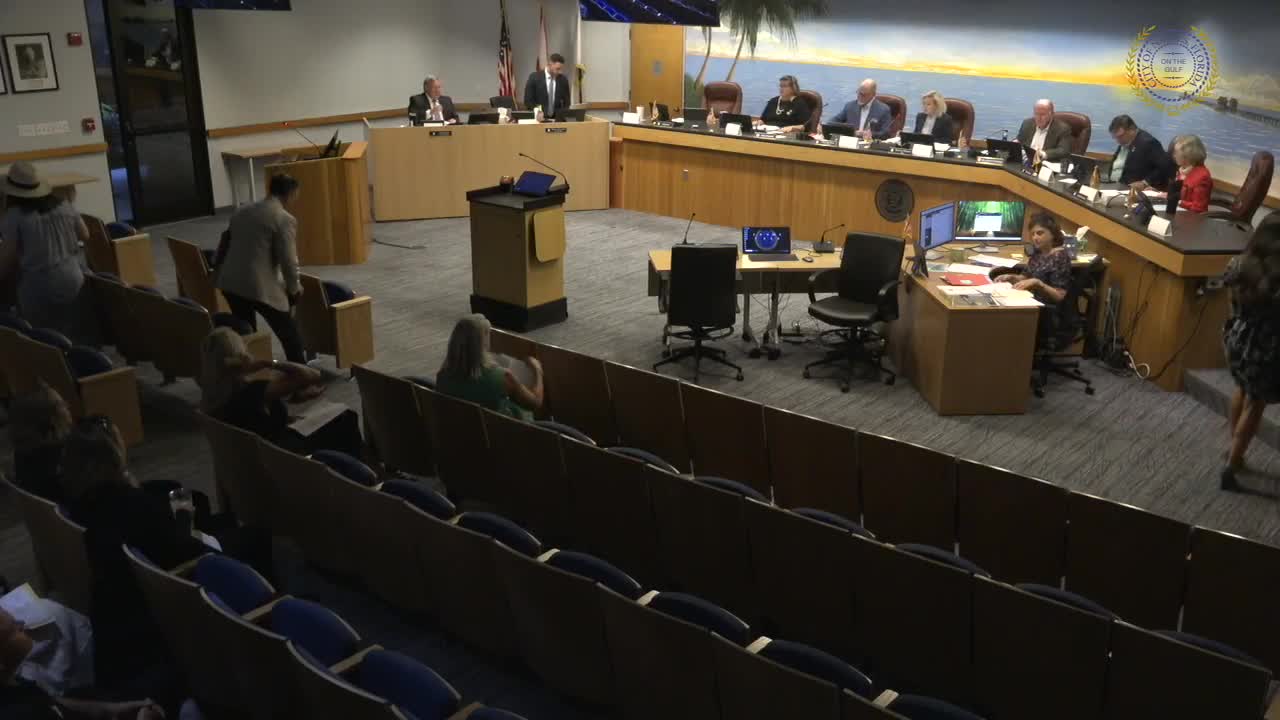
Naples City Council spent its Aug. 20 meeting weighing whether to join a statewide legal challenge to Senate Bill 180 and to sharpen a list of 2026 legislative requests focused on stormwater resiliency, infrastructure and home-rule protections.
Naples city leaders spent much of the Aug. 20 City Council meeting debating whether the city should join a multi-jurisdiction lawsuit seeking to block parts of Senate Bill 180 and setting which infrastructure and funding requests to press in Tallahassee next year.
The discussion followed an extended staff briefing on proposed appropriation requests — including funding for stormwater and resiliency projects, pump-station upgrades and raw-water well replacement — and a review of recent state laws council members said have reduced local control over land use and recovery after storms.
“More and more often we’re seeing decisions that come from Tallahassee and Washington that are overstepping their place,” Mayor Teresa Heitman said in remarks that framed the council’s later conversation on legal and legislative responses. Heitman and others repeatedly urged careful, strategic outreach to legislators while also preserving options for litigation.
City staff and the council’s communications office prepared a short list of priority funding requests for the 2026 session: design and phased construction money for stormwater/resiliency work (including targeted projects in the River Park area), upgrades to the Cove pump station, and replacement wells for raw-water production. Council members asked staff to pare and prioritize the dollar amounts before formal adoption so requests are realistic for the upcoming session.
“From a pure city financial standpoint, where’s our checkbook the healthiest?” Councilman Ray Christman said. He recommended emphasizing resiliency projects in state asks and scaling requests to levels the legislature is likely to fund.
The session also turned to Senate Bill 180, which took effect July 1. Council members described two provisions they called especially worrisome: a one-year limitation on adopting any “more burdensome or restrictive” land-use or building regulations after a named hurricane and a retroactive restriction that already applies to multiple counties for certain prior storm declarations. City staff cautioned the language is broad and legally uncertain, and council members said they want to push back both politically and, if needed, legally.
“We need to have a narrative that explains what the impact of SB 180 is on our community,” Christman said. “We don’t have that narrative yet, and we need to get it together.”
City staff reported a statewide law firm, Weiserota Huffman Cole & Berman, had organized a coalition of local governments and offered to represent municipalities challenging SB 180; the firm requested a modest fee to join the trial-level coalition and additional set sums in the event of appeals. Council members asked city staff and the city attorney to obtain more detail about the lawsuit’s scope, the exact legal targets, and any timing requirements and to report back so the council can decide whether to join. Several members said they favored coordinated action with other cities but wanted legal specifics before committing.
Council members also asked staff to produce clear, short talking points for Florida legislators explaining how property-tax changes or expanded homestead exemptions would cut local revenue and affect public safety, infrastructure and services. Staff said it will return with estimated revenue impacts under several hypothetical homestead-exemption scenarios so councilors — and the public — can understand tradeoffs.
By the end of the meeting councilors agreed the city would continue preparing the legislative packet and follow up with the state delegation and the League of Cities; they also asked for a follow-up workshop and requested the city attorney obtain more detail on the proposed multi-jurisdiction lawsuit before taking a vote on joining.
What’s next: City staff will refine the dollar amounts and priorities for the 2026 session, produce the revenue-impact scenarios tied to homestead changes, and ask the law firm for written detail about the proposed suit so the council can consider a final decision at its next regular meeting.