Get Full Government Meeting Transcripts, Videos, & Alerts Forever!
Get email alerts on the Departmental Budgets topic
No spam. Unsubscribe anytime.
City staff review 21 departmental budgets, highlight Riverwalk repairs, IT contracts and fleet replacements
Summary
Budget presenters detailed proposed funding across 21 departments, including Riverwalk and parking repairs, a $94.6 million technology budget with contract renewals, vehicle and fleet capital for heavy equipment and police, and general fund transfers for debt and resilience projects.
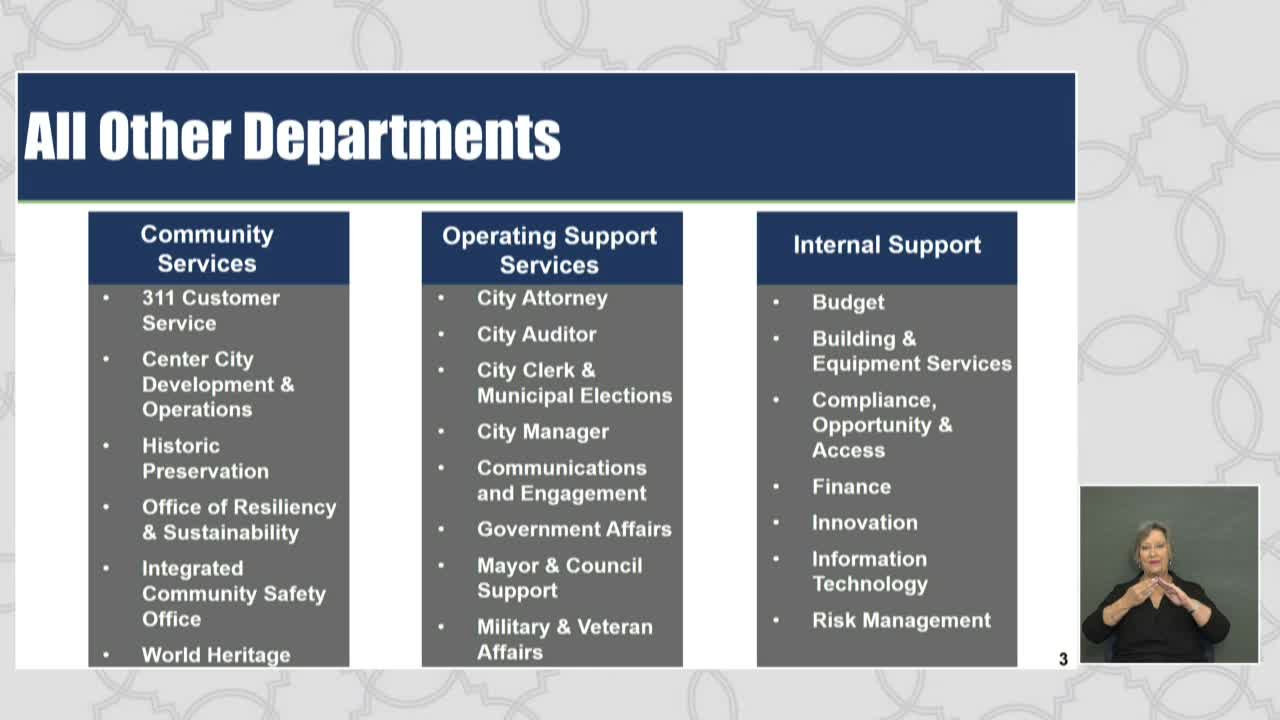
Freddie Martínez, Assistant Director for the City of San Antonio Office of Budget, led a presentation on remaining department budgets on Sept. 10, saying staff would focus on approximately $157.4 million of the proposed FY2026 budget outside internal service funds and highlighting programs and capital needs across 21 departments.
Martínez and departmental directors described funding and operating measures for a range of services: the 311 call center, downtown operations and Market Square, historic preservation, sustainability and resilience, the city attorney and auditor offices, archives and municipal records, communications and government affairs, veterans and military affairs, innovation, information technology, fleet and facilities maintenance, risk management, community services and more.
Staff told the council the 311 operation is budgeting for roughly 1,000,000 calls in FY25–26, with a target response‑rate metric of about 96 percent. Downtown operations and related enterprise funds include multiple sources: staff presented approximately $33.6 million supporting 156 positions, with earmarks for Market Square, Riverwalk and parking; slides called out $2,000,000 for Riverwalk repairs and $800,000 for continued sidewalk improvements in historic parking areas.
The preservation office was shown with about $3.5 million and 22 positions; the Office of Sustainability and Resilience’s proposed budget was presented as about $16.2 million with an implementation program that includes a climate and resilience plan and municipal solar projects, plus capital allocations for shade structures and rooftop work.
The information technology budget was shown at roughly $94.6 million and about 356 positions; staff noted increases in contractual obligations, including renewals with major vendors such as Microsoft and planned upgrades to the computer‑aided dispatch system. Fleet and equipment replacement lists included capital for approximately 555 vehicles and heavy equipment and noted a $9.6 million capital replacement program and a $6,000,000 project for electric vehicle charging infrastructure.
Budget staff described general‑fund transfers and key nonrecurring items: about $2.8 million proposed for payment related to the Edwards Aquifer, $2.4 million for resilience and energy efficiency projects, and assorted maintenance and utility funding for municipal facilities. The archives and municipal records item includes proposed fees for birth and death certificate copies ($22 and $20 respectively) and a $10 search fee, with a forthcoming municipal archives opening described in staff remarks.
Several councilmembers asked department‑specific follow‑ups about service levels, staffing reductions, and how proposed cuts would affect legal compliance and language access. Jennifer Mata, Director of Access, Opportunity and Compliance, told the council her office expects to meet performance measures despite two vacant positions and said staff will continue to monitor language access and disability services.
Councilmembers also raised questions about contractor use for mayoral communications, the Market Square tenant rent forgiveness timeline tied to ongoing construction, and the city’s strategy for pursuing external grant funds and partnerships to supplement local funding for resilience and cultural programs.
No formal votes were recorded on departmental budgets during the session. Budget staff said they would provide additional line‑by‑line detail and totals for identified savings and efficiencies in subsequent materials.