Get Full Government Meeting Transcripts, Videos, & Alerts Forever!
Get email alerts on the Economic Development Loan topic
No spam. Unsubscribe anytime.
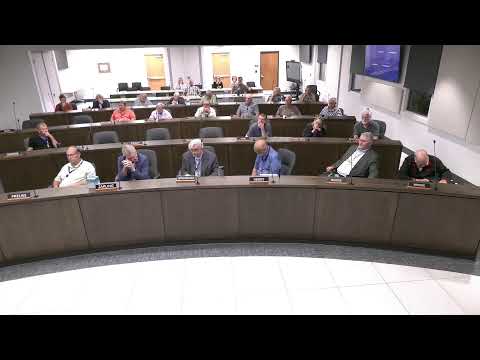
Jefferson County staff brief board on $18 million BCPL pass-through loan request for Ashland Bio energy upgrade
Summary
County staff outlined a proposed $23 million mechanical vapor recompression project at Ashland Bio that would be partly funded by a nearly $5 million Focus on Energy grant and require an $18 million pass-through loan from the state trust fund (BCPL); the matter will go to the finance committee for further due diligence.
At a Jefferson County Board meeting, county staff presented a proposal to apply for an $18,000,000 pass-through loan from the Wisconsin Board of Commissioners of Public Lands (BCPL) to help finance a $23,000,000 energy-efficiency upgrade at Ashland Bio.
Michael Lucky, a county staff member who presented the request, said the project involves installing a mechanical vapor recompression (MVR) system that would capture and re-use waste heat and replace some natural-gas–fired thermal processes with electric-driven compression. Lucky said the company expects the MVR system to cost about $23 million and to yield roughly $24 million in energy savings over 15 years. He said Focus on Energy has offered nearly $5,000,000 in grant support but that Ashland Bio needs the project implemented and operational by December 2026 to meet grant requirements.
The proposal would have Jefferson County apply for an $18,000,000 BCPL state trust fund loan that would be passed through to Ashland Bio; Lucky said BCPL loans may run 2–20 years at roughly 5–6.25% interest and must be structured as general-obligation loans backed by the borrower’s full faith and credit. Lucky said county staff and outside counsel have been working to identify ways to limit county risk and that the county’s finance committee had already directed staff to retain outside counsel for due diligence.
Why it matters: Lucky said the project’s economics are also affected by the federal section 45Z clean fuel production tax credit created by the Inflation Reduction Act. He said rulemaking earlier in the year clarified calculation methodology and that a subsequent extension of the credit lengthened the window of opportunity through 2029. Lucky noted Ashland Bio is an existing ethanol producer in the county and currently employs about 87 full-time workers; he said the MVR project would not create ongoing jobs beyond construction.
Discussion and next steps: Supervisors raised questions about public purpose, the scale of county risk, potential reward, and securitization of assets. Supervisor Kennard asked about the county’s financial exposure and whether the project would create jobs; Lucky replied the project would not add ongoing jobs beyond construction and emphasized energy-efficiency and reductions in natural gas usage. Supervisor Paulson asked whether the tax credits or other assets could be pledged; county staff said Ashland Bio has pledged assets, including the tax credits, to existing lenders and that, under the present proposal, the county could “step in line” with the existing lender and secure a lien on those credits, though county counsel had not found a way to make the county the sole priority lienholder.
Lucky asked board members to forward substantive questions to the finance committee (supervisors Jones, Drana, Jackel, Zahling and Christiansen) and said the finance committee may call a special meeting on short notice; he said the matter would likely return to the full board at the Oct. 14 meeting if the committee recommends moving forward. No formal county board vote was taken at the meeting; the presentation served to ask for feedback and to continue due-diligence work.
Clarifying details from the presentation: the MVR project cost estimate: $23,000,000 (company-provided); Focus on Energy grant estimate: nearly $5,000,000 (county-presented); estimated operational savings: about $24,000,000 over 15 years (company estimate); BCPL loan gap: $18,000,000 (county ask); grant operational deadline: project must be operational by December 2026 to qualify; 45Z tax credit window: extended through 2029 per presenter; current Ashland Bio full-time employees: 87 (presenter). Some technical metrics discussed (e.g., kilograms per MMBtu thresholds used to value 45Z credits) were described as complex and not fully estimated by county staff at the meeting.
Ending: County staff will continue legal and financial due diligence at the finance committee’s direction; board members were asked to channel questions and concerns to the finance committee ahead of any special meeting or the Oct. 14 board agenda so that the committee can evaluate risk-allocation options and potential loan terms.