Get Full Government Meeting Transcripts, Videos, & Alerts Forever!
Get email alerts on the Public Comments Bond topic
No spam. Unsubscribe anytime.
Public commenters urge inclusion of farmland preservation, school‑site reuse and nature‑based solutions in 2026 bond
Summary
Multiple speakers during public comment asked the Task Force to include farmland preservation, reuse of closed school sites as community resilience hubs, and prioritization of nature‑based solutions in the 2026 bond plan.
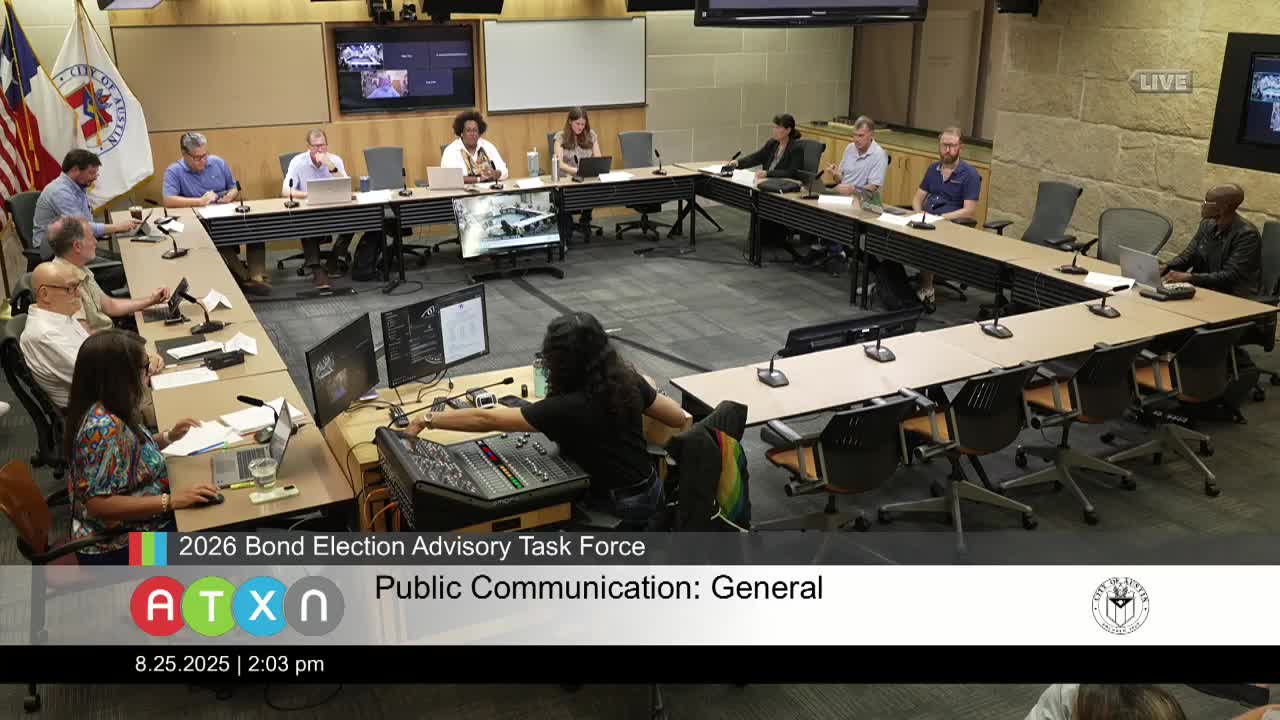
Public commenters at the Bond Election Advisory Task Force meeting urged the Task Force to include farmland preservation, reuse of closed Austin Independent School District sites and nature‑based solutions in the 2026 bond proposal.
Andy Smith, a member of the Austin‑Travis County Food Policy Board, said productive, affordable farmland is the “foundation of any healthy functional food system” and urged the Task Force to include farmland‑preservation projects or conservation easements in the bond package so the city could leverage USDA, NRCS, county and philanthropic funds. Smith cited data in his comments that the Austin region lost over 64,000 acres of farmland between 2007 and 2022 — nearly 25% of the farmland in 2007 — and is losing about 6,000 acres a year to development. "Without that protected farmland, our food system will remain pretty vulnerable," he said.
Speakers representing neighborhoods and the Austin Independent School District also urged using closed school sites as community resources. Jeremy Striffler, Director of Real Estate for Austin ISD, said the district’s underused facilities can be leveraged to provide affordable housing, child and senior care, parks, nonprofit space and other community services. "Austin ISD has served as more than a school system," Striffler said, listing libraries, warming shelters and reunification centers as examples of community functions school sites already provide.
Neighborhood leaders involved in planning for the former Sims Elementary School described a range of local priorities for that site: a community resilience hub, community kitchen and pantry, community garden space, workforce development, energy‑efficiency retrofits and space for health and wellness services. Nadia Barbot, co‑chair of the East MLK contact team, said the community wants the school buildings kept “as much as possible to stay at some semblance of their current shape, and scale, and reuse them where possible.” Alexandria Anderson, chair of the Martin Luther King Neighborhood Association, described using cafeterias and gyms for food distribution, emergency preparedness and community programming.
Marie Camino, with The Nature Conservancy in Texas, asked the Task Force to prioritize nature‑based solutions (NBS) in bond scoring and project implementation. She defined NBS as green infrastructure, low‑impact development and green stormwater infrastructure that can deliver co‑benefits including air and water quality, habitat and climate resilience. Camino referenced Austin’s technical guidance and the 2013 watershed protection ordinance and noted that Travis County and Dallas County have recently included NBS language in their project scoring; she recommended that Austin do the same for bond projects.
Why it matters: Commenters framed farmland and closed school sites as assets that serve multiple city priorities (flood mitigation, food security, small‑business support, community resilience). The Nature Conservancy and other commenters urged the Task Force to make NBS a preference so bond projects leverage public investment to model sustainable practices.
Ending
Task Force members acknowledged comments during the meeting; staff reminded the public that the city continues to accept project ideas on the bond website through the fall.