Get Full Government Meeting Transcripts, Videos, & Alerts Forever!
Get email alerts on the Reinsurance topic
No spam. Unsubscribe anytime.
Reinsurance is insurance for insurers, experts tell Georgia study committee
Summary
Industry representatives told a Georgia House study committee that reinsurance — insurance purchased by insurers — increases capacity and stability for primary carriers and can blunt the financial impact of major storms; committee members and presenters discussed NOAA data, market trends and federal crop reinsurance.
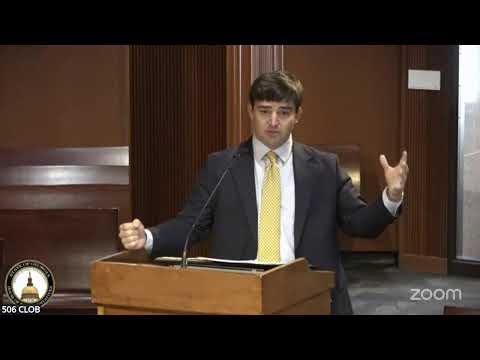
Jason Rudis, a policy representative with the Reinsurance Association of America, told the Georgia House study committee on reinsurance that “the easiest way to think about reinsurance is that it's insurance for insurance companies.” Rudis, a former insurer and legislative staffer, gave a primer on how reinsurance works and outlined how it is used in Georgia.
The presentation explained reinsurance as a business-to-business arrangement: policyholders pay insurers, insurers retain some risk and pay premiums to reinsurers to cede portions of that risk. Rudis described treaty reinsurance, which covers classes or whole books of business, and facultative reinsurance, which can be bought for individual policies or unusual risks. “Reinsurance is b 2 b,” he said, clarifying that it does not interface directly with policyholders.
Rudis told the committee that reinsurance increases an insurer’s capacity and reduces volatility in results. He used a multi-layer example — an insurer retention, a first working layer and higher excess layers — to show how a large claim can be shared so a primary insurer’s out-of-pocket exposure is reduced and the insurer can continue writing new business.
The presentation also included market analytics showing an uptick in the frequency and cost of billion-dollar weather events in Georgia. Rudis cited NOAA data and said the last three years account for a disproportionate share of costs going back to 1980. He noted that tropical cyclones account for a large share of the state’s insured catastrophe costs even though severe convective storms occur more frequently.
On the role of federal programs, Rudis described the federal crop insurance program as a major reinsurance source for crop insurers, saying the federal government reinsures a large share of that line. He warned the committee that losing federal data streams or weather-sensing infrastructure would hamper modeling and pricing: “we're hoping NOAA doesn't go away because it's vital for the insurance industry to maintain that data.”
Rudis offered policy notes for the committee’s consideration: state mitigation grants, fortified-roof programs and other resilience investments used elsewhere, and caution about state-run catastrophe reinsurance funds. He said state-run funds, modeled on health reinsurance programs, can shift costs to policyholders and urged careful design if Georgia explores that route.
Committee members asked how reinsurance pricing affects local premiums and whether losses in other states (for example California wildfires) could raise costs in Georgia. Rudis said reinsurance is usually priced on national books and that effects vary by market structure: “Florida companies ... are heavily reliant on reinsurance because they're lightly capitalized,” he said, noting that reliance on reinsurance can amplify local pricing effects in states with many smaller, in-state carriers.
The committee heard from members representing rural districts and the minority leader of the Georgia House, who asked follow-ups on pricing outlooks and mitigation programs; Rudis said model vendors and insurers use historical data to forecast forward and that modeling firms are the main source of forward-looking risk estimates.
The session was framed as informational; no formal vote or policy text was adopted at this hearing.