Get Full Government Meeting Transcripts, Videos, & Alerts Forever!
Get email alerts on the Business Privilege Tax topic
No spam. Unsubscribe anytime.
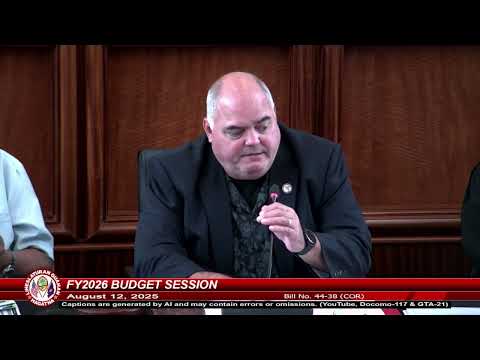
Guam lawmakers debate rollback of business privilege tax and revenue trade-offs
Summary
Lawmakers and administration officials debated a proposed rollback of the Business Privilege Tax (BPT), how different business types are taxed (gross vs. net), and revenue-modeling showing a $40 million–$80 million annual gap depending on rollback level.
Lawmakers at the Committee on General Government Operations and Appropriations heard extended questioning and analysis about Bill 11-38 (the substitute BPT rollback), including how the tax is applied to different business types and how revenue would change under a 4% or 4.5% rate.
The committee’s discussion centered on what businesses are taxed on gross receipts versus net income, and on the projected revenue loss if the BPT is cut from the current 5% rate. Senator Tina Rose Muña Barnes and Senator Mary Perez pressed Department of Revenue and Taxation staff for legal and technical distinctions and for a line-by-line calculation of impacts by taxpayer band.
The administration and DRT officials told the committee that most BPT categories are measured on gross income or gross proceeds of sale (for example: retail sales, services, contractors and professions), while some categories use net income (notably banks and banking institutions). DRT staff summarized statutory language showing banks are taxed on net income with prescribed deductions (salaries, interest, rents, ordinary operating expenses), and that many service, retail, contractor and insurance categories remain measured on gross receipts.
Committee staff and the administration presented revenue-sensitivity modeling. Using the taxable base cited in the hearing, a cut from 5% to 4% across the full taxable base would reduce BPT receipts by roughly $80 million annually on the aggregate figures shown to the committee; a 4.5% rate instead of 5% would lower receipts by about $40 million. For a narrower band (taxpayers with taxable income between $50,000 and $2,000,000) the staff calculation showed a difference of roughly $13 million between 5% and 4% for that segment alone. DRT emphasized the modeling used calendar-year tax bases for quick analysis and recommended further fiscal-year-aligned estimates.
Legislators asked how a BPT rollback would interact with corporate income receipts, noting that a lower BPT could increase reported corporate income and partially offset revenue loss. Officials said those offset effects are possible in principle but require detailed behavioral and timing analysis to quantify. Senator Joe Shumake and others asked the administration to produce a written sensitivity analysis that ties BPT rollback percentages to projected changes in corporate tax receipts and withholding, and to provide it to the committee before additional votes.
No final vote on Bill 11-38 occurred during the hearing; committee members requested additional written analysis and statutory citations before taking further action.
The hearing excerpt: “If we lower BPT from 5 percent to 4.5 or 4 percent, the aggregate loss is in the tens of millions; we need the administration to model offsets and corporate effects,” summarized a committee aide during the Q&A.
Looking ahead, the committee requested that DRT and the Governor’s fiscal office (OFB) deliver an integrated revenue sensitivity report (BPT rollback scenarios, expected corporate-income offsets, and updated withholding/refund projections) to inform any final amendment or vote.
Votes and formal enactment steps on Bill 11-38 were not recorded in the transcript.