Get Full Government Meeting Transcripts, Videos, & Alerts Forever!
Get email alerts on the Opioid Response topic
No spam. Unsubscribe anytime.
Greenville opioid response team details work funded by settlement, warns funding timeline uncertain
Summary
City-funded opioid response team described outreach, Narcan distribution and treatment placements funded through the national opioid settlement; staff said the city has about $2.1 million currently dispersed and must reapply annually for funds.
Autumn, program coordinator for the city’s opioid response team, told the Greenville City Council that the team’s positions and activities are funded through disbursements from the national opioid settlement and must be used for “opioid abatement strategy.”
The presentation described how South Carolina’s share of the national settlement exceeds $360 million and that Greenville’s allocation is 2.27 percent of the state’s portion. Autumn said the city currently has about $2.1 million that has been dispersed for the program and that disbursements have come irregularly; the most recent payment mentioned was $63,000 in April.
The nut graf: council members heard specific program outcomes and operational details designed to show how the settlement funds are being used for outreach, harm reduction and referrals, and why the city must plan for the funds’ uncertain timing.
Autumn said the team began hiring at the end of their first year and divides roles between outreach, data and education. Marley serves as the team’s data analyst and maintains the records system; Bridal Preswell (identified in the presentation as a response specialist) conducts street outreach. Kirby Reinhardt was introduced as the new education and outreach specialist and described as joining from DHEC.
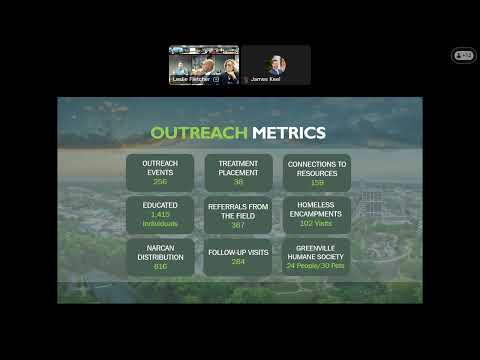
Staff described multiple program activities: community and employer trainings, school outreach, distribution of leave-behind Narcan kits and placement of people into treatment and shelter. Autumn said the team provided 256 outreach events that reached roughly 1,400 individuals. She said the team placed 38 people into withdrawal-management, rehabilitation or sober-living placements and cited 367 referrals from first responders that produced 284 follow-ups and 159 connections to resource services such as transportation, food and employment support.
Autumn described a community-distributor designation that allows the team to hand out naloxone to anyone who requests it. “We’re able to hand out Narcan to anybody who may need it,” she said, and described the kits as containing two doses of Narcan and printed resources.
Council members asked budget and sustainability questions. Council member Dworkin asked whether the city is drawing annually from the state allocation or from a local disbursement; staff explained the city must apply each year to the South Carolina Opioid Recovery Fund and that disbursements have varied in size and timing. Autumn said the team carried roughly $300,000 forward into the most recent application and that overall the city’s share available to apply for over time is about $8 million, but only a portion has been dispersed to date.
Council members also pressed on service delivery details: whether the team serves alternative schools and how the team finds treatment beds. Autumn said outreach began at specific alternative schools through an established connection and that the program will help residents access treatment beds wherever openings exist — in some cases transporting people to out-of-state providers if necessary and coordinating with receiving programs.
Ending: Council members praised the team’s outcomes and asked staff to continue work with budget planners given the irregular disbursements. Staff said the program will continue to apply annually to the state fund and to coordinate with the city’s budget office on multi-year planning.