Get Full Government Meeting Transcripts, Videos, & Alerts Forever!
Get email alerts on the Emergency Medical Services topic
No spam. Unsubscribe anytime.
Weston County residents and officials weigh forming EMS taxing district to fund ambulances
Summary
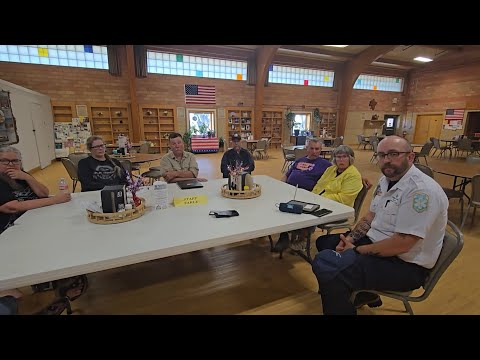
Weston County officials, EMS representatives and residents met in Newcastle to discuss creating an EMS taxing district that could raise local property tax revenue to support ambulance service, equipment and staffing.
Weston County officials, EMS representatives and residents met in Newcastle to discuss creating an EMS taxing district that could raise local property tax revenue to support ambulance service, equipment and staffing. County officials said forming a district would require a Board of County Commissioners’ resolution to create a governance board and would put any mill levy on the ballot for voter approval.
The discussion centered on how an EMS taxing district would work, how much it could raise and whether it would produce enough funding to sustain an ambulance locally. Speakers described a process in which the county forms the district by resolution, appoints an initial board (up to seven members), and the board then places a mill levy question before voters. The levy most often discussed at the meeting was 2 mills, with the legal maximum the speakers said could be taken to voters at up to 4 mills; presenters told attendees that 2 mills on a $100,000 home would be roughly $70 per year.
Brad McKee, who introduced himself as “Brad McKee, shift supervisor for EMS training and education at Campbell County Health,” outlined how Campbell County EMS is approaching the discussion. McKee said Campbell County would likely participate in educating voters and helping with standards if the district proceeds, but he stressed the local board and the voters would decide whether and how much to tax. “I think we’d be pretty actively involved depending on however the commissioners decide to set the board up,” McKee said.
State and local funding opportunities were discussed as partial supplements, but speakers cautioned those sources are limited. Presenters referred to the mineral royalty grant program, SLIB grants, and mechanisms tied to Medicaid and Medicare billing (described in the meeting as the upper payment limit) as possible but uncertain sources. Several speakers also said the legislature has been cautious about providing large new state funding and that reliance on state support could reduce local control.
A number of residents and attendees described personal experiences to explain the urgency. Several speakers recounted long ambulance response times, transfers that require ambulances to remain at the hospital until relief arrives, and the challenge of replacing or acquiring ambulances when private providers sell equipment or withdraw from a community. One attendee described a medical emergency that required a long drive to higher-level care and framed local ambulance availability as a life-or-death concern.
Organizers said a third-party needs assessment by SafeTec Solutions is scheduled to review call volumes, staffing and deployment locations; SafeTec will spend a day in Weston County as part of a three-phase assessment for the region. The assessment’s findings are expected to be delivered one to two months after the site visits, posted on the state EMS website, and could be used to identify whether Weston County requires one paid ambulance with volunteer backup, 1.5 ambulances, or a different configuration.
Speakers noted staffing is a statewide challenge. The meeting highlighted training and recruitment efforts, including Wyoming Department of Workforce Services–supported EMS education and local high-school pathways that have produced hired clinicians in other counties. Presenters said maintaining a pipeline of trained personnel will be necessary even if the district secures funding.
Attendees asked how an EMS district and levy would affect taxpayers, rent and large taxpaying entities. Presenters said property owners would pay the levy when it is approved by voters and acknowledged landlords or large taxpayers would bear a share; they also observed that many large industrial tax contributions do not directly use local ambulance services. Multiple residents voiced opposition to higher taxes but also described strong interest in faster ambulance response times and local coverage.
No formal vote or ordinance was taken at the meeting. Organizers urged continued community education, repeated votes if necessary, and public attendance at future meetings; the group listed an upcoming informational session on August 18 in Upton’s Community Center. Officials recommended that, if the county forms a board, that board would be responsible for further public outreach and for placing a mill-levy question on the ballot for final voter approval.
The meeting closed with organizers encouraging residents to review the upcoming SafeTec assessment and to attend additional informational meetings before any ballot measure is finalized.