Get Full Government Meeting Transcripts, Videos, & Alerts Forever!
Get email alerts on the Higher Education Finance topic
No spam. Unsubscribe anytime.
Advisory committee hears federal updates on short-term Pell, loan limits and data bill
Summary
At its quarterly meeting, the Learning Technology Advisory Committee received a briefing on federal higher-education provisions in the recently passed reconciliation package, proposed changes to student data reporting and timelines for negotiated rulemaking that will affect short-term Pell and institutional accountability.
The Learning Technology Advisory Committee heard a briefing on federal higher-education policies affecting digital and workforce programs, including new short-term Pell provisions, proposed loan limits and the College Transparency Act.
Van Davis, executive director of WCET, briefed the committee on the higher-education components of the reconciliation package he referred to as the "1 big beautiful bill act," and on pending legislation that would link student records to employment data. "Short term Pell, 8 to 15 week programs, 150 to 599 hours, clock hours, by accredited providers," Davis said, summarizing eligibility and program-length requirements built into the package.
Davis told members the short-term Pell provisions were rewritten to limit participation to accredited providers and to require state and U.S. Department of Education approval for programs. He summarized the bill's accountability measures: a 70% completion rate within 150% of the normal time to completion; 70% of graduates placed into jobs within 180 days; and a cost limit tied to a program-specific median value-added earnings calculation. He also said Pell awards under the program would be prorated to program length.
Davis warned that Pell funding is constrained and that expanding eligibility could accelerate drawdown of available Pell dollars. He said negotiated rulemaking will be used to write many implementing regulations and that the Department of Education has created two negotiated-rulemaking committees: one on loan regulation and one, called AHEAD (Accountability and Higher Education through Demand-driven workforce Pell), to address accountability and workforce Pell. Nominations for negotiators are due by Aug. 25, and the AHEAD committee will meet for one week in December and one week in January; Davis said the timeline makes it unlikely the Department will complete full regulations in time for a July 1, 2026 effective date without using an emergency declaration.
Davis also summarized proposed loan changes in the reconciliation package, including elimination of Grad PLUS loans as of July 1, 2026; cap proposals of $100,000 for typical graduate programs and $200,000 for professional programs; and a lifetime federal borrowing cap of $257,500 (excluding Parent PLUS loans). He said new accountability measures would require programs to meet earnings thresholds four years after graduation or risk losing eligibility for federal loans.
On the College Transparency Act, Davis said the bill would direct the National Center for Education Statistics to link student completion records with Bureau of Labor Statistics employment records and to create a public dashboard tracking enrollment, completion and post-collegiate outcomes. "Institutions would need to report student enrollment patterns, progression, completion, post-collegiate outcomes, higher ed costs, and financial aid," he said, while also noting NCES and BLS staffing cuts could limit the agencies' ability to implement such reporting quickly.
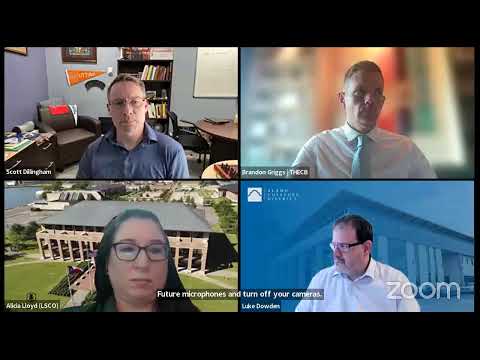
Committee members asked questions after the briefing. Luke Doudna of Alamo Colleges District asked about an "earnings premium" metric; "Is it, is it too late to fix the flaw that's in the metric," he asked, referencing analysis from outside observers. Davis said WCET planned blog posts and further analysis and invited members to follow subsequent guidance and materials.
The committee approved its summary notes from the June meeting during the session. Committee member Luke Doudna moved approval; Janet Camps seconded. The chair declared the summary notes approved unanimously after members confirmed their votes verbally and by reaction due to intermittent video/freeze issues.
Davis encouraged members to consider nominations to the negotiated-rulemaking committees and mentioned WCET will publish blog posts recapping the public hearing and guidance about submitting nominations, plus a separate post about the Department of Education's AI-related public comment window. The committee paused for a brief technical break to switch in-room equipment and planned to reconvene after five minutes.