Get Full Government Meeting Transcripts, Videos, & Alerts Forever!
Get email alerts on the Parks Recreation topic
No spam. Unsubscribe anytime.
Environmental Commission recommends variances for RBI Austin youth complex with restoration and safety conditions
Summary
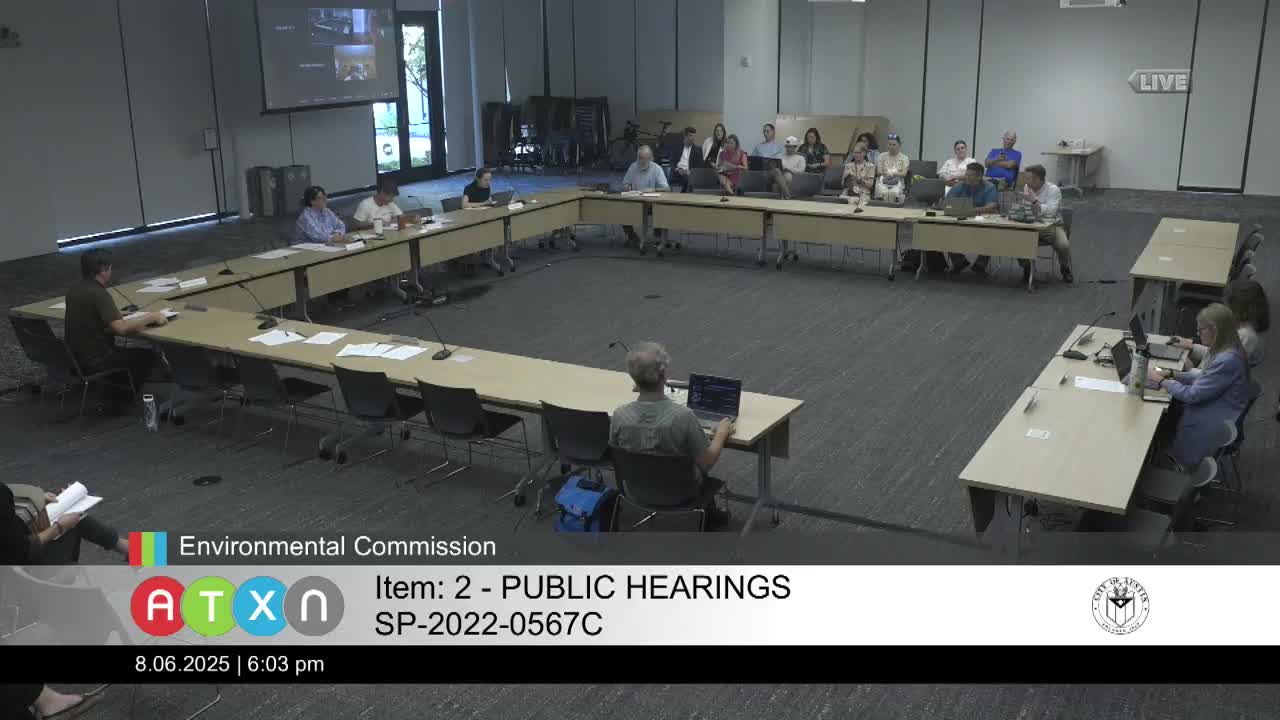
The Austin Environmental Commission on Aug. 6 recommended approval of multiple variances to allow development access across floodplain and critical environmental features for the proposed RBI Austin Youth Development Complex at 7401 Loyola Lane.
The Austin Environmental Commission on Aug. 6 recommended approval of multiple variances to allow development access across floodplain and critical environmental features for the proposed RBI Austin Youth Development Complex at 7401 Loyola Lane.
Staff and the applicant told commissioners the 17.14-acre site in the Walnut Creek watershed contains wetland critical environmental features, a hazardous pipeline easement, and a heritage tree that constrain vehicle access to the southern tract. The requested variances would allow limited cut and fill (up to 8 feet) for a bridge/driveway, and modifications to portions of floodplain and critical water quality zone so RBI can construct baseball/softball fields, a small building with indoor space and associated parking and stormwater controls.
The commission’s recommendation follows staff findings and a package of mitigation and restoration measures that staff said meet the code requirements. Those staff conditions, read into the record by the chair at the conclusion of the public hearing, include: providing 1.55 acres of floodplain restoration, 4.3 acres of floodplain mitigation, placing 4.7 acres of floodplain and 3.8 acres of environmentally sensitive land into a conservation easement, providing 0.63 acres of wildflower meadow and detention‑pond mitigation, an additional 0.62 acres of restoration within the conservation easement outside the floodplain, and paying $312,625.84 into the riparian zone mitigation fund.
Why it matters: the site sits inside the city’s Walnut Creek watershed and includes both critical environmental features and floodplain. The commission’s recommendation adds conditions intended to expand long‑term habitat and reduce water‑quality impacts while allowing RBI to establish a permanent home for its youth programs.
Key project details and mitigations - Site: 17.14 acres at 7401 Loyola Lane in the Walnut Creek watershed (suburban classification). - Proposed program: one indoor headquarters building, a covered turf field, one outdoor ball field, parking, access driveway/bridge and three detention ponds. The applicant described the project as RBI’s permanent hub for mentoring and year‑round athletic programming. - Floodplain/bridge: the applicant and staff said the driveway/bridge will remain elevated above the 500‑year flood elevation and the habitable building floor is roughly 17.5 feet above the 500‑year water surface elevation. - Impervious cover: staff backup materials list total impervious cover at about 31% for the proposed development. - Restoration/mitigation offered: 1.55 acres floodplain restoration; 4.3 acres floodplain mitigation; 0.63 acres of wildflower meadow associated with detention ponds; additional 0.62 acres of restoration within the conservation easement outside the floodplain; conservation easement acreage covering 4.7 acres of floodplain and 3.8 acres of environmentally sensitive land; and payment of $312,625.84 into the city’s riparian mitigation fund. - Trees and planting: staff and Watershed staff described high‑density planting of bare‑root seedlings in portions of the eastern tract to accelerate canopy recovery; Watershed staff estimated roughly 10% survival for bare‑root seedlings without irrigation but said canopy targets drive the restoration approach.
Public engagement and applicant statements Applicant representative Amanda Swore (Renner Group) thanked staff for a multiyear review and said the complex will give RBI (Reviving Baseball in Inner Cities) a permanent home for year‑round programming. Matt Price, RBI’s executive director, said RBI served about 1,600 children in 2024 across roughly 20 sites and that the Loyola site would function as a hub while RBI continues neighborhood programming at other facilities.
Commissioners’ concerns and staff responses Commissioners asked repeatedly about flood risk and emergency access, lighting and dark‑sky compliance, the longevity and monitoring of restoration plantings, heritage trees, artificial turf and potential water‑quality impacts from turf infill materials (PFAS, metals, microplastics). Staff and applicant responses included: - Flooding/data: Watershed staff said the small tributary is “flashy,” with limited local gauge data; engineers said the bridge will remain elevated above modeled 100‑ and 500‑year elevations and detention ponds are sized to capture the 100‑year event modeled for the site. - Restoration monitoring: staff said environmental inspectors review plantings before certificates of occupancy; staff acknowledged there is not a long‑term standardized monitoring program that automatically returns years later but said restoration standards account for some initial die‑off. - Turf and water quality: Development Services staff noted artificial turf is treated as impervious cover under the LDC and that required water‑quality treatment (biofiltration/ponds) would apply to runoff from turf as it would to parking or buildings; Watershed staff explained that some infill materials (recycled rubber) present higher metal and chemical risks while alternative infill (coir, gravel) and modern PFAS‑free products are options and that ponds will capture larger particulates, though existing stormwater control measures are not designed to remove PFAS.
Commission action and vote Chair Elizabeth Bridal moved the commission’s recommendation to approve the variances with staff conditions and to add three environmental‑commission conditions: (1) dark‑sky lighting for outdoor sports with an automatic shutoff at 10 p.m.; (2) measures to reduce leaching from the field via retention and water‑quality ponds; and (3) use of a Blackland Prairie seed mix along the roadway for restoration. Commissioners then added an amendment requiring an emergency‑evacuation plan, written with “special attention given to folks who require ADA accessibility.” The motion passed on a show‑of‑hands vote: tally recorded in the meeting as 8 in favor, 1 opposed (Krueger). No other individual votes were recorded by name in the transcript.
What the commission did not decide tonight The commission’s action was a recommendation on the environmental variances; the site development and building permits, design details for artificial turf or specific plant palettes, and long‑term monitoring protocols will be addressed during subsequent permit reviews. Commission members discussed but did not require a permanent formal long‑term monitoring program beyond the standard inspection regime prior to certificate of occupancy.
Next steps The Environmental Commission’s recommendation will be part of the project record for the Development Services review and any further environmental variances or site‑plan approvals. The applicant will move forward with final design and permitting, and staff will enforce conditions through permit review and the environmental inspection process.
Ending: The commission’s recommendation attempts to balance RBI’s request for access to a constrained site with additional habitat restoration and public‑safety steps; it preserves staff mitigation requirements while adding dark‑sky, restoration, water‑quality and evacuation conditions the commission judged necessary for community safety and ecological protection.