Get Full Government Meeting Transcripts, Videos, & Alerts Forever!
Get email alerts on the Historic District Designation topic
No spam. Unsubscribe anytime.
Commission recommends permanent designation for South Superior ‘Publer’s Cottages’ district; moves to zoning committee
Summary
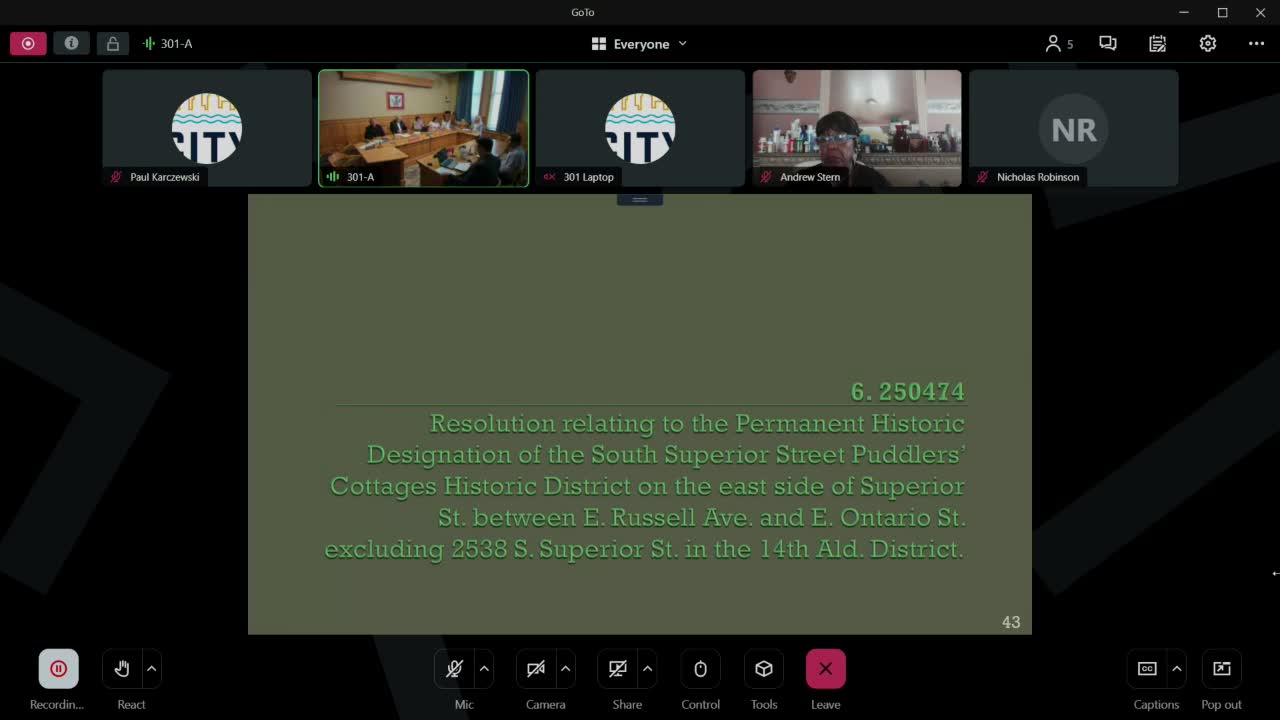
After a public hearing with mixed public testimony, the Historic Preservation Commission voted 6–1 to recommend permanent historic designation for the South Superior Street (Publer’s Cottages) district and will forward the recommendation to the zoning committee.
The Historic Preservation Commission voted 6–1 Monday to recommend permanent historic designation for the South Superior Street “Publer’s Cottages” Historic District on the East Side, covering the east side of the 2500 block of South Superior Street (excluding 2538 South Superior). The commission’s recommendation advances the nomination to the Common Council zoning committee for further review.
Staff presented a detailed historical overview: the cottages were developed beginning in the late 1860s and were associated with the Milwaukee Iron Company as worker housing (puddlers), and the staff report cited architectural and historic factors supporting designation. The nomination includes eight cottages and one nineteenth‑century barn structure; the staff noted several properties have had investment and the new construction now under way will proceed regardless of designation.
The public hearing drew several residents who said they care for and maintain the cottages but voiced concerns about potential costs and restrictions for owners. Jeffrey Reinbold of 2508 S. Superior questioned the impact of designation on homeowners and said owners had modernized houses to make them livable. Joe Patrick, who said he had once tried to buy a vacant lot in the block, described historical lot and zoning complexities. Other speakers — including neighborhood nonprofit representatives — expressed opposition citing affordability concerns, the presence of rooming houses and the expense of compliance.
Staff said the nomination includes customized design guidelines that will allow existing siding to be replaced in kind and intends to balance preservation with owner needs. Commissioners stressed their role at this stage is to decide whether the district meets designation criteria (not zoning or affordability tradeoffs) and adopted the recommendation based on three criteria: identification with persons who shaped the city’s development, embodiment of architectural characteristics, and association with works by notable architects.
The motion to recommend designation passed on a 6–1 vote and will be transmitted to the Zoning, Neighborhoods and Development Committee and then, if approved there, to the full Common Council. The staff report addresses potential effects on low- and moderate‑income housing and includes design guidelines tailored to the district.