Get Full Government Meeting Transcripts, Videos, & Alerts Forever!
Get email alerts on the City Budget Millage topic
No spam. Unsubscribe anytime.
Melbourne council sets maximum proposed millage, directs staff on capital priorities
Summary
City Council reviewed the proposed fiscal year 2026 budget, discussed capital priorities including downtown pedestrian bridge and Holmes Park, and set a maximum tentative operating millage to appear on August TRIM notices; council also adopted the proposed debt-service millage.
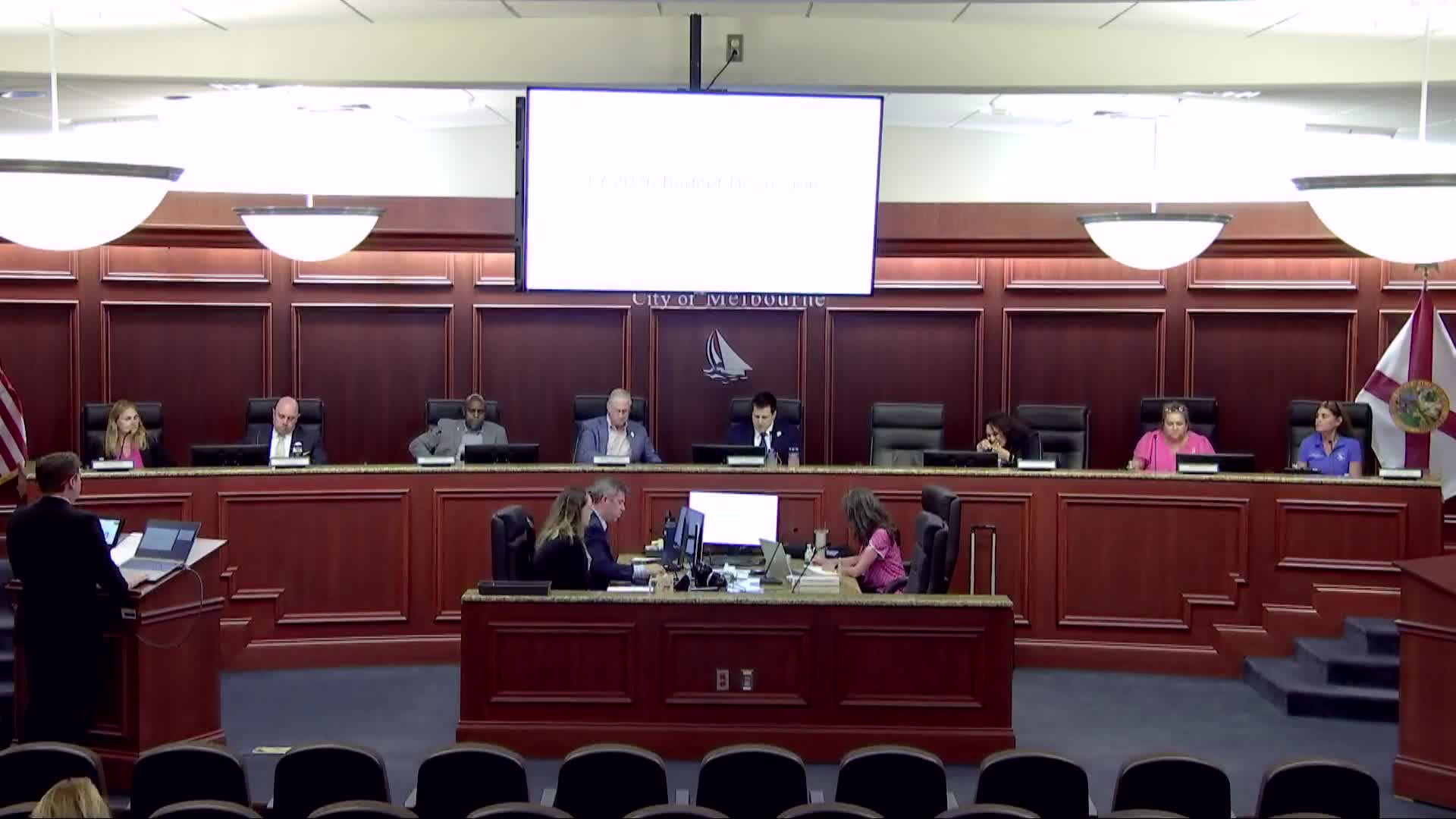
Melbourne City Council on July 28 reviewed the proposed fiscal year 2026 budget, heard public comment on infrastructure needs and downtown projects, and set a maximum tentative operating millage rate to appear on August TRIM notices while adopting the separate proposed debt-service millage.
The council, at the end of a roughly two-hour workshop presentation by budget staff, signaled consensus to publish the highest of the presented millage options (the “two‑thirds” maximum option), and then voted to adopt the debt-service millage shown in the budget packet. Ross, the city budget presenter, told the council: “The current rate right now is 6.5466. The rollback millage ... is 6.2927. And the proposed millage rate in the book before you ... is 6.6703.” Councilmembers discussed alternatives that would raise more revenue to address roads, deferred machinery and equipment, and other capital needs.
The discussion focused on tradeoffs between maintaining current services and accelerating deferred capital projects. Ross said the draft 2026 general fund budget before council is $120,669,439, up about 6.69% from the 2025 adopted general fund of $113,101,347; the total proposed 2026 budget across all funds is approximately $266,907,000. Staff highlighted main cost drivers: employee compensation increases (including a 6% COLA for one bargaining unit and a 9% COLA for the fire contract), a projected 12% medical insurance increase factored into health insurance lines, and deferred machinery and equipment spending of about $1,350,000.
Council members asked staff for options that tie recurring pavement funding to a percentage of property-tax revenue and for more detail on line items that could be reduced or reallocated. Several members recommended directing additional millage revenue toward roads and the capital improvement program (CIP). Ross presented six millage options that trade off operating vs. additional CIP funding; the most expansive option (the maximum two‑thirds rate presented) would increase the median single‑family home’s city operating tax bill by about $116.77 annually, compared with a $46.83 increase under the budget as presented in the book.
Council also debated whether to remove a long‑standing downtown CRA pedestrian‑bridge project (Crane Creek pedestrian bridge) from near‑term funding and instead repurpose the current $440,000 in CRA fund balance toward Holmes Park or downtown streetscape design. Council directed staff to keep the pedestrian‑bridge project on the CIP list (so it remains visible) but to return with a specific budget adjustment or resolution that would reallocate the currently earmarked CRA fund balance to accelerate Holmes Park design and related downtown priorities if council approves that transfer in a future budget adjustment.
Other discussion items included smaller operating line items such as the council’s training and education budget ($15,000), which some members proposed trimming and moving to contingency if needed. Staff explained that unspent operating funds roll to fund balance and that fund‑balance policy prioritizes one‑time capital uses rather than recurring costs. Ross also previewed utility rate work: the 2026 draft anticipates a roughly 10.5% water increase and about a 7% sewer increase to cover operating and regulatory costs; staff said a water‑rate consultant will present formal findings in August.
Public comment emphasized infrastructure needs. Jeremy Hancock urged the council to consider new revenue options and regional surtaxes to address roads and anticipated growth tied to missions at Patrick Space Force Base. Mark Herndine urged preservation of the pedestrian-bridge project and faster pursuit of grants and property acquisitions for linear‑park connections to downtown.
On formal actions, council took two votes related to the tax rates. Vice Mayor Newman called for adoption of the operating millage at the maximum two‑thirds option presented; Councilmember Hanley moved to adopt the higher operating millage rate shown for the maximum option and Councilmember Bassett seconded. The council then voted to adopt the proposed debt‑service millage as presented in the packet; that motion was seconded by Councilmember LaRusso. Both measures passed on council voice votes; staff recorded that a nay vote was voiced during the operating‑millage voice vote but the motion carried.
Staff said the adoption tonight establishes the tentative millage rates for the TRIM notices mailed in August; council can lower the rate at the required public hearings in September but cannot increase it above the published tentative level. Ross and finance staff will return with budget adjustments and the water/sewer consultant presentation at upcoming meetings and will prepare specific CIP reallocation proposals per council direction.
Looking ahead, council members asked staff to prepare: (1) a list of line‑item reductions and options for reallocating funding into contingency or CIP; (2) a formal proposal to accelerate Holmes Park design if council confirms reallocation of CRA fund balance; and (3) a CIP prioritization memo that shows the consequences and timing for projects such as the Crane Creek pedestrian bridge, Linear Park parcels, and pavement management funding.