
Tennessee textbook commission approves Schedule E scores, sets appeals deadline and hears CTE concerns
Get AI-powered insights, summaries, and transcripts
Sign Up Free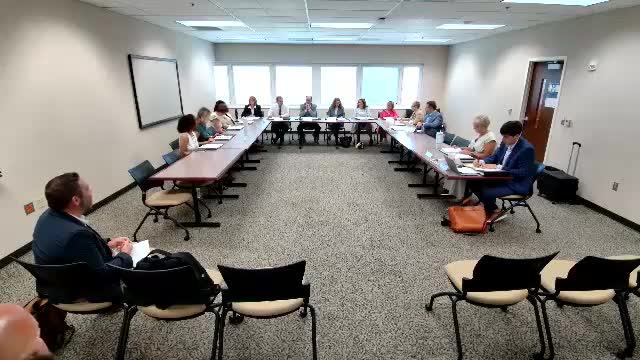
Summary
The Tennessee Textbook and Instructional Materials Quality Commission approved preliminary Schedule E advisory-panel scores, set an Aug. 21 deadline for publisher appeals and approved the Schedule F (social studies) adoption timeline at its July 30 meeting in Murfreesboro.
The Tennessee Textbook and Instructional Materials Quality Commission approved preliminary advisory-panel scores for Schedule E instructional materials, set an appeals process and timeline for publishers, and approved the Schedule F textbook-adoption calendar during a July 30, 2025 meeting at the MTSU Library in Murfreesboro.
The commission voted, by roll call, to accept the Schedule E advisory-panel scoring report and later approved the Schedule F adoption timeline. Lee Houston, director of the Textbook Commission, told the panel the Schedule E review covered two Career and Technical Education (CTE) sections in this round and that advisory reviewers underwent a two‑day training before scoring materials under state guidance.
Why it matters: the actions determine which instructional materials advance to the formal adoption process and set the timetable and procedures publishers must follow to appeal failing reviews. Publishers that did not pass the initial review will receive written reviewer analyses and may submit revised materials for the commission to reconsider.
Houston summarized the appeals process and deadlines: each publisher whose materials failed will receive detailed reviewer feedback; revised materials and any request to speak at the Sept. 12, 2025 commission meeting must be submitted to tennessetextbook@tn.gov by 4:00 p.m. Central on Aug. 21, 2025. Publishers granted a hearing may present for 10 minutes (30 minutes for multi‑band appeals) followed by a 15‑minute Q&A; the commission will deliberate 15–30 minutes before deciding.
Commission staff and department content experts presented and discussed the rubric for social studies (Schedule F). Michael Bradburn, senior director of secondary literacy, humanities and student opportunities for the Tennessee Department of Education, explained that the social-studies rubrics use the same 0–2 scoring scale as other content areas, that 100% alignment with grade/course standards functions as a gateway, and that social‑studies practices and accessibility features are explicit rubric components. Rebecca Reed, the department’s K–12 social studies manager, was cited as the staff lead who developed the draft rubrics.
Several commissioners asked how the state standards are developed and where legal compliance appears in the review. Bradburn and other department staff explained the State Board of Education develops standards through public feedback cycles and produces a crosswalk showing where content shifted between grade bands. Commissioners and staff agreed to make training and rubric language clearer about reviewers’ responsibilities for flagging materials that might conflict with Tennessee legal requirements; the commission directed staff to provide the training materials and to consider adding an explicit indicator or guidance to the rubric so reviewers can identify potential legal issues.
CTE materials returned to the adoption cycle for the first time in years; Daniel Aldridge, director of career and technical education, thanked commissioners for re‑including CTE and described advisory committees that include secondary, postsecondary and industry professionals. Commissioners and CTE leaders discussed whether the requirement that textbooks address 100% of course standards remains feasible for CTE subjects. Several commissioners and CTE directors said many CTE courses lack commercially published textbooks that fully meet Tennessee standards and suggested considering lower thresholds (for example, 75–80%) or other accommodations while preserving instructional quality.
Houston read aloud the preliminary pass/fail outcomes for CTE items and related titles. Several publishers and titles passed (for example, CodeHS resources for some computer science bands and Goodheart‑Wilcox titles for machining and robotics were listed by staff as passing), while numerous CTE submissions failed the initial review or had no submissions. Staff emphasized that failing publishers receive detailed rubrics indicating which indicators to correct and that many failures may be remediable by revision and resubmission before the Aug. 21 deadline.
Votes at a glance: - Approval of agenda (voice vote): agenda adopted by unanimous voice vote. - Approval of minutes (March 13, 2025) (roll call): motion passed; roll call recorded ayes from commissioners present. - Approval of Schedule E advisory‑panel scoring report (roll call): motion passed; roll call recorded ayes from commissioners present. - Approval of Schedule F (social studies) textbook‑adoption timeline (roll call): motion passed; roll call recorded ayes from commissioners present.
The commission confirmed its next meeting for Sept. 12, 2025 at 10:00 a.m. at the MTSU Library; that meeting will include appeals hearings for Schedule E materials. Houston and department staff said they will email detailed reviewer feedback and appeal instructions to publishers and will circulate rubric and training materials to the commission before the next cycle.
The meeting record shows commissioners asked staff to: (1) clarify where legal‑compliance checks and “prohibited concepts” guidance appear in reviewer training and rubric language; (2) follow up with local CTE directors to assess a realistic standards‑coverage threshold for CTE textbooks; and (3) share state standards and crosswalk documents with commissioners before the next rubric review. The session included extended discussion of the CTE results and how to help publishers and teachers obtain usable, standards‑aligned materials.
Looking ahead, the commission expects to review revised submissions after Aug. 21 and to consider any publisher appeals on Sept. 12. Staff said materials that pass on resubmission will be notified by email and may withdraw a request to speak if they choose not to appear in person.