Get Full Government Meeting Transcripts, Videos, & Alerts Forever!
Get email alerts on the Affordable Housing And Open Space Bond Projects topic
No spam. Unsubscribe anytime.
Buncombe County committee hears bond project updates, directs staff to clarify annual report and dashboard
Summary
The Buncombe County bond oversight committee on Tuesday heard updates from staff about the status of general-obligation bond projects for affordable housing and open space, was told roughly $14.9 million in bonds has been issued to date, and directed staff to revise the committee’s annual report and dashboard to show clearer data definitions and a simple table of bond issuance.
The Buncombe County bond oversight committee on Tuesday heard updates from staff about the status of general-obligation bond projects for affordable housing and open space, was told roughly $14.9 million in bonds has been issued to date, and directed staff to revise the committee’s annual report and dashboard to show clearer data definitions and a simple table of bond issuance.
Committee members were given project-level updates for several affordable housing developments — Laurelwood, Lakeshore Villas and Maryville — and for a list of planned open-space and passive recreation projects, including Redwood Commons and Rocky River Apartments. Rachel Sawyer, strategic partnerships director, said the county’s data sources include FEMA damage assessments and a recent housing needs and capacity assessment (the OAN report), and that staff are using those to update supply-and-demand assumptions after recent storm damage.
Why it matters: Committee members said members of the public and county leaders need clear, consistent figures showing what money is budgeted, what is contractually committed and what has actually been issued or spent. Staff agreed to add definitions and an issuance table to the dashboard and to make clarifying edits to the annual report before returning it for a formal vote.
Most project money has not been spent yet, staff said. Jennifer Harrison, speaking about conservation easements, said, “the money had been allocated, just not spent, because it just takes, anywhere from 1 to 3 years to close a conservation easement. The transactions happen at closing for the most part.” That timetable contrasts with affordable housing projects, which typically draw bond funds progressively as construction milestones are met.
Staff gave additional budget and schedule details: the county has issued approximately $14.9 million in bonds so far; debt-issuance costs for that tranche are in the low hundreds of thousands of dollars; Lakeshore Villas is the furthest along in construction and has been drawing county funds first; Laurelwood closed recently and has 140 units; some projects — notably Redwood Commons — still have financing gaps and are therefore more tenuous. Staff told the committee that bonds must be issued by 2029 (the Local Government Commission review and issuance deadline described by staff), and that typical project timelines run about two to three years from start to finish.
Staff and committee members discussed the dashboard that the county uses to show project and bond activity. Committee members asked for three distinct data points to be shown for each funding category: a) budgeted/allocated (the amount the board has approved or budgeted for a project), b) obligated/contracted (amounts encumbered via contract), and c) spent (actual disbursements). Committee members recommended adding a short glossary on the dashboard that defines those terms and a clear table listing how much bond principal has actually been sold.
Other funding and program details discussed: staff said Lakeshore Villas received ARPA and other local funds and that the county has about $380,000 in returned allocation that is now available for reallocation. Committee members asked about unit mixes and affordability targets; Sawyer said contracts will specify unit counts and income-targeted rents, and that county structure generally secures a 20-year period of affordability for projects (some tax-credit structures require longer affordability periods).
Next steps directed by the committee included: staff will 1) revise the annual report to correct tenses and to call out implementation challenges (for example, the length of time to close conservation easements and storm-related impacts on scope and cost), 2) add a simple bond-issuance table and clear definitions (budgeted/allocated, obligated/contracted, spent) to the dashboard, 3) reconcile a numeric discrepancy in the open-space table so the pages total consistently, and 4) schedule a short special meeting within about a month for the committee to review and vote on the revised annual report.
Votes at a glance
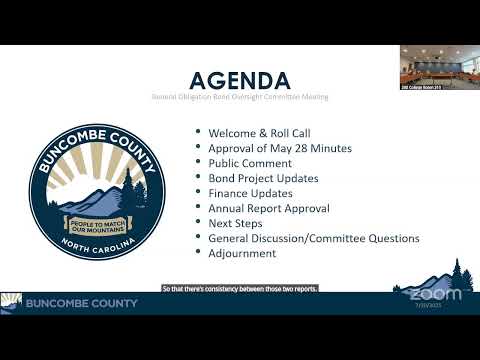
- Minutes of the May 28 meeting — approved (no mover/second or roll-call tally recorded in the transcript).
Ending: Committee members and staff agreed to return the updated annual report and dashboard to the committee for final review and a narrowly noticed special meeting so the committee can vote on the final annual report before it is forwarded to the Board of Commissioners.