Get Full Government Meeting Transcripts, Videos, & Alerts Forever!
Get email alerts on the Land Use topic
No spam. Unsubscribe anytime.
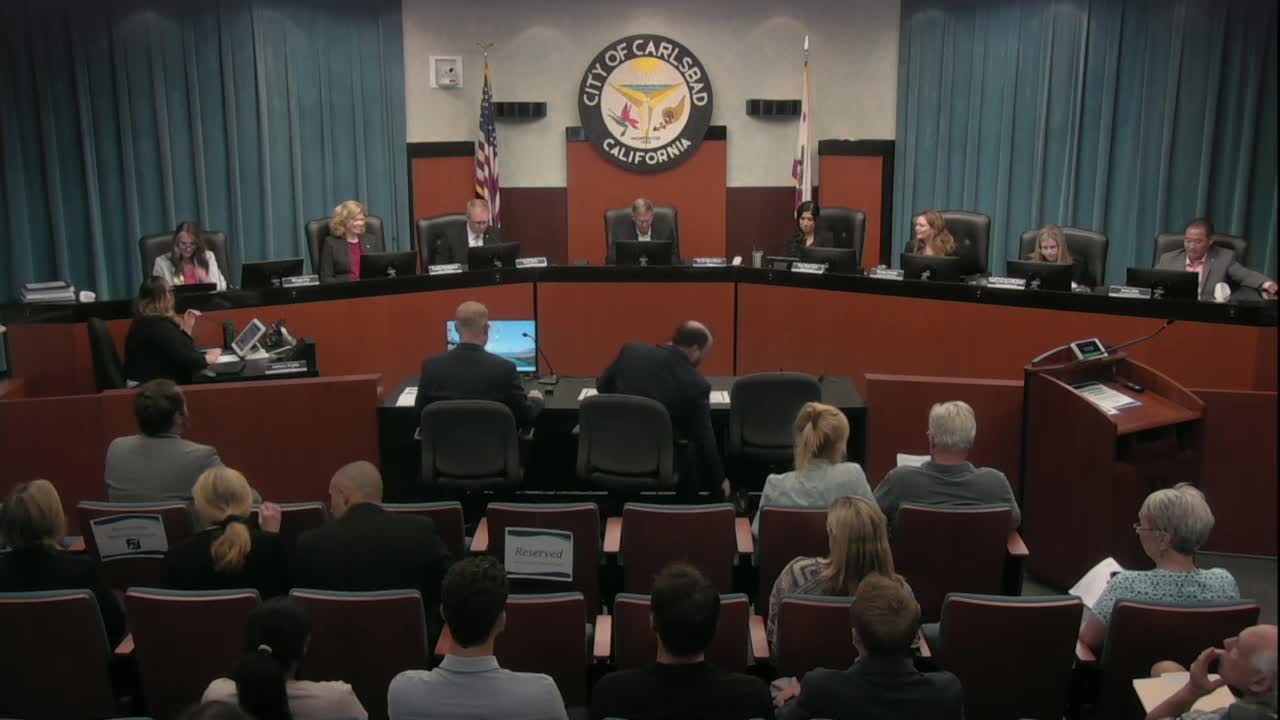
Carlsbad council approves Roosevelt mixed‑use project over parking objections
Summary
The City Council approved a four‑story mixed‑use development in the Village and Barrio area, allowing a 50% density bonus to reach 23 units and several waivers. Debate centered on reduced parking and state law limiting local parking requirements; the measure passed 4‑1 with Council member Burkholder dissenting.
The City Council voted 4‑1 to approve the Roosevelt site development plan, a mixed‑use project on a 0.46‑acre lot in the Village and Barrio master plan area that would create 23 apartments and about 5,400 square feet of ground‑floor commercial space.
City Planner Eric Lardy told the council the proposal requests two density bonuses — for dedication of very low‑ and moderate‑income units — that increase the site’s base density from 11 to 23 units. Lardy said staff recommends adopting a resolution approving a CEQA exemption and the site development plan as described in the staff report.
The project, presented by Fabric (the applicant), would build up to four stories in a portion of the lot with a proposed height of about 44–45 feet, provide five ground‑floor retail suites facing a new pedestrian plaza the developer calls "Roosevelt Alley," and include 24 residential parking spaces. The developer described the project as locally led, high‑quality infill intended to add neighborhood‑serving retail and public plaza space. The applicant said the design intentionally provides an open plaza and aims to preserve scale near existing one‑story properties.
Lardy and the applicant explained the project relies on state density bonus law to justify concessions and waivers. Among the concessions requested are a waiver of a required water‑main upsizing on Roosevelt Street and reduction or waiver of commercial parking requirements under the state law for projects within a half‑mile of transit. Staff said the project also seeks multiple objective design standard waivers including reduced front setbacks, additional height and story allowances, smaller parking stall dimensions, and less transparent storefront percentage than required by village standards.
Much of the council and public discussion focused on parking. Council member Burkholder said the project’s parking is “wildly inadequate” and that she “can’t vote yes for this project,” arguing nearby businesses and residents will be further strained by limited spaces. Several council members and public speakers acknowledged parking pressure in the village and barrio but noted that state law limits the city’s ability to require more parking when a project is within a half‑mile of transit.
Council member Acosta and others praised the project’s design and the developer’s local track record, while acknowledging the constraints imposed by state rules. Lardy said staff and the applicant provided unit and parking information during the hearing; he described the apartments as “primarily one‑bedroom” and noted state law generally allows roughly one space per unit in areas near transit, which the project follows.
Planning staff noted that the Planning Commission recommended approval on April 2 by a 4‑0 vote with three commissioners absent. Staff also presented a draft notice of exemption under the California Environmental Quality Act and recommended adoption of the exemption and project resolution.
The council adopted the resolution approving the CEQA exemption and the site development plan by a 4‑1 vote, with Burkholder voting no and the council making note of her parking concerns. The record shows the approval includes the requested density bonuses, concessions and waivers as listed in staff’s package.
Council and staff comments during the hearing indicated the city will continue monitoring parking and the Village and Barrio area generally; no additional conditions altering the approved waivers or the density bonus were imposed in the council action.
What happens next: the approval finalizes the site development plan and CEQA exemption for the Roosevelt project as presented to council. Implementation steps such as building permits, any required ministerial reviews, and coordination on utilities and construction will follow normal city processes.