Get Full Government Meeting Transcripts, Videos, & Alerts Forever!
Get email alerts on the Employee Health topic
No spam. Unsubscribe anytime.
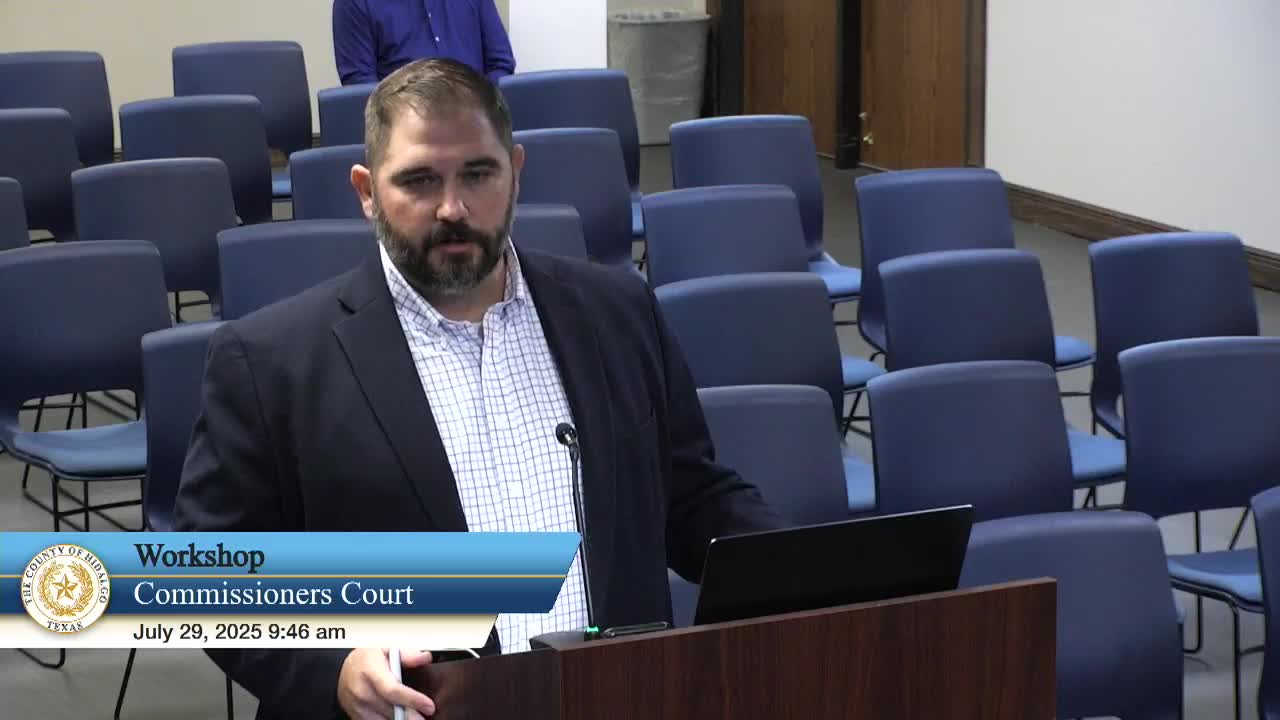
Frontier Health pitches county-run clinics to lower Hidalgo County employee health costs
Summary
Frontier Health presented a direct primary care proposal to Hidalgo County commissioners, proposing on-site and local clinics, a membership fee model and guaranteed first-year savings; commissioners asked about capacity, utilization, contract terms and next steps.
Frontier Health representatives presented Hidalgo County commissioners a proposal to provide direct primary care clinics and related services for county employees, saying the model would lower the county’s health-plan spending while offering $0 out-of-pocket primary care, same- and next-day access and prescriptions delivered by mail.
Joe Wilson, Executive Vice President of Growth and Government Affairs for Frontier, told the court “the county right now spends roughly $49,000,000 a year on healthcare for their employees,” and framed the company’s offering as a way to reduce high-cost claims and emergency-room use by steering more care to primary-care clinics and contracted specialists.
The proposal would not replace the county’s Aetna-administered self-funded plan. Instead, Frontier said the county would continue funding claims while allocating part of the per-member-per-month budget to Frontier’s membership services. Frontier told commissioners it would negotiate cash prices with local specialists and imaging centers, run a mail-order generic drug program included in the membership, and maintain a “Medicash” escrow to cover referral costs.
Why it matters: County staff told the court Hidalgo’s medical and pharmacy claims have risen over five years; Frontier says accessible primary care and direct contracting can reduce high-cost claimant events and slow the projected rise in county health spending. Frontier presented a first‑year net-savings estimate of about $3.6 million for Hidalgo County, including a roughly $4.2 million annual membership fee for an estimated 6,104 members and a guaranteed minimum credit back of $1.8 million if contract targets are missed.
Details and projections: Frontier provided a multi-part model and cited local case studies. Company representatives said their conservative modeling assumes month-over-month program take-up rising from roughly 10% in month 1 to an average year‑end utilization of about 63% (an average utilization figure Frontier reported from comparable local customers). For Hidalgo County Frontier projected: - Medical‑claim savings of roughly $4.5 million - Direct contract (imaging/specialist) savings of roughly $1.8 million - Pharmacy/mail‑order savings of roughly $1.4 million - Total projected gross claims savings: ~$7.9 million - Membership/administration fees: roughly $4.2 million - Net first‑year savings: about $3.6 million (Frontier said it will guarantee at least $1.8 million and credit fees if targets are missed)
Frontier described the clinical model as three components: Frontier Direct Care (primary‑care clinics), Frontier Direct Pay (contracted cash pricing for services outside clinics), and Frontier Rx (mail‑order generics included in membership). Dr. Maria Madrid, a Frontier clinician who practices in Edinburg, described a capped panel size (Frontier told the court clinicians’ panels are typically capped at 800 patients) and said the clinical workflow emphasizes long visits and direct phone/text access to a patient’s provider.
Commissioner questions and county concerns: Commissioners and county staff asked about capacity, scope, after‑hours access, continuity of care, and the company’s contractual commitments. Points raised included: - Capacity and access: Commissioners asked whether Frontier’s clinics could absorb 6,000-plus lives. Frontier said its Edinburg clinic has eight exam rooms and Weslaco two exam rooms “ready to fill,” and executives said clinical access and certain contractual KPIs (no wait times, etc.) would be included in the contract; Frontier’s CEO (Bibb/Bev Beal) said those KPIs are contractual and failure to meet them would give the county contract remedies. - Scope of services: Frontier and its chief medical officer, Dr. Pete Lazapena, said clinics provide typical primary‑care services (women’s health, chronic disease management, minor wound care and stitches, splinting for nondisplaced fractures, occupational health like DOT physicals) and coordinate urgent or emergent care referrals; they said 80–90% of lifetime health needs are handled in clinic and more complex care is referred and negotiated via direct contracts. - After‑hours and emergent access: Frontier stated members would have 24/7 phone access to their provider and clinicians would triage urgent issues; routine clinic hours would be roughly 8 a.m.–5 p.m., Monday–Friday, with same‑ or next‑day appointments emphasized. - Stop‑loss and claims context: County staff and Frontier discussed the county’s stop‑loss deductible (Frontier and staff referenced a $350,000 individual specific stop‑loss). Frontier emphasized targeting high‑cost claimants — the company said prior implementations reduced high‑cost claimant counts in comparable clients.
Contract terms, timeline and next steps: Frontier presented draft commercial terms the company said were under legal review. Key items Frontier cited in its presentation included a prospective start/billing date of January 1, 2026; a 2‑year initial contract term with options to renew up to three additional years; an estimated annual membership fee of roughly $4.2 million for the county population shown; and guaranteed savings provisions (Frontier said it would credit fees if contract guarantees were not met). Frontier told the court it expected a decision on the contract in August and offered to coordinate onboarding and open‑enrollment outreach with county HR and the county’s benefits consultant.
County action items recorded in the meeting: Yvonne Orgogon (county consultant) told the court she had drafted an employee survey and sent it to HR director Reyna and county legal counsel for review; county legal counsel asked Frontier’s counsel and staff to report back on outstanding contract terms at the next meeting. No contract was executed during the workshop.
What commissioners said: Commissioners emphasized outreach and onboarding; several asked for robust Spanish/English communications and detailed, precinct‑level education. Commissioners expressed interest in pursuing cost containment but also skepticism based on past clinic contracts that suffered operational issues. One commissioner suggested closing offices for two hours on a slow day to allow precinct employees to attend enrollment briefings.
Ending: Frontier’s team invited commissioners to review contract language with staff and legal counsel and to check performance examples from other local clients (Frontier referenced McAllen, Brownsville and Pharr as existing clients). County consultants and legal counsel agreed to return with contract status, and Frontier asked the commissioners to decide on the contract timeline in August so onboarding could align with open enrollment for a January 1, 2026 billing start.