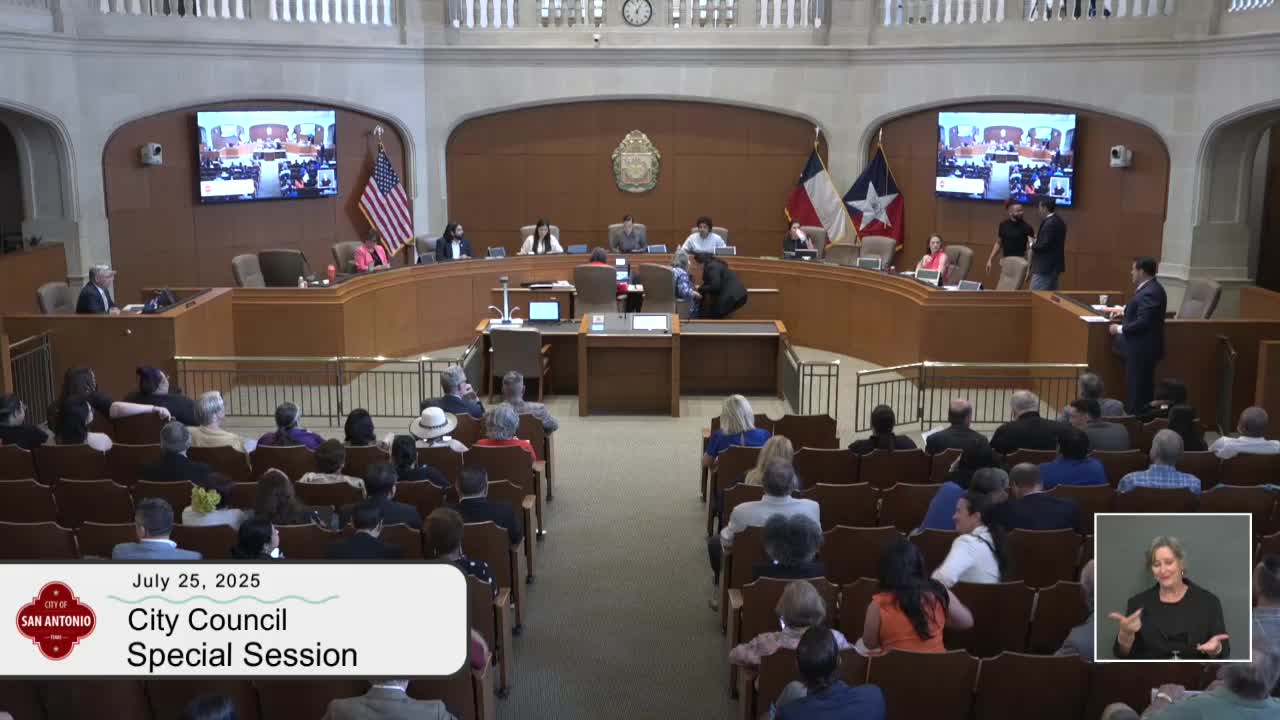
San Antonio council hears staff briefing and wide public comment on proposed downtown arena; staff to continue negotiations
Loading...
Summary
San Antonio City Council met in a July 25 special session to review a draft financing framework for a proposed downtown arena and broader “Project Marvel” sports and entertainment district; staff said it will continue negotiating a term sheet with the Spurs while supplying an independent economic analysis and a community engagement report.
San Antonio officials held a special City Council session on July 25 to review a draft term sheet and community‑benefits proposals tied to a proposed downtown arena and larger “Project Marvel” sports and entertainment district. City Manager Eric Walsh told the council the Spurs and a private developer have proposed a funding framework that would rely on a combination of private guarantees, development‑generated tax increment and state hotel‑related revenues, and staff will continue negotiations with the Spurs while supplying more data to the council.
The discussion matters because city leaders said the community faces substantial budget pressures and want clarity on whether and how any arena deal could produce money for the general fund and what legally enforceable community benefits would accompany private investment. Mayor Jones told the council, “We have a $141,000,000 budget gap in 2027…that gap grows to $220,000,000 in 2030,” and asked staff to explore whether revenue sharing or other mechanisms could produce recurring money for city services.
Walsh recapped the timeline and prior steps: the city, Bexar County and Spurs signed a memorandum of understanding in April; the Spurs provided a draft term sheet in mid‑May; staff publicly presented a financing framework in June; and additional meetings between city staff and Spurs negotiators have continued through July. Walsh said staff’s illustrative scenarios have centered on three revenue levers the city would rely on if it contributed to the arena: an arena lease/payment, ground leases for private development around the site and captured taxable value within the designated tax increment/reinvestment zone. Walsh also said the Spurs supplied a community benefits proposal the city currently values at about $60,000,000 overall, including roughly $35,000,000 for early‑childhood programs spread across multiple options and timeframes.
On revenue sharing, Walsh told the council the Spurs’ position so far is that "the team would retain those revenues, and that there would be no revenue sharing, given the current structure of the proposed financing." He said some items remain outstanding for the city’s negotiators, including complete financial detail from the Spurs on naming rights, broadcast, concessions, merchandising and ticket revenue so staff can understand the city’s negotiating space.
Staff presented illustrative city contribution scenarios ranging roughly from $350,000,000 to $500,000,000 (for planning purposes only), and described how those amounts could be covered by combinations of Spurs/developer guarantees and state PFC (hotel‑related) funds. Walsh and other staff emphasized those examples were internal models, not final obligations. The county separately submitted a letter indicating it might place a venue tax on a ballot covering 25% of the regional arena cost up to $311,000,000; the county’s process and timeline are independent of the city’s.
Public commenters spoke for and against the project. Opponents raised the risk of displacement, asked for binding protections for affordable housing and living wages, and urged the council to require a legally binding community benefits agreement (CBA) negotiated with resident coalitions. Father Jimmy Drennan urged the Spurs to begin negotiations from a higher contribution level: “We’d like to begin with you paying 100% for the cost of this arena,” he said. Historian and planning critic Haywood Sanders urged the council to obtain a firm, independent cost estimate; “It’s imperative that you and the public in this community, before we move ahead much further, get a firm substantive cost estimate with some real guarantees,” he said.
Supporters said a sports and entertainment district could spur downtown development, jobs and long‑term visitor economy gains. Jeff Webster, president and CEO of the Greater San Antonio Chamber, described the project as “an investment into the future” and urged council members to weigh longer‑term benefits in their decision making. Several business and small‑business advocacy speakers, including representatives of the San Antonio Hispanic Chamber of Commerce, said they want guaranteed contracting and vendor opportunities for local firms.
Speakers across the public‑comment period repeatedly requested more detail about: (1) the arena’s full projected construction cost (staff and outside commentators referenced recent estimates in the $1.3–$1.5 billion range); (2) precise dollar commitments and timing from the Spurs and any private developer; (3) the structure and enforceability of any CBA; and (4) protections against displacement and for deeply affordable housing near the project area. A number of speakers additionally requested environmental and racial equity impact analyses prior to major decisions.
Council members largely directed staff to continue negotiating but also demanded more information and stronger community protections before any council approval. Council Member Villagran said she wanted staff to “continue with the negotiations proposed deal for the downtown arena, under the structure that has been presented and to continue negotiations on the term sheet, but to take into consideration the CBA that we talked about.” Several other council members asked staff to return with the outside economic analysis and the community engagement report, to present options for how incremental tax or lease revenues might be split, and to show specific terms that could deliver enforceable CBAs and anti‑displacement measures.
Next steps and timeline provided by staff: Walsh said the city would distribute the economic‑impact analysis and the community engagement report to the council the week of July 28 (staff referenced an update on July 31 and a b‑session presentation on August 6) and that the council might consider a final term sheet later in August; Walsh also listed August 21 as a potential council consideration date. Staff said the term sheet is nonbinding and that definitive agreements detailing obligations and remedies would require further negotiation.
No formal votes or binding approvals were taken at the July 25 special session. Instead, the council and staff left the record open for further negotiations and additional information. Council members and staff repeatedly emphasized that any final agreement would need clear, enforceable language on financing, guarantees and community benefits before the council would take a binding vote.
Ending: City staff will return to the council with the economic analysis and the community engagement report and continue negotiations with the Spurs; the council asked staff to incorporate those reports into revised negotiating instructions and to present the status of those negotiations in a public update and an executive‑session briefing before any final term‑sheet approval.