Get Full Government Meeting Transcripts, Videos, & Alerts Forever!
Get email alerts on the Asset Forfeiture And Budget topic
No spam. Unsubscribe anytime.
MPD presents $1.2M 2025 plan for federal equitable-sharing funds; commissioners press for DOJ details
Summary
Milwaukee Police Department officials presented a 2025 asset‑forfeiture plan to the Fire and Police Commission on July 24, proposing about $1.2 million in allocations from roughly $2.0 million available in a federal equitable‑sharing trust fund.
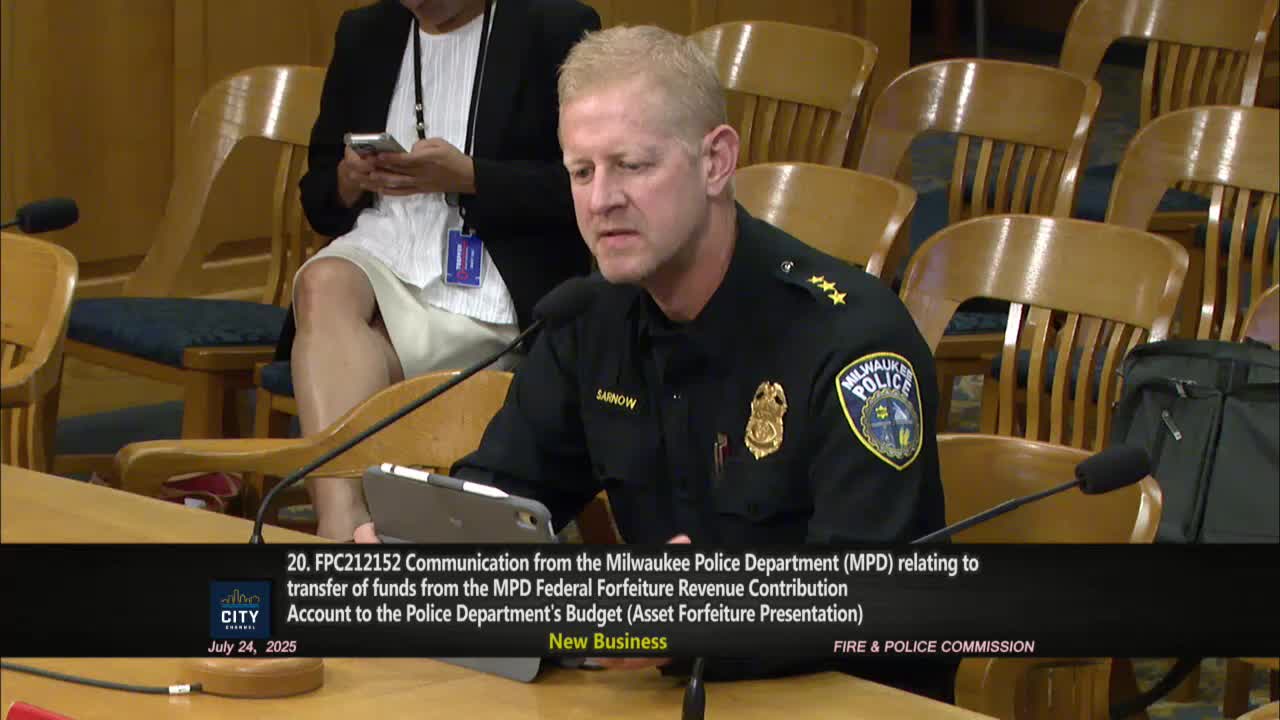
Assistant Chief Craig Sarno and Laura Engin of the Milwaukee Police Department presented the department’s 2025 Asset Forfeiture / Equitable Sharing Plan to the Fire and Police Commission on July 24, outlining roughly $2.0 million available in the equitable-sharing trust fund and about $1.2 million proposed for 2025 projects.
Engin said the plan prioritizes equipment and supplies (about $600,000), technology initiatives (about $250,000), training and travel (about $90,000), a contract for the Urban Stables (about $100,000) and community engagement (about 3% of the planned allocation). Notable line items discussed included $250,000 proposed for drone equipment, $123,000 for a Gladiator cell-phone tracking system for special investigations, and a single full‑spectrum camera for forensic identification.
Engin and Assistant Chief Sarno emphasized the federal program’s rules: equitable-sharing distributions are typically the product of adjudicated cases and can take many years between conviction and distribution. “It may be many years between a time in which a conviction occurs and that asset is actually shared,” Engin said. Commissioners and staff noted that federal Department of Justice rules and state law constrain how the funds can be used — for example, asset-forfeiture money could not be used for entertainment or food under current guidance, and it is intended as a supplement rather than a replacement for the city’s operating budget.
Commissioners pressed for more detail on federal oversight. Commissioner Fung and others asked which DOJ office runs the equitable-sharing program; staff said they would follow up with that information. Commissioner Fung and another commissioner also voiced concerns about the larger policy implications of asset forfeiture. “I do not like asset forfeiture,” one commissioner said on the record, citing the potential for perverse incentives despite acknowledging the department’s safeguards in this case.
Staff said requests across the department for asset-forfeiture funding totaled about $2.3 million for 2025 and noted the department could only fund a portion of those requests. Engin described the process: departments submit requests, command staff review and the department selects projects based on available funds and program guidelines. The commission received the communication; no formal action was required.
Why it matters: Equitable-sharing funds can add technology and equipment to policing operations but are governed by federal and state rules and constrained by judicial processes. Commissioners requested additional details about federal administration of the program and expressed caution about the broader policy incentives of asset forfeiture.