Lifetime Citizen Portal Access — AI Briefings, Alerts & Unlimited Follows
UN secretary‑general urges Gaza ceasefire, warns conflicts and finance gaps threaten SDG progress
Loading...
Summary
United Nations Secretary‑General António Guterres urged an immediate ceasefire in Gaza and stronger global finance and development actions at the High‑Level Political Forum, saying conflicts and slowing economies are putting Sustainable Development Goals off track.
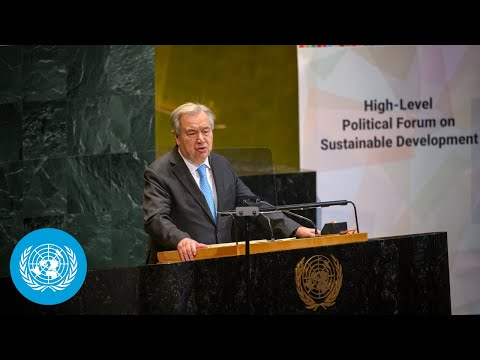
António Guterres, secretary‑general of the United Nations, told the High‑Level Political Forum that an immediate ceasefire in Gaza, the release of all hostages and unimpeded humanitarian access are necessary first steps toward a two‑state solution and to protect development gains.
Guterres said the forum meets amid “profound challenge, but also real possibility,” and pointed to recent multilateral agreements as examples of what coordinated action can achieve. “We saw it in Geneva, where the World Health Assembly adopted the pandemic agreement, a vital step toward the safer, more equitable global health architecture,” he said. He also cited recent ocean and financing conferences where governments made commitments on marine protection and on reshaping global finance.
The secretary‑general framed the forum as a moment to renew commitments to end poverty, protect the planet and ensure prosperity for all. He warned that ongoing conflicts from Gaza and Ukraine to Sudan, as well as rising trade tensions, growing inequality and shrinking aid budgets, are placing the Sustainable Development Goals (SDGs) “further out of reach.” “The SDGs still are within reach if we act with urgency and ambition,” Guterres said.
Guterres highlighted five priorities for the year’s forum: universal health coverage, gender equality, decent work, life below water and global partnerships. On health, he urged greater investment in universal health coverage “rooted in strong primary care and prevention, reaching those furthest behind first.” On gender, he called for rights‑based policies, accountability and financing that support inclusion and equality for women and girls. On jobs, he noted the global accelerator on jobs and social protection as a tool to expand livelihoods, and said tomorrow he would speak on “the enormous opportunities of the renewables revolution.”
The secretary‑general presented data on SDG progress: “Only 35% of SDG targets are on track or making moderate progress,” he said, adding that nearly half of targets are moving too slowly and 18% are going backwards. He warned that the global economy’s slowdown and rising military spending risk reversing development gains, even as “since 2015, millions more people have access to electricity, clean cooking, and the internet,” and social protection now reaches over half the world’s population, up from about a quarter a decade ago.
On finance, Guterres said commitments from recent financing for development discussions include steps to channel public and private finance where needed, strengthen domestic resource mobilization — including through tax reform — improve frameworks for debt relief and expand the lending capacity of multilateral development banks.
Throughout his address, Guterres linked peace and development, calling for a just and lasting peace in Ukraine based on the UN Charter and UN resolutions and an end to violence in Sudan and other conflict zones. He said sustainable peace requires sustainable development and urged renewed multilateral cooperation, stronger science and data capacity, and the harnessing of digital innovation, including artificial intelligence, to accelerate progress without deepening divides.
Looking ahead, Guterres said the forum should translate commitments into concrete financing, policy reforms and implementation on the ground, and he reiterated the need to reform global financial governance so developing countries have a greater voice in institutions that shape their future.