Get Full Government Meeting Transcripts, Videos, & Alerts Forever!
Get email alerts on the Fisheries Management topic
No spam. Unsubscribe anytime.
FWC presents Charlotte Harbor plan to manage spotted seatrout regionally; seagrass loss and red tide cited
Summary
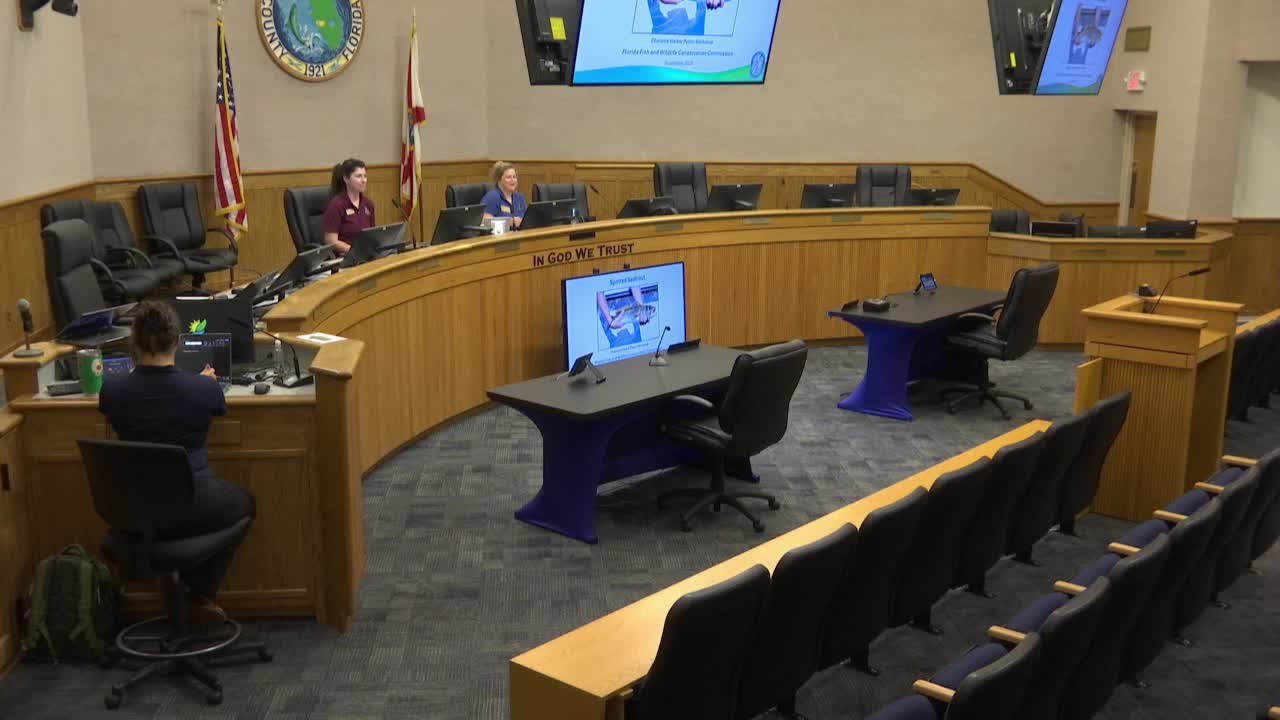
Florida Fish and Wildlife Conservation Commission (FWC) staff presented a proposed regional management approach for spotted seatrout and solicited public feedback at a Charlotte County workshop.
Florida Fish and Wildlife Conservation Commission (FWC) staff presented a proposed regional management approach for spotted seatrout and solicited public feedback at a Charlotte County workshop. Kaylee Spurgeon, a regional biologist with FWC's Division of Marine Fisheries Management, led the presentation and described a plan to divide Florida into nine management regions, evaluate each region annually using six metrics, and bring proposed rule changes to the commission in November 2025.
The proposal would apply the same “holistic” management framework previously used for snook and redfish. Spurgeon said the six metrics are spawning potential ratio (SPR), harmful algal blooms (HABs), stakeholder feedback, fishing effort and landings, habitat trends (notably seagrass), and relative abundance. She told the room that “SPR is determined at a stock wide level and it's not appropriate to assess at a smaller regional scale,” and that the last statewide stock assessment (2024) showed the Gulf stock exceeding the management target of 35% SPR.
FWC staff emphasized that local conditions can differ from stockwide results. Spurgeon noted localized factors — including how often people fish, environmental conditions, fish behavior and distribution, and harmful algal blooms — can affect anglers’ experience and local abundance. To address that, staff would produce a two-page annual review for each proposed region summarizing the six metrics and other relevant data to support regional management decisions.
On Charlotte Harbor specifically, staff proposed a smaller management region that would include inland waters of the Caloosahatchee, Myakka and Peace rivers and their tributaries (excluding Lake Okeechobee). Data presented for the Charlotte Harbor area included: more than 3,500 statewide responses to an angler satisfaction survey (FWC reported “over 250 responses” from the local area), fishery-independent sampling showing young-of-year spotted seatrout trends roughly stable with recent adult trends near long-term averages, and fishery-dependent data from NOAA’s Marine Recreational Information Program (MRIP) indicating increased directed recreational trips after lows in 2019–22.
Staff highlighted habitat and harmful-algal-bloom metrics as especially concerning for Charlotte Harbor. Spurgeon said Southwest Florida Water Management District data show seagrass acreage in Upper Charlotte Harbor has declined since 2020 and is now below 1988 levels, and the region has a high frequency and extended duration of Karenia brevis events. For 2024, staff presented about three months of red tide concentrations in the region that could cause or probably caused fish kills; extended red-tide events have previously led to fishery closures.
Current regulations proposed to be carried into the Charlotte Harbor region (staff described these as matching the South Region rules adopted in 2020) were summarized by staff: for recreational anglers, a 15–19 inch slot limit with one fish over 19 inches allowed per vessel and a three-fish daily bag limit per person; for the commercial sector, staff noted a seasonal closure beginning November 1 through May (end date in the presentation was not specified). Spurgeon said commercial landings of spotted seatrout have been “very low” since a net-limitation amendment in 1995 and that commercial landings now make up less than 1% of total statewide landings.
Workshop attendees offered brief public comments and questions. Captain Josh Greer, a local fishing guide of nearly 20 years, told staff he favored regional boundaries and asked specifically for a closed season: “If you ask me, matching the commercial close season would be kinda nice because that is their spawning time. And I'd like to see those fish protected while they're spawning.”
Nick Simone, who identified himself as from Bokeelia, asked why commercial fishers are allowed to keep larger fish while the recreational slot limits restrict harvest to mostly smaller fish. FWC staff member Andy Murray replied with a historical summary of commercial regulations and catch limits, noting that commercial harvest has declined and that managers had adjusted seasons and catch limits over time; Murray said she would provide contact information to discuss the history in more detail and that staff will record requests for any proposed modifications.
Spurgeon closed by reminding attendees about remaining outreach steps: a statewide virtual workshop scheduled Thursday from 6 to 8 p.m., prerecorded region-specific presentations to be posted on the FWC website, and an online comment form (myfwc.com/saltwatercomments). Staff said they plan to present compiled public feedback and suggested proposed rules to the commission at the November 2025 meeting.
No formal regulatory changes or votes were taken at the workshop; the session was a public input and informational meeting.
Next steps identified by staff: additional virtual and written comment opportunities, publication of annual two-page region reviews if the nine-region framework is adopted, and a staff recommendation to commissioners in November 2025.