Get Full Government Meeting Transcripts, Videos, & Alerts Forever!
Get email alerts on the Elevator Safety topic
No spam. Unsubscribe anytime.
Business and Labor panel opens LR281 study on elevator licensing; debate over vertical conveyors
Summary
The Nebraska Business and Labor Committee held an interim study, LR281, reviewing state licensing and inspection rules for elevator mechanics and contractors and hearing testimony on whether vertical reciprocating conveyors should be exempt from those licensing requirements.
The Nebraska Legislature's Business and Labor Committee on LR281 heard testimony about state licensing and inspection rules for elevator mechanics and contractors and whether those requirements should apply to vertical reciprocating conveyors used for freight.
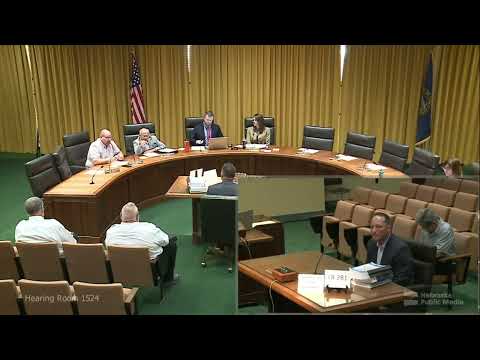
Senator Kathleen Couth, chair of the Business and Labor Committee, opened the interim study hearing on LR281, saying the session fulfills requirements of the Occupational Board Reform Act enacted in 2020 and the committee's routine review of occupational licenses.
Thomas Helget, legal counsel for the Business and Labor Committee, told members the review was prompted in part by legislative changes made earlier this year in LB415 and LB435 and by the committee's responsibility under the reform act to review a portion of regulated occupations each year.
Josh Joseph, director of codes and standards for the International Union of Elevator Constructors, told the panel that most of the safety and inspection requirements for conveyances are grounded in model codes including ASME A17.1, ASME A17.2, the International Building Code and NFPA 70. "Elevators have to be safe enough for a 4 year old to get in, push the button, you go to the floor, and you get off," Joseph said, arguing that licensing and consistent standards protect both riders and building owners. Joseph said the state's licensing standards currently apply only in the three largest counties and recommended extending the same licensing standards statewide so smaller communities receive the same protections.
Doug Hohbein, interim state fire marshal, described the Nebraska Conveyance Safety Program and cited the relevant state statutory framework. "The conveyance safety program is governed by the conveyance safety act," Hohbein said. He summarized licensing pathways described in state law: elevator contractors must document work experience and insurance, and elevator mechanics may qualify with work experience plus passage of a national or state test or with an equivalent out-of-state license. Hohbein said licenses are issued for two years and renewed with required continuing education. He also said the division's staff includes one chief inspector, three inspectors, one full-time temporary inspector working toward accreditation and two support staff who provide inspection and licensing services statewide.
Tom Quandt of RMH Systems, which sells vertical lifts, urged the committee to exempt vertical reciprocating conveyors (VRCs) used solely for moving freight from elevator-contractor licensing. "I sell vertical lifts. I have nothing to do with elevators whatsoever," Quandt said, and described instances where VRCs were installed by millwrights and welders, then inspected and load-tested by city inspectors. He told the committee that requiring licensed elevator contractors for those installs drives labor costs; he cited hourly labor comparisons in testimony, saying elevator-contractor labor had reached roughly $180 an hour while millwrights and welders typically bill around $110 to $120 an hour, and that his company typically sells three to four such units per year.
Senators pressed witnesses on a few points: committee members asked whether VRCs ever carry people (witnesses said they do not and are marked "no riders"), whether the recent statutory edits need further change (Hohbein called earlier edits primarily "cleanup"), and who might oppose an exemption for VRCs (Quandt said the unions and licensed elevator contractors would likely object because of lost business).
No committee action or vote was taken during the hearing; the proceeding was an informational interim study. The hearing record will include written comments submitted by Tom Quandt and another individual, Thomas Archie, and the committee may use testimony and submitted materials during its LR281 review.
The hearing combined technical code discussion, statutory detail about licensure and qualifications, and testimony from a business representative arguing an exemption for freight-only vertical conveyors to avoid higher installation costs. The committee reserved closing remarks for the introducing senator and did not make any formal recommendations at the session.