Get Full Government Meeting Transcripts, Videos, & Alerts Forever!
Get email alerts on the Accessory Dwelling Units topic
No spam. Unsubscribe anytime.
Broadwater County discusses formal process for DEQ letters to support accessory dwelling units
Summary
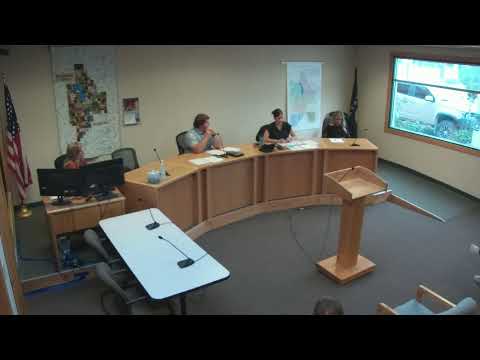
Broadwater County commissioners and planning staff discussed a proposed process to provide Department of Environmental Quality (DEQ) letters of approval for accessory dwelling units (ADUs) within subdivisions and set a goal to vote on rules by Oct. 1.
Broadwater County commissioners and planning staff discussed a proposed process to provide Department of Environmental Quality (DEQ) letters of approval for accessory dwelling units, commonly called ADUs, within subdivisions. Commissioners said the county will pursue a formal permitting authorization form and draft regulations and set a goal to vote on the measures by Oct. 1, though they cautioned that date is not firm.
The discussion centered on creating an objective, consistent process so county staff can respond to DEQ requests for a county position on proposed ADUs without becoming involved in enforcing private subdivision covenants. Commissioners and staff said covenants remain private agreements among property owners and enforcement is a civil matter; the county’s role, they said, is limited to documenting landowner acknowledgments and confirming basic site conditions for DEQ.
Planning staff described two draft documents: (1) a permitting authorization form that would record landowner and parcel information and require an owner acknowledgment that the proposed ADU complies with any private covenants, and (2) a set of draft ADU regulations based on Montana Senate Bill 532 and the comparable municipal statute, MCA 76-2-345. The draft form would include a $250 application fee, consistent with the statutes discussed, to cover county review costs.
Consultant JJ Connor told the commission that formalizing a local process could help property owners and consultants move projects forward and might reduce the chance of a one-size-fits-all state mandate. "I like the idea of what you guys [are] doing because part of the issue is ... I can't get anything from the county," Connor said, urging a predictable procedure so applicants do not incur engineering costs before the county provides the DEQ acknowledgment.
Members of the public and agency representatives raised practical implementation issues. Planning board member Charles Freshman urged clarity about what application materials Nicole (county staff) will receive, noting that a full DEQ sanitary review can require lot-layout revisions, drainfield relocation and stormwater recalculation. Freshman said those engineering tasks can be expensive and recommended minimizing duplicative work when a primary residence and ADU are being designed at the same time.
Resident Mary Heinemann questioned earlier enforcement actions and asked why the county previously had not allowed a second unit in a specific case. She told commissioners, "If you're not enforcing the — you have no regulations prohibiting that — why did you not allow him to put the second unit on?" Commissioners and staff clarified that the county does not enforce private covenants and that past cases were handled amid evolving law and guidance.
Fire safety and water supply were raised repeatedly. Ed Shindoll, who spoke on behalf of the local fire district, said the district needs to know the proposed unit type, access for heavy fire apparatus, water availability and potential fire planning if multiple residences occupy a lot. Shindoll said the district would expect to be contacted and to develop a site-specific plan; he agreed the district could provide a sign-off form for the county to accept as evidence of contact.
Planning staff said the drafts would require applicants to submit a simple site plan showing existing buildings, proposed ADU location and the location of wells and septic systems so county staff and DEQ have basic locational information. They also proposed that properties larger than 20 acres may receive a different level of sanitary review by the county sanitarian. The commission discussed adding language that would allow applicants who are creating both a primary dwelling and an ADU at the same time to consolidate DEQ review to avoid duplicate fees and redesign.
Commissioners discussed solid-waste and tax consequences: county staff will consult the treasurer and solid-waste administrator about whether an additional livable unit on a parcel should change sanitation assessments or require additional stickers/fees. Staff said tax and sanitation impacts should be captured in the application and routed internally to the appropriate county offices.
The draft ADU regulations discussed would allow an ADU on a parcel with a single-family dwelling "by right" without a public hearing or discretionary permit, require the ADU to be smaller than the primary residence, and bar additional local requirements beyond those applicable to the primary dwelling except where construction directly disturbs public infrastructure. Commissioners noted private covenants can still restrict ADUs but enforcement remains outside county jurisdiction.
Next steps: staff will refine the authorization form and draft regulations to address the commission’s questions about addressing, sanitary review thresholds (including the 20-acre threshold discussed), fire-district sign-off language and how to notify tax and sanitation offices. The commission scheduled continued discussion on the item at upcoming meetings and reiterated the Oct. 1 goal if schedule permits.
The proposals remain drafts and no formal regulation or county-wide approval was adopted at the meeting.